James S L Browning, Daniel R Tauritz, John Beckmann
{"title":"Evolutionary algorithms simulating molecular evolution: a new field proposal.","authors":"James S L Browning, Daniel R Tauritz, John Beckmann","doi":"10.1093/bib/bbae360","DOIUrl":null,"url":null,"abstract":"<p><p>The genetic blueprint for the essential functions of life is encoded in DNA, which is translated into proteins-the engines driving most of our metabolic processes. Recent advancements in genome sequencing have unveiled a vast diversity of protein families, but compared with the massive search space of all possible amino acid sequences, the set of known functional families is minimal. One could say nature has a limited protein \"vocabulary.\" A major question for computational biologists, therefore, is whether this vocabulary can be expanded to include useful proteins that went extinct long ago or have never evolved (yet). By merging evolutionary algorithms, machine learning, and bioinformatics, we can develop highly customized \"designer proteins.\" We dub the new subfield of computational evolution, which employs evolutionary algorithms with DNA string representations, biologically accurate molecular evolution, and bioinformatics-informed fitness functions, Evolutionary Algorithms Simulating Molecular Evolution.</p>","PeriodicalId":9209,"journal":{"name":"Briefings in bioinformatics","volume":"25 5","pages":""},"PeriodicalIF":7.7000,"publicationDate":"2024-07-25","publicationTypes":"Journal Article","fieldsOfStudy":null,"isOpenAccess":false,"openAccessPdf":"https://www.ncbi.nlm.nih.gov/pmc/articles/PMC11317538/pdf/","citationCount":"0","resultStr":null,"platform":"Semanticscholar","paperid":null,"PeriodicalName":"Briefings in bioinformatics","FirstCategoryId":"99","ListUrlMain":"https://doi.org/10.1093/bib/bbae360","RegionNum":2,"RegionCategory":"生物学","ArticlePicture":[],"TitleCN":null,"AbstractTextCN":null,"PMCID":null,"EPubDate":"","PubModel":"","JCR":"Q1","JCRName":"BIOCHEMICAL RESEARCH METHODS","Score":null,"Total":0}
引用次数: 0
Abstract
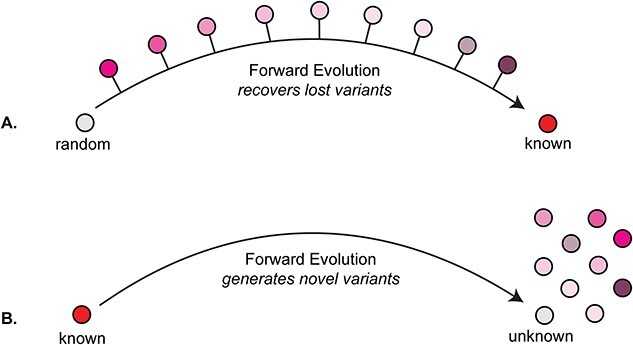
The genetic blueprint for the essential functions of life is encoded in DNA, which is translated into proteins-the engines driving most of our metabolic processes. Recent advancements in genome sequencing have unveiled a vast diversity of protein families, but compared with the massive search space of all possible amino acid sequences, the set of known functional families is minimal. One could say nature has a limited protein "vocabulary." A major question for computational biologists, therefore, is whether this vocabulary can be expanded to include useful proteins that went extinct long ago or have never evolved (yet). By merging evolutionary algorithms, machine learning, and bioinformatics, we can develop highly customized "designer proteins." We dub the new subfield of computational evolution, which employs evolutionary algorithms with DNA string representations, biologically accurate molecular evolution, and bioinformatics-informed fitness functions, Evolutionary Algorithms Simulating Molecular Evolution.
期刊介绍:
Briefings in Bioinformatics is an international journal serving as a platform for researchers and educators in the life sciences. It also appeals to mathematicians, statisticians, and computer scientists applying their expertise to biological challenges. The journal focuses on reviews tailored for users of databases and analytical tools in contemporary genetics, molecular and systems biology. It stands out by offering practical assistance and guidance to non-specialists in computerized methodologies. Covering a wide range from introductory concepts to specific protocols and analyses, the papers address bacterial, plant, fungal, animal, and human data.
The journal's detailed subject areas include genetic studies of phenotypes and genotypes, mapping, DNA sequencing, expression profiling, gene expression studies, microarrays, alignment methods, protein profiles and HMMs, lipids, metabolic and signaling pathways, structure determination and function prediction, phylogenetic studies, and education and training.





 京公网安备 11010802042870号
京ICP备2023020795号-1
京公网安备 11010802042870号
京ICP备2023020795号-1

 分享
分享
 求助内容:
求助内容: 应助结果提醒方式:
 扫码关注我们
