{"title":"Efficient Vulnerability Assessment of Large-Scale Dynamic Transportation Networks","authors":"Venkateswaran Shekar;Lance Fiondella","doi":"10.1109/TR.2024.3413315","DOIUrl":null,"url":null,"abstract":"Static and dynamic methods are used to assess the efficiency and vulnerability of transportation networks. Dynamic methods identify both where and when disruptions would be most detrimental. However, exhaustive analysis is computationally prohibitive for large networks because thousands of simulations are required. To enhance the scalability of dynamic transportation network vulnerability assessment, this article presents a subnetwork approach to identify the impact of an edge closure at a specific time by simulating only a portion of the network immediately surrounding the disruption and then incorporating this subnetwork simulation into the baseline scenario without disruptions. Our experiments confirm a strong correlation between the results of complete network simulation and the subnetwork approach with significant computational reductions. Subnetwork size is a tunable parameter, enabling a tradeoff between the accuracy of the subnetwork approach relative to the exhaustive approach and time savings achieved. We also identify a heuristic method to select the subnetwork size for any network to reap the greatest benefits with respect to accuracy and speed up. The subnetwork vulnerability assessment method is subsequently used to allocate limited resources to mitigate travel time disruptions. The approach only required hours not months to complete, advancing methods for city-scale disaster recovery and planning.","PeriodicalId":56305,"journal":{"name":"IEEE Transactions on Reliability","volume":"74 2","pages":"2738-2750"},"PeriodicalIF":5.7000,"publicationDate":"2024-06-19","publicationTypes":"Journal Article","fieldsOfStudy":null,"isOpenAccess":false,"openAccessPdf":"","citationCount":"0","resultStr":null,"platform":"Semanticscholar","paperid":null,"PeriodicalName":"IEEE Transactions on Reliability","FirstCategoryId":"94","ListUrlMain":"https://ieeexplore.ieee.org/document/10564837/","RegionNum":2,"RegionCategory":"计算机科学","ArticlePicture":[],"TitleCN":null,"AbstractTextCN":null,"PMCID":null,"EPubDate":"","PubModel":"","JCR":"Q1","JCRName":"COMPUTER SCIENCE, HARDWARE & ARCHITECTURE","Score":null,"Total":0}
引用次数: 0
Abstract
Static and dynamic methods are used to assess the efficiency and vulnerability of transportation networks. Dynamic methods identify both where and when disruptions would be most detrimental. However, exhaustive analysis is computationally prohibitive for large networks because thousands of simulations are required. To enhance the scalability of dynamic transportation network vulnerability assessment, this article presents a subnetwork approach to identify the impact of an edge closure at a specific time by simulating only a portion of the network immediately surrounding the disruption and then incorporating this subnetwork simulation into the baseline scenario without disruptions. Our experiments confirm a strong correlation between the results of complete network simulation and the subnetwork approach with significant computational reductions. Subnetwork size is a tunable parameter, enabling a tradeoff between the accuracy of the subnetwork approach relative to the exhaustive approach and time savings achieved. We also identify a heuristic method to select the subnetwork size for any network to reap the greatest benefits with respect to accuracy and speed up. The subnetwork vulnerability assessment method is subsequently used to allocate limited resources to mitigate travel time disruptions. The approach only required hours not months to complete, advancing methods for city-scale disaster recovery and planning.
期刊介绍:
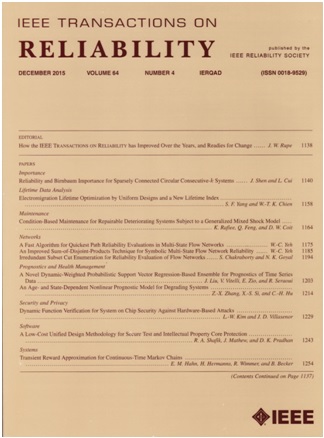
IEEE Transactions on Reliability is a refereed journal for the reliability and allied disciplines including, but not limited to, maintainability, physics of failure, life testing, prognostics, design and manufacture for reliability, reliability for systems of systems, network availability, mission success, warranty, safety, and various measures of effectiveness. Topics eligible for publication range from hardware to software, from materials to systems, from consumer and industrial devices to manufacturing plants, from individual items to networks, from techniques for making things better to ways of predicting and measuring behavior in the field. As an engineering subject that supports new and existing technologies, we constantly expand into new areas of the assurance sciences.



 京公网安备 11010802042870号
京ICP备2023020795号-1
京公网安备 11010802042870号
京ICP备2023020795号-1

 分享
分享
 求助内容:
求助内容: 应助结果提醒方式:
 扫码关注我们
