Jingyu Zhang;Jacky Wai Keung;Yan Xiao;Yihan Liao;Yishu Li;Xiaoxue Ma
{"title":"UniAda: Universal Adaptive Multiobjective Adversarial Attack for End-to-End Autonomous Driving Systems","authors":"Jingyu Zhang;Jacky Wai Keung;Yan Xiao;Yihan Liao;Yishu Li;Xiaoxue Ma","doi":"10.1109/TR.2024.3394894","DOIUrl":null,"url":null,"abstract":"Adversarial attacks play a pivotal role in testing and improving the reliability of deep learning (DL) systems. Existing literature has demonstrated that subtle perturbations to the input can elicit erroneous outcomes, thereby substantially compromising the security of DL systems. This has emerged as a critical concern in the development of DL-based safety–critical systems like autonomous driving systems (ADSs). The focus of existing adversarial attack methods on end-to-end (E2E) ADSs has predominantly centered on misbehaviors of steering angle, which overlooks speed-related controls or imperceptible perturbations. To address these challenges, we introduce UniAda–a multiobjective white-box attack technique with a core function that revolves around crafting an image-agnostic adversarial perturbation capable of simultaneously influencing both steering and speed controls. UniAda capitalizes on an intricately designed multiobjective optimization function with the adaptive weighting scheme (AWS), enabling the concurrent optimization of diverse objectives. Validated with both simulated and real-world driving data, UniAda outperforms five benchmarks across two metrics, inducing steering and speed deviations from 3.54\n<inline-formula><tex-math>$^{\\circ }$</tex-math></inline-formula>\n to 29\n<inline-formula><tex-math>$^{\\circ }$</tex-math></inline-formula>\n and 11 to 22 km/h on average. This systematic approach establishes UniAda as a proven technique for adversarial attacks on modern DL-based E2E ADSs.","PeriodicalId":56305,"journal":{"name":"IEEE Transactions on Reliability","volume":"73 4","pages":"1892-1906"},"PeriodicalIF":5.7000,"publicationDate":"2024-06-03","publicationTypes":"Journal Article","fieldsOfStudy":null,"isOpenAccess":false,"openAccessPdf":"","citationCount":"0","resultStr":null,"platform":"Semanticscholar","paperid":null,"PeriodicalName":"IEEE Transactions on Reliability","FirstCategoryId":"94","ListUrlMain":"https://ieeexplore.ieee.org/document/10546476/","RegionNum":2,"RegionCategory":"计算机科学","ArticlePicture":[],"TitleCN":null,"AbstractTextCN":null,"PMCID":null,"EPubDate":"","PubModel":"","JCR":"Q1","JCRName":"COMPUTER SCIENCE, HARDWARE & ARCHITECTURE","Score":null,"Total":0}
引用次数: 0
Abstract
Adversarial attacks play a pivotal role in testing and improving the reliability of deep learning (DL) systems. Existing literature has demonstrated that subtle perturbations to the input can elicit erroneous outcomes, thereby substantially compromising the security of DL systems. This has emerged as a critical concern in the development of DL-based safety–critical systems like autonomous driving systems (ADSs). The focus of existing adversarial attack methods on end-to-end (E2E) ADSs has predominantly centered on misbehaviors of steering angle, which overlooks speed-related controls or imperceptible perturbations. To address these challenges, we introduce UniAda–a multiobjective white-box attack technique with a core function that revolves around crafting an image-agnostic adversarial perturbation capable of simultaneously influencing both steering and speed controls. UniAda capitalizes on an intricately designed multiobjective optimization function with the adaptive weighting scheme (AWS), enabling the concurrent optimization of diverse objectives. Validated with both simulated and real-world driving data, UniAda outperforms five benchmarks across two metrics, inducing steering and speed deviations from 3.54
$^{\circ }$
to 29
$^{\circ }$
and 11 to 22 km/h on average. This systematic approach establishes UniAda as a proven technique for adversarial attacks on modern DL-based E2E ADSs.
期刊介绍:
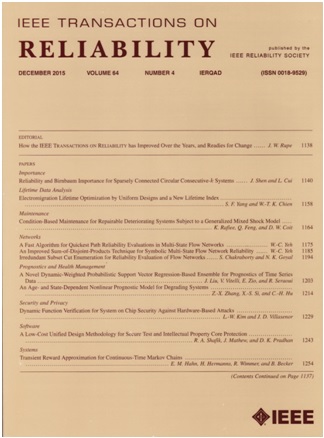
IEEE Transactions on Reliability is a refereed journal for the reliability and allied disciplines including, but not limited to, maintainability, physics of failure, life testing, prognostics, design and manufacture for reliability, reliability for systems of systems, network availability, mission success, warranty, safety, and various measures of effectiveness. Topics eligible for publication range from hardware to software, from materials to systems, from consumer and industrial devices to manufacturing plants, from individual items to networks, from techniques for making things better to ways of predicting and measuring behavior in the field. As an engineering subject that supports new and existing technologies, we constantly expand into new areas of the assurance sciences.



 京公网安备 11010802042870号
京ICP备2023020795号-1
京公网安备 11010802042870号
京ICP备2023020795号-1

 分享
分享
 求助内容:
求助内容: 应助结果提醒方式:
 扫码关注我们
