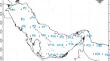
Evaluating the Sea surface temperature (SST) pattern of the Persian Gulf is considered as a key parameter in understanding global climate changes. The present study aims to examine and compare the above-mentioned changes in the Asian continent and other oceans in the world. The correlation of the aforementioned parameter with the volume of warm water in temperature of more than 20 °C was compared considering the El Niño Southern Oscillation (ENSO) phase during 36 years. The remote sensing temperature data in 24 selected points in the Persian Gulf and Strait of Hormuz were collected from the NOAA site in terms of years and same months, and processed. Based on the results, no significant relationship was reported by the Pearson correlation coefficient of 41.66% between the volume of warm water and temperature during 36 years. No significant relationship was defined in the seasonal approach and same months. A significant relationship was observed by the average correlation coefficient between the two quantities after breaking the time period to six years. The maximum variance values of the above-mentioned index have been accompanied by a weaker intensity of 1.5–2 years similar to the Persian Gulf since 2000. Furthermore, the curve regression calculation indicated a significant relationship between temperature extremes and the aforementioned index. As observed, the intensity of the fluctuations and maximum extreme in the variance dereases significantly. An uneven event occurs at the minimum limit during 2010. Further, the maximum event occurs within 1–2 years. The intensity of the fluctuations related to temperature dispersion in the surface of the Persian Gulf increased during 1980–2000 compared to 2000 and later similar to the variance related to the volume of warm water entering the Indian Ocean. A significant relationship was reported in the averages of the same months between the extremes and aforementioned index in all of the 11 types of curve regression. Finally, the best adaptation equation was extracted.



 京公网安备 11010802042870号
京ICP备2023020795号-1
京公网安备 11010802042870号
京ICP备2023020795号-1

 分享
分享
 求助内容:
求助内容: 应助结果提醒方式:
 扫码关注我们
