Zhedong Zhang, Jiaxuan Li, Rui Gao, Yang Zhao, Yan Zhang, Lei Zhang, Zefu Ye, Zhujun Zhu, Peihua Zhang, Wangbao Yin and Suotang Jia
{"title":"Enhancing multi-type coal quality prediction accuracy with fusion spectra and classification models using NIRS and XRF techniques","authors":"Zhedong Zhang, Jiaxuan Li, Rui Gao, Yang Zhao, Yan Zhang, Lei Zhang, Zefu Ye, Zhujun Zhu, Peihua Zhang, Wangbao Yin and Suotang Jia","doi":"10.1039/D4JA00193A","DOIUrl":null,"url":null,"abstract":"<p >The various analytical indices of coal are important criteria for evaluating the quality of commercial coal. Coals of different qualities exhibit different physical and chemical characteristics in their utilization. In the case of multiple coal types, the spectral characteristics of different coals may overlap within certain wavelength ranges, or be affected by interference or noise from other coal types, leading to low accuracy in coal quality prediction. Rapid and accurate coal quality testing is of great significance for improving industrial production efficiency and enhancing corporate profitability. This study employs near-infrared spectroscopy (NIRS) and X-ray fluorescence spectroscopy (XRF) combined techniques to explore the accuracy and feasibility of predicting coal quality based on coal type classification models. In terms of classification algorithms, coal samples are identified and classified using Support Vector Machine (SVM) based on fusion spectra. Regarding the modeling approach, Partial Least Squares (PLS) is utilized to establish both an overall model for all coal samples and individual classification models corresponding to each coal type. The results show that the precision, accuracy, recall, and <em>F</em><small><sub>1</sub></small> score of this classification algorithm reached 96.49%, 97.50%, 95.83%, and 96.41%, respectively. The determination coefficients (<em>R</em><small><sup>2</sup></small>) for the classification model's predictions of ash, volatile matter, and sulfur in coal quality indicators reached 0.992, which represents improvements of 1.85%, 5.31%, and 10.10% over the overall model. The root mean square errors of prediction (RMSE<small><sub>P</sub></small>) for these indicators were 0.062, 0.080, and 0.008, showing reductions of 0.24%, 0.68%, and 0.05% compared to the overall model. It indicates that the method of first identifying the coal type and then predicting coal quality indicators using the corresponding classification model can significantly improve the accuracy of coal quality detection in complex coal type scenarios.</p>","PeriodicalId":81,"journal":{"name":"Journal of Analytical Atomic Spectrometry","volume":" 10","pages":" 2433-2442"},"PeriodicalIF":3.1000,"publicationDate":"2024-08-06","publicationTypes":"Journal Article","fieldsOfStudy":null,"isOpenAccess":false,"openAccessPdf":"","citationCount":"0","resultStr":null,"platform":"Semanticscholar","paperid":null,"PeriodicalName":"Journal of Analytical Atomic Spectrometry","FirstCategoryId":"92","ListUrlMain":"https://pubs.rsc.org/en/content/articlelanding/2024/ja/d4ja00193a","RegionNum":2,"RegionCategory":"化学","ArticlePicture":[],"TitleCN":null,"AbstractTextCN":null,"PMCID":null,"EPubDate":"","PubModel":"","JCR":"Q2","JCRName":"CHEMISTRY, ANALYTICAL","Score":null,"Total":0}
引用次数: 0
Abstract
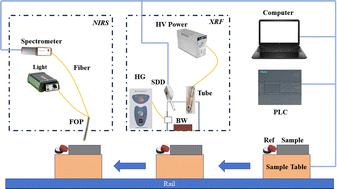
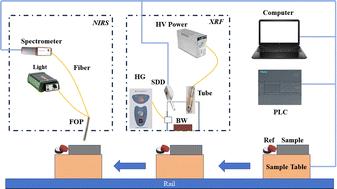
The various analytical indices of coal are important criteria for evaluating the quality of commercial coal. Coals of different qualities exhibit different physical and chemical characteristics in their utilization. In the case of multiple coal types, the spectral characteristics of different coals may overlap within certain wavelength ranges, or be affected by interference or noise from other coal types, leading to low accuracy in coal quality prediction. Rapid and accurate coal quality testing is of great significance for improving industrial production efficiency and enhancing corporate profitability. This study employs near-infrared spectroscopy (NIRS) and X-ray fluorescence spectroscopy (XRF) combined techniques to explore the accuracy and feasibility of predicting coal quality based on coal type classification models. In terms of classification algorithms, coal samples are identified and classified using Support Vector Machine (SVM) based on fusion spectra. Regarding the modeling approach, Partial Least Squares (PLS) is utilized to establish both an overall model for all coal samples and individual classification models corresponding to each coal type. The results show that the precision, accuracy, recall, and F1 score of this classification algorithm reached 96.49%, 97.50%, 95.83%, and 96.41%, respectively. The determination coefficients (R2) for the classification model's predictions of ash, volatile matter, and sulfur in coal quality indicators reached 0.992, which represents improvements of 1.85%, 5.31%, and 10.10% over the overall model. The root mean square errors of prediction (RMSEP) for these indicators were 0.062, 0.080, and 0.008, showing reductions of 0.24%, 0.68%, and 0.05% compared to the overall model. It indicates that the method of first identifying the coal type and then predicting coal quality indicators using the corresponding classification model can significantly improve the accuracy of coal quality detection in complex coal type scenarios.



 京公网安备 11010802042870号
京ICP备2023020795号-1
京公网安备 11010802042870号
京ICP备2023020795号-1

 分享
分享
 求助内容:
求助内容: 应助结果提醒方式:
 扫码关注我们
