Jason C. Young , Stephan A. Brinckmann , Ray S. Fertig III , Stephen P. Lynch , Carl P. Frick
{"title":"Influence of layer thickness and exposure on mechanical properties of additively manufactured polymer-derived SiOC ceramics","authors":"Jason C. Young , Stephan A. Brinckmann , Ray S. Fertig III , Stephen P. Lynch , Carl P. Frick","doi":"10.1016/j.oceram.2024.100652","DOIUrl":null,"url":null,"abstract":"<div><p>One significant hurdle in additively manufacturing polymer-derived ceramics lies in reconciling the lower mechanical properties of additively manufactured parts compared to traditionally manufactured ceramics and PDCs. Here, a methodology is presented for evaluating the influence of layer thickness and exposure on polymer-derived ceramics within the constraints of commercially available software and hardware. Maximizing exposure within printable limitation of DLP processes, produced green bodies with the highest conversion, and resulted in improved pyrolysis outcomes, manufacturability, and most importantly ceramic strengths comparable to traditionally manufactured SiOC PDCs. Decreasing layer thickness and increasing total dwell time had a dramatic impact on mechanical properties, increasing flexural strength by more than 6x from 18 MPa at 100 μm layer thickness to 111 MPa at 10 μm layer thickness. Density of resultant ceramic also increased from 1.62 ± 0.03 g/cc to 2.3 ± 0.05 g/cc. This represented a large increase in mechanical strengths of PDCs produced via DLP in literature.</p></div>","PeriodicalId":34140,"journal":{"name":"Open Ceramics","volume":"19 ","pages":"Article 100652"},"PeriodicalIF":2.8000,"publicationDate":"2024-09-01","publicationTypes":"Journal Article","fieldsOfStudy":null,"isOpenAccess":false,"openAccessPdf":"https://www.sciencedirect.com/science/article/pii/S2666539524001160/pdfft?md5=2ff09e20d9315211c54c085073529567&pid=1-s2.0-S2666539524001160-main.pdf","citationCount":"0","resultStr":null,"platform":"Semanticscholar","paperid":null,"PeriodicalName":"Open Ceramics","FirstCategoryId":"1085","ListUrlMain":"https://www.sciencedirect.com/science/article/pii/S2666539524001160","RegionNum":0,"RegionCategory":null,"ArticlePicture":[],"TitleCN":null,"AbstractTextCN":null,"PMCID":null,"EPubDate":"2024/8/3 0:00:00","PubModel":"Epub","JCR":"Q1","JCRName":"MATERIALS SCIENCE, CERAMICS","Score":null,"Total":0}
引用次数: 0
Abstract
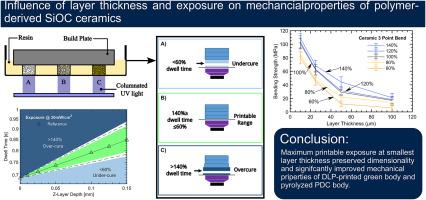
One significant hurdle in additively manufacturing polymer-derived ceramics lies in reconciling the lower mechanical properties of additively manufactured parts compared to traditionally manufactured ceramics and PDCs. Here, a methodology is presented for evaluating the influence of layer thickness and exposure on polymer-derived ceramics within the constraints of commercially available software and hardware. Maximizing exposure within printable limitation of DLP processes, produced green bodies with the highest conversion, and resulted in improved pyrolysis outcomes, manufacturability, and most importantly ceramic strengths comparable to traditionally manufactured SiOC PDCs. Decreasing layer thickness and increasing total dwell time had a dramatic impact on mechanical properties, increasing flexural strength by more than 6x from 18 MPa at 100 μm layer thickness to 111 MPa at 10 μm layer thickness. Density of resultant ceramic also increased from 1.62 ± 0.03 g/cc to 2.3 ± 0.05 g/cc. This represented a large increase in mechanical strengths of PDCs produced via DLP in literature.



 京公网安备 11010802042870号
京ICP备2023020795号-1
京公网安备 11010802042870号
京ICP备2023020795号-1

 分享
分享
 求助内容:
求助内容: 应助结果提醒方式:
 扫码关注我们
