Future tree mortality is impossible to observe, but a new model reveals why tropical tree traits matter more than climate change variability for predicting hydraulic failure
{"title":"Future tree mortality is impossible to observe, but a new model reveals why tropical tree traits matter more than climate change variability for predicting hydraulic failure","authors":"D. Scott Mackay","doi":"10.1111/nph.20049","DOIUrl":null,"url":null,"abstract":"<p>As sessile organisms, plants cannot simply uproot and move to a better spot when the climate in their current location becomes unfavourable. They have only a few options for acclimating to climate warming and drying. They can modify their range over time through reproduction, but this is an incredibly slow process relative to the rate of change of temperature and atmospheric concentration of CO<sub>2</sub> seen since the start of the Industrial Revolution which is anticipated to accelerate over the next century (Fig. 1a). Forest composition may change over time as individual plants die and are replaced, which may allow for the selection of traits that favour higher GPP and lower risk of hydraulic failure. This too is a slow process. Alternatively, the current composition of forests may contain the trait assemblages, or sets of functional traits, needed to confer on cohorts of plants the ability to acclimate to climate change. Combining a tropical plant trait database with a state-of-the-art model of plant demography and hydraulics, FATES-HYDRO (Xu <i>et al</i>., <span>2023</span>), Robbins <i>et al</i>. demonstrate that the fate of the wet tropical forest on Barro Colorado Island (BPI), Panama, depends on the interactions of plant trait assemblages, and not so much on climate change.</p><p>The finding that knowledge of plants traits can give insight on future forest health outcomes is encouraging, because future temperature, precipitation, and CO<sub>2</sub> concentrations are effectively unknowable. The standard-bearer for this climate uncertainty is the Intergovernmental Panel on Climate Change (IPCC, <span>2021</span>), which defines alternative Shared Socioeconomic Pathways (SSPs), including SSP2-4.5 wherein social, economic, and technological trends of the past are assumed to be maintained. Thereby, resulting in an equivalent increase in radiative forcing by the year 2100 relative to preindustrial levels of 4.5 Wm<sup>−2</sup>, and SSP5-8.5, assuming accelerated carbon emissions and an 8.5 Wm<sup>−2</sup> increase in equivalent radiative forcing. ESMs developed for IPCC, and used in the study by Robbins <i>et al</i>., are highly sensitive to chosen SSP and show considerable divergence among models. There is also little agreement on the notion of CO<sub>2</sub> fertilization providing a compensating benefit to increasing temperatures by increasing the substrate for photosynthesis, while simultaneously reducing stomatal conductance (Purcell <i>et al</i>., <span>2018</span>). Less attention is paid to the effects of elevated CO<sub>2</sub> on coordinated development of stomatal conductance and xylem vulnerability to cavitation (Rico <i>et al</i>., <span>2013</span>). Moreover, high confidence in leaf level, short-term physiological responses to elevated CO<sub>2</sub> (Way <i>et al</i>., <span>2015</span>) does not hold up at the stand-level (Ainsworth & Long, <span>2005</span>). At spatial scales of whole forests, the physiological responses to elevated CO<sub>2</sub> are moderated by forest structure and internal feedback (Norby & Zak, <span>2011</span>), such as aerodynamic conductance (Knauer <i>et al</i>., <span>2017</span>), divergent physiological responses (Lemordant <i>et al</i>., <span>2018</span>), and belowground processes such as groundwater flow (Tai <i>et al</i>., <span>2021</span>). Importantly, the approach presented by Robbins <i>et al</i>., and indeed the FATES-HYDRO model, can easily accommodate a multitude of landscape scale variables that affect plant responses to elevated CO<sub>2</sub>.</p><p>As Robbins <i>et al</i>. note, the use of FATES-HYDRO is a breakthrough in modeling hydraulic failure in tropical forests because it accounts for forest composition, plant hydraulics, and the effects of CO<sub>2</sub> on photosynthesis and stomatal conductance. What is also truly innovative here is how the authors use a multi-driver, multi-trait framework to transform a complex problem into testable hypotheses on the interactions between plant traits and climate change, thereby essentially putting forth a theory that can be tested in other forests. The approach centers on the use of <i>post hoc</i> Markov-Chain Monte Carlo analysis, which shares some of the benefits of Bayesian methods for making probabilistic statements but with computational advantages, to refine a 1000-count set of trait assemblages into a manageable set of 54 trait assemblages (Fig. 1b). Simulations run with historic meteorological inputs and fitted to monthly observations of soil water, runoff, evapotranspiration (ET) and GPP reveal plausible trait combinations associated with the 20 dominant tree species in the study. Each trait assemblage could span multiple species and thus represent the mean trait values of a given forest trait composition. This clever approach builds up a comprehensive picture of a forest's functional traits even when data is sparse for individual species. It also represents an important advance in revealing the emergent traits of a complex forest without requiring the use of assumptions about basal area dominance changes over time.</p><p>The authors combine plausible trait assemblages with meteorological forcings based on climate scenarios. To create climate scenarios, 16 ESMs are used to simulate both historical (2000–2014) and end-of-century conditions for two emissions scenarios (SSP2-4.5 and SSP5-8.5; 2086–2100) for Barrow Colorado Island, from which weekly temperature and precipitation anomalies are computed, and these anomalies are added to a contemporary simulation driver (2003–2016). CO<sub>2</sub> levels are then applied using either contemporary (367 ppm) or SSP projected (603 or 1059 ppm) levels, resulting in 64 meteorological drivers for FATES-HYDRO. The 64 drivers × 54 trait assemblages in essence give the model a realistic picture of the plausible sources of variability in both the abiotic drivers and biotic responses, a robust framework for hypothesis testing (Fig. 1c). While GPP benefits in future climates when exposed to future CO<sub>2</sub> levels (hypothesis H2A), the risk of hydraulic failure essentially doubles regardless of CO<sub>2</sub> level (hypothesis H2B). Trait assemblages that experience hydraulic failure across all future scenarios also spend more time at leaf water potentials associated with 50% or higher levels of stomatal closure. While GPP and ET are mostly explained by plant traits and partly explained by climate change and CO<sub>2</sub> level, risk of hydraulic failure is explained predominantly by the trait assemblages.</p><p>The consequences of Robbins <i>et al</i>. are far-reaching. First, their results suggest that whether or not forest mortality rates increase and GPP declines as a consequence of higher temperatures and lower available soil water primarily depends on plant traits. This narrows the focus for predicting hydraulic failure on deepening knowledge of plant trait interactions, a major step forward for guiding collaboration between tropical field ecology and vegetation model development. Second, the study shows a way forward for using collections of traits from a wide range of species, even in sparse databases, to make informed decisions with models. Finally, and perhaps most importantly, the modelling study by Robbins <i>et al</i>. moves the global change ecology field forward by providing a framework that can be evaluated and compared across biomes. It would be interesting to apply the authors' approach across forests with contrasting environmental conditions, such as sites with projected large changes in vapour pressure deficit (Grossiord <i>et al</i>., <span>2020</span>) or more prone to extreme drought (Chiang <i>et al</i>., <span>2021</span>) which, as noted by the authors, may alter some of the findings.</p>","PeriodicalId":214,"journal":{"name":"New Phytologist","volume":"244 6","pages":"2115-2117"},"PeriodicalIF":8.1000,"publicationDate":"2024-08-13","publicationTypes":"Journal Article","fieldsOfStudy":null,"isOpenAccess":false,"openAccessPdf":"https://onlinelibrary.wiley.com/doi/epdf/10.1111/nph.20049","citationCount":"0","resultStr":null,"platform":"Semanticscholar","paperid":null,"PeriodicalName":"New Phytologist","FirstCategoryId":"99","ListUrlMain":"https://nph.onlinelibrary.wiley.com/doi/10.1111/nph.20049","RegionNum":1,"RegionCategory":"生物学","ArticlePicture":[],"TitleCN":null,"AbstractTextCN":null,"PMCID":null,"EPubDate":"","PubModel":"","JCR":"Q1","JCRName":"PLANT SCIENCES","Score":null,"Total":0}
引用次数: 0
Abstract
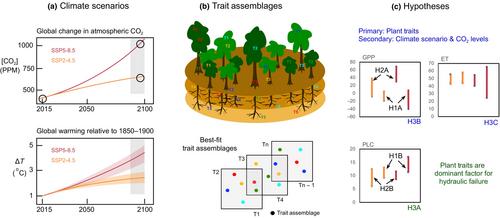
As sessile organisms, plants cannot simply uproot and move to a better spot when the climate in their current location becomes unfavourable. They have only a few options for acclimating to climate warming and drying. They can modify their range over time through reproduction, but this is an incredibly slow process relative to the rate of change of temperature and atmospheric concentration of CO2 seen since the start of the Industrial Revolution which is anticipated to accelerate over the next century (Fig. 1a). Forest composition may change over time as individual plants die and are replaced, which may allow for the selection of traits that favour higher GPP and lower risk of hydraulic failure. This too is a slow process. Alternatively, the current composition of forests may contain the trait assemblages, or sets of functional traits, needed to confer on cohorts of plants the ability to acclimate to climate change. Combining a tropical plant trait database with a state-of-the-art model of plant demography and hydraulics, FATES-HYDRO (Xu et al., 2023), Robbins et al. demonstrate that the fate of the wet tropical forest on Barro Colorado Island (BPI), Panama, depends on the interactions of plant trait assemblages, and not so much on climate change.
The finding that knowledge of plants traits can give insight on future forest health outcomes is encouraging, because future temperature, precipitation, and CO2 concentrations are effectively unknowable. The standard-bearer for this climate uncertainty is the Intergovernmental Panel on Climate Change (IPCC, 2021), which defines alternative Shared Socioeconomic Pathways (SSPs), including SSP2-4.5 wherein social, economic, and technological trends of the past are assumed to be maintained. Thereby, resulting in an equivalent increase in radiative forcing by the year 2100 relative to preindustrial levels of 4.5 Wm−2, and SSP5-8.5, assuming accelerated carbon emissions and an 8.5 Wm−2 increase in equivalent radiative forcing. ESMs developed for IPCC, and used in the study by Robbins et al., are highly sensitive to chosen SSP and show considerable divergence among models. There is also little agreement on the notion of CO2 fertilization providing a compensating benefit to increasing temperatures by increasing the substrate for photosynthesis, while simultaneously reducing stomatal conductance (Purcell et al., 2018). Less attention is paid to the effects of elevated CO2 on coordinated development of stomatal conductance and xylem vulnerability to cavitation (Rico et al., 2013). Moreover, high confidence in leaf level, short-term physiological responses to elevated CO2 (Way et al., 2015) does not hold up at the stand-level (Ainsworth & Long, 2005). At spatial scales of whole forests, the physiological responses to elevated CO2 are moderated by forest structure and internal feedback (Norby & Zak, 2011), such as aerodynamic conductance (Knauer et al., 2017), divergent physiological responses (Lemordant et al., 2018), and belowground processes such as groundwater flow (Tai et al., 2021). Importantly, the approach presented by Robbins et al., and indeed the FATES-HYDRO model, can easily accommodate a multitude of landscape scale variables that affect plant responses to elevated CO2.
As Robbins et al. note, the use of FATES-HYDRO is a breakthrough in modeling hydraulic failure in tropical forests because it accounts for forest composition, plant hydraulics, and the effects of CO2 on photosynthesis and stomatal conductance. What is also truly innovative here is how the authors use a multi-driver, multi-trait framework to transform a complex problem into testable hypotheses on the interactions between plant traits and climate change, thereby essentially putting forth a theory that can be tested in other forests. The approach centers on the use of post hoc Markov-Chain Monte Carlo analysis, which shares some of the benefits of Bayesian methods for making probabilistic statements but with computational advantages, to refine a 1000-count set of trait assemblages into a manageable set of 54 trait assemblages (Fig. 1b). Simulations run with historic meteorological inputs and fitted to monthly observations of soil water, runoff, evapotranspiration (ET) and GPP reveal plausible trait combinations associated with the 20 dominant tree species in the study. Each trait assemblage could span multiple species and thus represent the mean trait values of a given forest trait composition. This clever approach builds up a comprehensive picture of a forest's functional traits even when data is sparse for individual species. It also represents an important advance in revealing the emergent traits of a complex forest without requiring the use of assumptions about basal area dominance changes over time.
The authors combine plausible trait assemblages with meteorological forcings based on climate scenarios. To create climate scenarios, 16 ESMs are used to simulate both historical (2000–2014) and end-of-century conditions for two emissions scenarios (SSP2-4.5 and SSP5-8.5; 2086–2100) for Barrow Colorado Island, from which weekly temperature and precipitation anomalies are computed, and these anomalies are added to a contemporary simulation driver (2003–2016). CO2 levels are then applied using either contemporary (367 ppm) or SSP projected (603 or 1059 ppm) levels, resulting in 64 meteorological drivers for FATES-HYDRO. The 64 drivers × 54 trait assemblages in essence give the model a realistic picture of the plausible sources of variability in both the abiotic drivers and biotic responses, a robust framework for hypothesis testing (Fig. 1c). While GPP benefits in future climates when exposed to future CO2 levels (hypothesis H2A), the risk of hydraulic failure essentially doubles regardless of CO2 level (hypothesis H2B). Trait assemblages that experience hydraulic failure across all future scenarios also spend more time at leaf water potentials associated with 50% or higher levels of stomatal closure. While GPP and ET are mostly explained by plant traits and partly explained by climate change and CO2 level, risk of hydraulic failure is explained predominantly by the trait assemblages.
The consequences of Robbins et al. are far-reaching. First, their results suggest that whether or not forest mortality rates increase and GPP declines as a consequence of higher temperatures and lower available soil water primarily depends on plant traits. This narrows the focus for predicting hydraulic failure on deepening knowledge of plant trait interactions, a major step forward for guiding collaboration between tropical field ecology and vegetation model development. Second, the study shows a way forward for using collections of traits from a wide range of species, even in sparse databases, to make informed decisions with models. Finally, and perhaps most importantly, the modelling study by Robbins et al. moves the global change ecology field forward by providing a framework that can be evaluated and compared across biomes. It would be interesting to apply the authors' approach across forests with contrasting environmental conditions, such as sites with projected large changes in vapour pressure deficit (Grossiord et al., 2020) or more prone to extreme drought (Chiang et al., 2021) which, as noted by the authors, may alter some of the findings.
期刊介绍:
New Phytologist is an international electronic journal published 24 times a year. It is owned by the New Phytologist Foundation, a non-profit-making charitable organization dedicated to promoting plant science. The journal publishes excellent, novel, rigorous, and timely research and scholarship in plant science and its applications. The articles cover topics in five sections: Physiology & Development, Environment, Interaction, Evolution, and Transformative Plant Biotechnology. These sections encompass intracellular processes, global environmental change, and encourage cross-disciplinary approaches. The journal recognizes the use of techniques from molecular and cell biology, functional genomics, modeling, and system-based approaches in plant science. Abstracting and Indexing Information for New Phytologist includes Academic Search, AgBiotech News & Information, Agroforestry Abstracts, Biochemistry & Biophysics Citation Index, Botanical Pesticides, CAB Abstracts®, Environment Index, Global Health, and Plant Breeding Abstracts, and others.




 京公网安备 11010802042870号
京ICP备2023020795号-1
京公网安备 11010802042870号
京ICP备2023020795号-1

 分享
分享
 求助内容:
求助内容: 应助结果提醒方式:
 扫码关注我们
