Christel Bidet-Ildei, Olfa BenAhmed, Diaddin Bouidaine, Victor Francisco, Arnaud Decatoire, Yannick Blandin, Jean Pylouster, Christine Fernandez-Maloigne
{"title":"SmartDetector: Automatic and vision-based approach to point-light display generation for human action perception.","authors":"Christel Bidet-Ildei, Olfa BenAhmed, Diaddin Bouidaine, Victor Francisco, Arnaud Decatoire, Yannick Blandin, Jean Pylouster, Christine Fernandez-Maloigne","doi":"10.3758/s13428-024-02478-1","DOIUrl":null,"url":null,"abstract":"<p><p>Over the past four decades, point-light displays (PLD) have been integrated into psychology and psychophysics, providing a valuable means to probe human perceptual skills. Leveraging the inherent kinematic information and controllable display parameters, researchers have utilized this technique to examine the mechanisms involved in learning and rehabilitation. However, classical PLD generation methods (e.g., motion capture) are difficult to apply for behavior analysis in real-world situations, such as patient care or sports activities. Therefore, there is a demand for automated and affordable tools that enable efficient and real-world-compatible generation of PLDs for psychological research. In this paper, we propose SmartDetector, a new artificial intelligence (AI)-based tool for automatic PLD creation from RGB videos. To evaluate humans' perceptual skills for processing PLD building with SmartDetector, 126 participants were randomly assigned to recognition, discrimination, or detection tasks. Results demonstrated that, irrespective of the task, PLDs generated by SmartDetector exhibited commendable perceptual performance in terms of accuracy and response times compared to literature findings. Moreover, to enhance usability and broaden accessibility, we developed an intuitive web interface for our method, making it available to a wider audience. The resulting application is available at https://plavimop.prd.fr/index.php/en/automatic-creation-pld . SmartDetector offers interesting possibilities for using PLD in research and makes the use of PLD more accessible for nonacademic applications.</p>","PeriodicalId":8717,"journal":{"name":"Behavior Research Methods","volume":" ","pages":"8349-8361"},"PeriodicalIF":3.9000,"publicationDate":"2024-12-01","publicationTypes":"Journal Article","fieldsOfStudy":null,"isOpenAccess":false,"openAccessPdf":"","citationCount":"0","resultStr":null,"platform":"Semanticscholar","paperid":null,"PeriodicalName":"Behavior Research Methods","FirstCategoryId":"102","ListUrlMain":"https://doi.org/10.3758/s13428-024-02478-1","RegionNum":2,"RegionCategory":"心理学","ArticlePicture":[],"TitleCN":null,"AbstractTextCN":null,"PMCID":null,"EPubDate":"2024/8/13 0:00:00","PubModel":"Epub","JCR":"Q1","JCRName":"PSYCHOLOGY, EXPERIMENTAL","Score":null,"Total":0}
引用次数: 0
Abstract
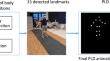
Over the past four decades, point-light displays (PLD) have been integrated into psychology and psychophysics, providing a valuable means to probe human perceptual skills. Leveraging the inherent kinematic information and controllable display parameters, researchers have utilized this technique to examine the mechanisms involved in learning and rehabilitation. However, classical PLD generation methods (e.g., motion capture) are difficult to apply for behavior analysis in real-world situations, such as patient care or sports activities. Therefore, there is a demand for automated and affordable tools that enable efficient and real-world-compatible generation of PLDs for psychological research. In this paper, we propose SmartDetector, a new artificial intelligence (AI)-based tool for automatic PLD creation from RGB videos. To evaluate humans' perceptual skills for processing PLD building with SmartDetector, 126 participants were randomly assigned to recognition, discrimination, or detection tasks. Results demonstrated that, irrespective of the task, PLDs generated by SmartDetector exhibited commendable perceptual performance in terms of accuracy and response times compared to literature findings. Moreover, to enhance usability and broaden accessibility, we developed an intuitive web interface for our method, making it available to a wider audience. The resulting application is available at https://plavimop.prd.fr/index.php/en/automatic-creation-pld . SmartDetector offers interesting possibilities for using PLD in research and makes the use of PLD more accessible for nonacademic applications.
期刊介绍:
Behavior Research Methods publishes articles concerned with the methods, techniques, and instrumentation of research in experimental psychology. The journal focuses particularly on the use of computer technology in psychological research. An annual special issue is devoted to this field.




 京公网安备 11010802042870号
京ICP备2023020795号-1
京公网安备 11010802042870号
京ICP备2023020795号-1

 分享
分享
 求助内容:
求助内容: 应助结果提醒方式:
 扫码关注我们
