Ane Poly DDS, MSc, PhD, Daniel Hupp DDS Candidate, Jeff Lowry Med, Jordan L. Schweitzer DDS, MS
{"title":"An innovative interactive scenario-based approach to teaching endodontic diagnosis","authors":"Ane Poly DDS, MSc, PhD, Daniel Hupp DDS Candidate, Jeff Lowry Med, Jordan L. Schweitzer DDS, MS","doi":"10.1002/jdd.13693","DOIUrl":null,"url":null,"abstract":"<p>The diagnosis of endodontic conditions involves a comprehensive approach. Clinicians must follow a systematic approach, incorporating inquiry, testing, and reasoning to achieve an accurate diagnosis and develop an appropriate treatment plan. After learning pulpal and periapical diagnosis<span><sup>1</sup></span> through a traditional lecture-centered approach, predoctoral students often struggle to master its application in the clinical setting.<span><sup>2</sup></span> Educators should adopt teaching approaches for Gen Z students, emphasizing engagement, intellectual stimulation, and rapport-building to address their digital learning needs effectively.<span><sup>3</sup></span></p><p>Scenario-based e-learning promotes the practical application of knowledge and stimulates critical thinking, decision-making, and problem-solving abilities. Storyline Articulate 360 software is a subscription-based e-learning platform designed specifically to develop interactive educational modules. This platform allows quick development of e-learning content that can be easily integrated into a learning management system (LMS). Currently, there is no available data regarding the use of this platform in dentistry.</p><p>Three interactive endodontic diagnostic scenarios were developed using the software. Case content was provided by the subject matter experts (Ane Poly and Jordan L. Schweitzer) and an instructional designer (Jeff Lowry) developed the modules. After a pilot testing, the three modules were exported as SCORM packages, published in the University's Canvas LMS, and applied to 102 third-year dental students enrolled at Texas A&M School of Dentistry. The self-paced scenarios increased in difficulty as the students progressed through the three cases.</p><p>These scenarios replicated real clinical situations and included intermediary questions covering pulpal and periapical diagnosis, as well as treatment planning. Students were required to thoroughly review hypothetical patients' medical and dental histories, test results, radiographic interpretations, and more. Storyline Articulate 360 software provided immediate feedback to students for both correct and incorrect answers.</p><p>The first scenario involved a case of pulp necrosis and asymptomatic apical periodontitis, requiring the student to correlate the objective results with the periapical radiolucency evident on radiographs (Figure 1). This scenario also served as an introduction to the interface for students and involved only four questions.</p><p>The second scenario featured a patient experiencing referred pain, leading to a diagnosis of symptomatic irreversible pulpitis and symptomatic apical periodontitis, and included 10 questions (Figure 2). Both the first and second scenarios included a description of the attached radiographs.</p><p>The third scenario was a virtual escape room (VER), a gamification technique designed to engage students in learning tasks by incorporating competitive elements to encourage desired behaviors.<span><sup>4</sup></span> VERs are digital adaptations of traditional escape rooms and have demonstrated effectiveness in healthcare education. These online interactive environments challenge students to solve puzzles within a set time limit.<span><sup>5</sup></span> This scenario involved a patient who presented to the office with diffuse pain on the left side triggered by cold and sweets, plus the confounding issue of a recent root canal treatment performed on the same side. This scenario required students to interpret radiographs, unlike the previous two scenarios. The final diagnosis for the actual culprit tooth was reversible pulpitis and normal apical tissues. Students were tasked with gathering all necessary information and providing correct answers to seven questions, each yielding one letter. These letters were then unscrambled to discover the escape password (Figure 3).</p><p>In the end, students were invited to answer three 5-point scale questions regarding the level of difficulty of each scenario, the intuitiveness and ease of navigation of the platform, and its potential usefulness in other courses.</p><p>The interactive endodontic diagnostic scenarios were successfully developed and applied. One limitation in the third scenario was the lack of a time limit, as VERs typically should be timed. However, we prioritized allowing students to review all feedback, both correct and incorrect, to enhance learning. Imposing a time limit could hinder this educational process.</p><p>Seventy participants responded to the qualitative survey. More than 50% recognized the difficult levels of each scenario, 85% found them intuitive with a friendly interface, and 88% believed their use would be beneficial in other disciplines. These scenarios are now integrated into the problem-based learning activities for the D3 endodontics course in a formative capacity, allowing students to experiment with this new educational modality without impacting their course grades. Although summative grading has not yet been implemented, these scenarios could serve as an excellent option for online Objective Structured Clinical Examinations, and interactive additions to teaching methodology. Online learning scenarios can complement traditional teaching, enhance student engagement, and meet the remote learning needs highlighted by the coronavirus disease 2019 pandemic.</p><p>A demonstration video is available here showing numerous aspects of the scenarios. The scenarios can be accessed for free without an account or subscription through the following direct links: Interactive Clinical Scenario #1, Interactive Clinical Scenario #2, and Interactive Clinical Scenario #3.</p>","PeriodicalId":50216,"journal":{"name":"Journal of Dental Education","volume":"89 S1","pages":"998-1000"},"PeriodicalIF":1.6000,"publicationDate":"2024-08-13","publicationTypes":"Journal Article","fieldsOfStudy":null,"isOpenAccess":false,"openAccessPdf":"https://onlinelibrary.wiley.com/doi/epdf/10.1002/jdd.13693","citationCount":"0","resultStr":null,"platform":"Semanticscholar","paperid":null,"PeriodicalName":"Journal of Dental Education","FirstCategoryId":"3","ListUrlMain":"https://onlinelibrary.wiley.com/doi/10.1002/jdd.13693","RegionNum":4,"RegionCategory":"医学","ArticlePicture":[],"TitleCN":null,"AbstractTextCN":null,"PMCID":null,"EPubDate":"","PubModel":"","JCR":"Q3","JCRName":"DENTISTRY, ORAL SURGERY & MEDICINE","Score":null,"Total":0}
引用次数: 0
Abstract
The diagnosis of endodontic conditions involves a comprehensive approach. Clinicians must follow a systematic approach, incorporating inquiry, testing, and reasoning to achieve an accurate diagnosis and develop an appropriate treatment plan. After learning pulpal and periapical diagnosis1 through a traditional lecture-centered approach, predoctoral students often struggle to master its application in the clinical setting.2 Educators should adopt teaching approaches for Gen Z students, emphasizing engagement, intellectual stimulation, and rapport-building to address their digital learning needs effectively.3
Scenario-based e-learning promotes the practical application of knowledge and stimulates critical thinking, decision-making, and problem-solving abilities. Storyline Articulate 360 software is a subscription-based e-learning platform designed specifically to develop interactive educational modules. This platform allows quick development of e-learning content that can be easily integrated into a learning management system (LMS). Currently, there is no available data regarding the use of this platform in dentistry.
Three interactive endodontic diagnostic scenarios were developed using the software. Case content was provided by the subject matter experts (Ane Poly and Jordan L. Schweitzer) and an instructional designer (Jeff Lowry) developed the modules. After a pilot testing, the three modules were exported as SCORM packages, published in the University's Canvas LMS, and applied to 102 third-year dental students enrolled at Texas A&M School of Dentistry. The self-paced scenarios increased in difficulty as the students progressed through the three cases.
These scenarios replicated real clinical situations and included intermediary questions covering pulpal and periapical diagnosis, as well as treatment planning. Students were required to thoroughly review hypothetical patients' medical and dental histories, test results, radiographic interpretations, and more. Storyline Articulate 360 software provided immediate feedback to students for both correct and incorrect answers.
The first scenario involved a case of pulp necrosis and asymptomatic apical periodontitis, requiring the student to correlate the objective results with the periapical radiolucency evident on radiographs (Figure 1). This scenario also served as an introduction to the interface for students and involved only four questions.
The second scenario featured a patient experiencing referred pain, leading to a diagnosis of symptomatic irreversible pulpitis and symptomatic apical periodontitis, and included 10 questions (Figure 2). Both the first and second scenarios included a description of the attached radiographs.
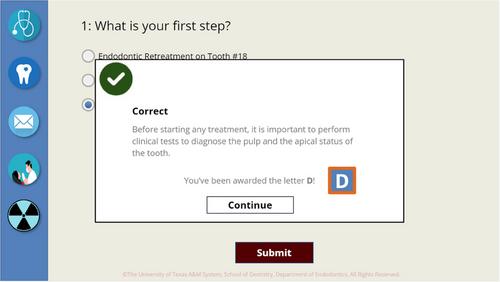
The third scenario was a virtual escape room (VER), a gamification technique designed to engage students in learning tasks by incorporating competitive elements to encourage desired behaviors.4 VERs are digital adaptations of traditional escape rooms and have demonstrated effectiveness in healthcare education. These online interactive environments challenge students to solve puzzles within a set time limit.5 This scenario involved a patient who presented to the office with diffuse pain on the left side triggered by cold and sweets, plus the confounding issue of a recent root canal treatment performed on the same side. This scenario required students to interpret radiographs, unlike the previous two scenarios. The final diagnosis for the actual culprit tooth was reversible pulpitis and normal apical tissues. Students were tasked with gathering all necessary information and providing correct answers to seven questions, each yielding one letter. These letters were then unscrambled to discover the escape password (Figure 3).
In the end, students were invited to answer three 5-point scale questions regarding the level of difficulty of each scenario, the intuitiveness and ease of navigation of the platform, and its potential usefulness in other courses.
The interactive endodontic diagnostic scenarios were successfully developed and applied. One limitation in the third scenario was the lack of a time limit, as VERs typically should be timed. However, we prioritized allowing students to review all feedback, both correct and incorrect, to enhance learning. Imposing a time limit could hinder this educational process.
Seventy participants responded to the qualitative survey. More than 50% recognized the difficult levels of each scenario, 85% found them intuitive with a friendly interface, and 88% believed their use would be beneficial in other disciplines. These scenarios are now integrated into the problem-based learning activities for the D3 endodontics course in a formative capacity, allowing students to experiment with this new educational modality without impacting their course grades. Although summative grading has not yet been implemented, these scenarios could serve as an excellent option for online Objective Structured Clinical Examinations, and interactive additions to teaching methodology. Online learning scenarios can complement traditional teaching, enhance student engagement, and meet the remote learning needs highlighted by the coronavirus disease 2019 pandemic.
A demonstration video is available here showing numerous aspects of the scenarios. The scenarios can be accessed for free without an account or subscription through the following direct links: Interactive Clinical Scenario #1, Interactive Clinical Scenario #2, and Interactive Clinical Scenario #3.
期刊介绍:
The Journal of Dental Education (JDE) is a peer-reviewed monthly journal that publishes a wide variety of educational and scientific research in dental, allied dental and advanced dental education. Published continuously by the American Dental Education Association since 1936 and internationally recognized as the premier journal for academic dentistry, the JDE publishes articles on such topics as curriculum reform, education research methods, innovative educational and assessment methodologies, faculty development, community-based dental education, student recruitment and admissions, professional and educational ethics, dental education around the world and systematic reviews of educational interest. The JDE is one of the top scholarly journals publishing the most important work in oral health education today; it celebrated its 80th anniversary in 2016.



 京公网安备 11010802042870号
京ICP备2023020795号-1
京公网安备 11010802042870号
京ICP备2023020795号-1

 分享
分享
 求助内容:
求助内容: 应助结果提醒方式:
 扫码关注我们
