Erwin Yudi Hidayat, Yani Parti Astuti, Ika Novita Dewi, Abu Salam, Moch Arief Soeleman, Zainal Arifin Hasibuan, Ahmed Sabeeh Yousif
{"title":"Genetic Algorithm-based Convolutional Neural Network Feature Engineering for Optimizing Coronary Heart Disease Prediction Performance.","authors":"Erwin Yudi Hidayat, Yani Parti Astuti, Ika Novita Dewi, Abu Salam, Moch Arief Soeleman, Zainal Arifin Hasibuan, Ahmed Sabeeh Yousif","doi":"10.4258/hir.2024.30.3.234","DOIUrl":null,"url":null,"abstract":"<p><strong>Objectives: </strong>This study aimed to optimize early coronary heart disease (CHD) prediction using a genetic algorithm (GA)-based convolutional neural network (CNN) feature engineering approach. We sought to overcome the limitations of traditional hyperparameter optimization techniques by leveraging a GA for superior predictive performance in CHD detection.</p><p><strong>Methods: </strong>Utilizing a GA for hyperparameter optimization, we navigated a complex combinatorial space to identify optimal configurations for a CNN model. We also employed information gain for feature selection optimization, transforming the CHD datasets into an image-like input for the CNN architecture. The efficacy of this method was benchmarked against traditional optimization strategies.</p><p><strong>Results: </strong>The advanced GA-based CNN model outperformed traditional methods, achieving a substantial increase in accuracy. The optimized model delivered a promising accuracy range, with a peak of 85% in hyperparameter optimization and 100% accuracy when integrated with machine learning algorithms, namely naïve Bayes, support vector machine, decision tree, logistic regression, and random forest, for both binary and multiclass CHD prediction tasks.</p><p><strong>Conclusions: </strong>The integration of a GA into CNN feature engineering is a powerful technique for improving the accuracy of CHD predictions. This approach results in a high degree of predictive reliability and can significantly contribute to the field of AI-driven healthcare, with the possibility of clinical deployment for early CHD detection. Future work will focus on expanding the approach to encompass a wider set of CHD data and potential integration with wearable technology for continuous health monitoring.</p>","PeriodicalId":12947,"journal":{"name":"Healthcare Informatics Research","volume":"30 3","pages":"234-243"},"PeriodicalIF":2.1000,"publicationDate":"2024-07-01","publicationTypes":"Journal Article","fieldsOfStudy":null,"isOpenAccess":false,"openAccessPdf":"https://www.ncbi.nlm.nih.gov/pmc/articles/PMC11333810/pdf/","citationCount":"0","resultStr":null,"platform":"Semanticscholar","paperid":null,"PeriodicalName":"Healthcare Informatics Research","FirstCategoryId":"1085","ListUrlMain":"https://doi.org/10.4258/hir.2024.30.3.234","RegionNum":0,"RegionCategory":null,"ArticlePicture":[],"TitleCN":null,"AbstractTextCN":null,"PMCID":null,"EPubDate":"2024/7/31 0:00:00","PubModel":"Epub","JCR":"Q3","JCRName":"MEDICAL INFORMATICS","Score":null,"Total":0}
引用次数: 0
Abstract
Objectives: This study aimed to optimize early coronary heart disease (CHD) prediction using a genetic algorithm (GA)-based convolutional neural network (CNN) feature engineering approach. We sought to overcome the limitations of traditional hyperparameter optimization techniques by leveraging a GA for superior predictive performance in CHD detection.
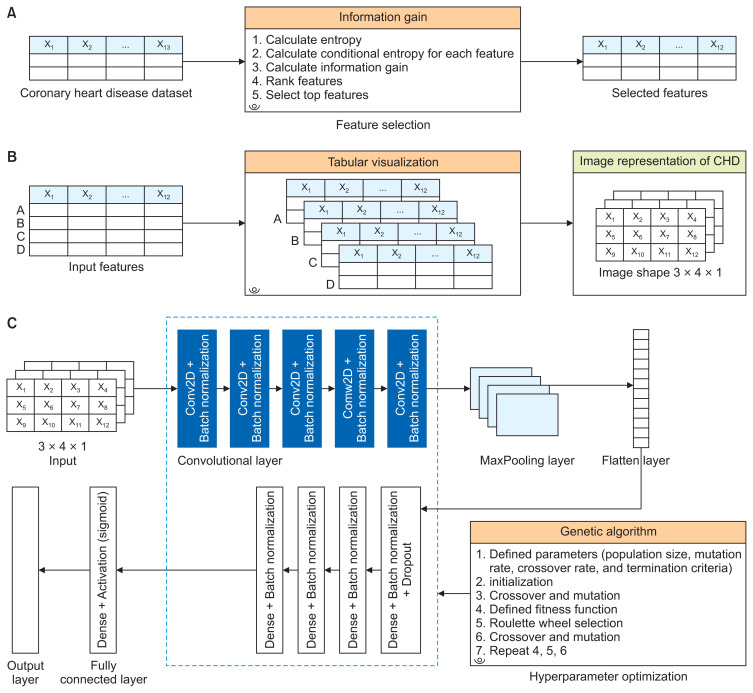
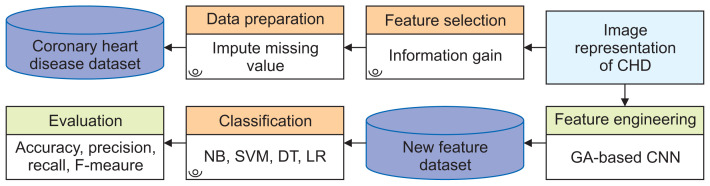
Methods: Utilizing a GA for hyperparameter optimization, we navigated a complex combinatorial space to identify optimal configurations for a CNN model. We also employed information gain for feature selection optimization, transforming the CHD datasets into an image-like input for the CNN architecture. The efficacy of this method was benchmarked against traditional optimization strategies.
Results: The advanced GA-based CNN model outperformed traditional methods, achieving a substantial increase in accuracy. The optimized model delivered a promising accuracy range, with a peak of 85% in hyperparameter optimization and 100% accuracy when integrated with machine learning algorithms, namely naïve Bayes, support vector machine, decision tree, logistic regression, and random forest, for both binary and multiclass CHD prediction tasks.
Conclusions: The integration of a GA into CNN feature engineering is a powerful technique for improving the accuracy of CHD predictions. This approach results in a high degree of predictive reliability and can significantly contribute to the field of AI-driven healthcare, with the possibility of clinical deployment for early CHD detection. Future work will focus on expanding the approach to encompass a wider set of CHD data and potential integration with wearable technology for continuous health monitoring.




 京公网安备 11010802042870号
京ICP备2023020795号-1
京公网安备 11010802042870号
京ICP备2023020795号-1

 分享
分享
 求助内容:
求助内容: 应助结果提醒方式:
 扫码关注我们
