Talya D. Hackett, Alix M. C. Sauve, Kate P. Maia, Daniel Montoya, Nancy Davies, Rose Archer, Simon G. Potts, Jason M. Tylianakis, Ian P. Vaughan, Jane Memmott
{"title":"Multi-habitat landscapes are more diverse and stable with improved function","authors":"Talya D. Hackett, Alix M. C. Sauve, Kate P. Maia, Daniel Montoya, Nancy Davies, Rose Archer, Simon G. Potts, Jason M. Tylianakis, Ian P. Vaughan, Jane Memmott","doi":"10.1038/s41586-024-07825-y","DOIUrl":null,"url":null,"abstract":"Conservation, restoration and land management are increasingly implemented at landscape scales1,2. However, because species interaction data are typically habitat- and/or guild-specific, exactly how those interactions connect habitats and affect the stability and function of communities at landscape scales remains poorly understood. We combine multi-guild species interaction data (plant–pollinator and three plant–herbivore–parasitoid communities, collected from landscapes with one, two or three habitats), a field experiment and a modelling approach to show that multi-habitat landscapes support higher species and interaction evenness, more complementary species interactions and more consistent robustness to species loss. These emergent network properties drive improved pollination success in landscapes with more habitats and are not explained by simply summing component habitat webs. Linking landscape composition, through community structure, to ecosystem function, highlights mechanisms by which several contiguous habitats can support landscape-scale ecosystem services. Species interaction data, a field experiment and modelling of plant–insect communities show that landscapes with more habitat types support more even species, more complementary interactions, are more consistently robust to species loss, and confer greater pollination function.","PeriodicalId":18787,"journal":{"name":"Nature","volume":"633 8028","pages":"114-119"},"PeriodicalIF":48.5000,"publicationDate":"2024-08-21","publicationTypes":"Journal Article","fieldsOfStudy":null,"isOpenAccess":false,"openAccessPdf":"https://www.nature.com/articles/s41586-024-07825-y.pdf","citationCount":"0","resultStr":null,"platform":"Semanticscholar","paperid":null,"PeriodicalName":"Nature","FirstCategoryId":"103","ListUrlMain":"https://www.nature.com/articles/s41586-024-07825-y","RegionNum":1,"RegionCategory":"综合性期刊","ArticlePicture":[],"TitleCN":null,"AbstractTextCN":null,"PMCID":null,"EPubDate":"","PubModel":"","JCR":"Q1","JCRName":"MULTIDISCIPLINARY SCIENCES","Score":null,"Total":0}
引用次数: 0
Abstract
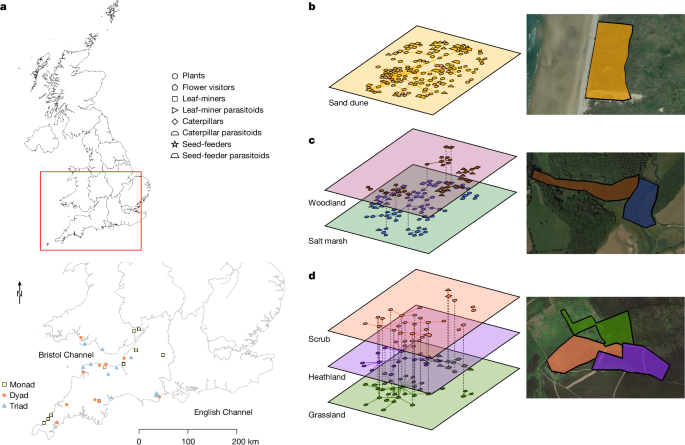
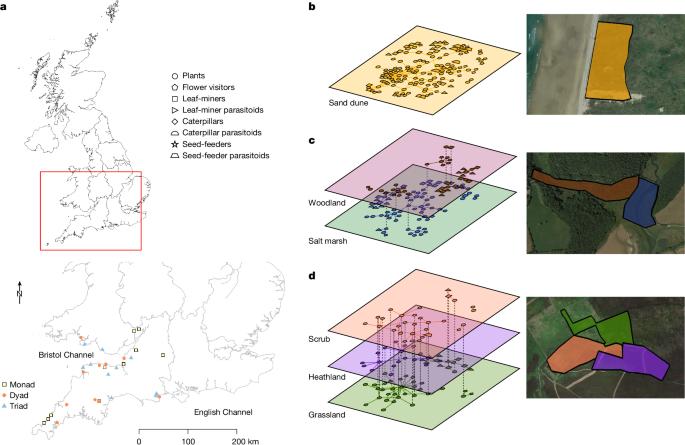
Conservation, restoration and land management are increasingly implemented at landscape scales1,2. However, because species interaction data are typically habitat- and/or guild-specific, exactly how those interactions connect habitats and affect the stability and function of communities at landscape scales remains poorly understood. We combine multi-guild species interaction data (plant–pollinator and three plant–herbivore–parasitoid communities, collected from landscapes with one, two or three habitats), a field experiment and a modelling approach to show that multi-habitat landscapes support higher species and interaction evenness, more complementary species interactions and more consistent robustness to species loss. These emergent network properties drive improved pollination success in landscapes with more habitats and are not explained by simply summing component habitat webs. Linking landscape composition, through community structure, to ecosystem function, highlights mechanisms by which several contiguous habitats can support landscape-scale ecosystem services. Species interaction data, a field experiment and modelling of plant–insect communities show that landscapes with more habitat types support more even species, more complementary interactions, are more consistently robust to species loss, and confer greater pollination function.
期刊介绍:
Nature is a prestigious international journal that publishes peer-reviewed research in various scientific and technological fields. The selection of articles is based on criteria such as originality, importance, interdisciplinary relevance, timeliness, accessibility, elegance, and surprising conclusions. In addition to showcasing significant scientific advances, Nature delivers rapid, authoritative, insightful news, and interpretation of current and upcoming trends impacting science, scientists, and the broader public. The journal serves a dual purpose: firstly, to promptly share noteworthy scientific advances and foster discussions among scientists, and secondly, to ensure the swift dissemination of scientific results globally, emphasizing their significance for knowledge, culture, and daily life.



 京公网安备 11010802042870号
京ICP备2023020795号-1
京公网安备 11010802042870号
京ICP备2023020795号-1

 分享
分享
 求助内容:
求助内容: 应助结果提醒方式:
 扫码关注我们
