{"title":"Transgenerational effects of stress on reproduction strategy in the mixed mating plant Lamium amplexicaule.","authors":"Mor Binder, Eyal Zinger, Lilach Hadany, Nir Ohad","doi":"10.1186/s12870-024-05458-x","DOIUrl":null,"url":null,"abstract":"<p><strong>Background: </strong>The theory of Condition Dependent Sex predicts that - everything else being equal - less fit individuals would outcross at higher rates compared with fitter ones. Here we used the mixed mating plant Lamium amplexicaule, capable of producing both self-pollinating closed flowers (CL), alongside open flowers (CH) that allow cross pollination to test it. We investigated the effects of abiotic stress - salt solution irrigation - on the flowering patterns of plants and their offspring. We monitored several flowering and vegetative parameters, including the number and distribution of flowers, CH fraction, and plant size.</p><p><strong>Results: </strong>We found that stressed plants show an increased tendency for self-pollination and a deficit in floral and vegetative development. However, when parentally primed, stressed plants show a milder response. Un-stressed offspring of stressed parents show reversed responses and exhibit an increased tendency to outcross, and improve floral and vegetative development.</p><p><strong>Conclusions: </strong>In summary, we found that stress affects the reproduction strategy in the plants that experienced the stress and in subsequent offspring through F2 generation. Our results provide experimental evidence supporting a transgenerational extension to the theories of fitness associate sex and dispersal, where an individual's tendency for sex and dispersal may depend on the stress experienced by its parents.</p>","PeriodicalId":9198,"journal":{"name":"BMC Plant Biology","volume":"24 1","pages":"794"},"PeriodicalIF":4.8000,"publicationDate":"2024-08-22","publicationTypes":"Journal Article","fieldsOfStudy":null,"isOpenAccess":false,"openAccessPdf":"https://www.ncbi.nlm.nih.gov/pmc/articles/PMC11340105/pdf/","citationCount":"0","resultStr":null,"platform":"Semanticscholar","paperid":null,"PeriodicalName":"BMC Plant Biology","FirstCategoryId":"99","ListUrlMain":"https://doi.org/10.1186/s12870-024-05458-x","RegionNum":2,"RegionCategory":"生物学","ArticlePicture":[],"TitleCN":null,"AbstractTextCN":null,"PMCID":null,"EPubDate":"","PubModel":"","JCR":"Q1","JCRName":"PLANT SCIENCES","Score":null,"Total":0}
引用次数: 0
Abstract
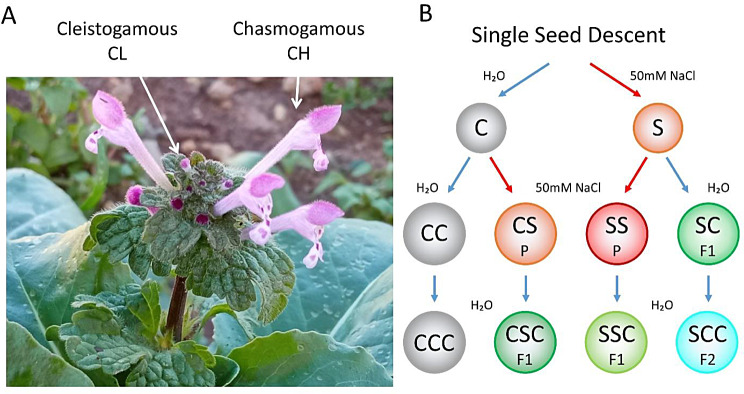
Background: The theory of Condition Dependent Sex predicts that - everything else being equal - less fit individuals would outcross at higher rates compared with fitter ones. Here we used the mixed mating plant Lamium amplexicaule, capable of producing both self-pollinating closed flowers (CL), alongside open flowers (CH) that allow cross pollination to test it. We investigated the effects of abiotic stress - salt solution irrigation - on the flowering patterns of plants and their offspring. We monitored several flowering and vegetative parameters, including the number and distribution of flowers, CH fraction, and plant size.
Results: We found that stressed plants show an increased tendency for self-pollination and a deficit in floral and vegetative development. However, when parentally primed, stressed plants show a milder response. Un-stressed offspring of stressed parents show reversed responses and exhibit an increased tendency to outcross, and improve floral and vegetative development.
Conclusions: In summary, we found that stress affects the reproduction strategy in the plants that experienced the stress and in subsequent offspring through F2 generation. Our results provide experimental evidence supporting a transgenerational extension to the theories of fitness associate sex and dispersal, where an individual's tendency for sex and dispersal may depend on the stress experienced by its parents.
期刊介绍:
BMC Plant Biology is an open access, peer-reviewed journal that considers articles on all aspects of plant biology, including molecular, cellular, tissue, organ and whole organism research.





 京公网安备 11010802042870号
京ICP备2023020795号-1
京公网安备 11010802042870号
京ICP备2023020795号-1

 分享
分享
 求助内容:
求助内容: 应助结果提醒方式:
 扫码关注我们
