{"title":"Configuration Optimization of a Dual-Arm Reconfigurable Space Robot Based on Closed-Chain Inertia Matching","authors":"Zhihui Xue;Jinguo Liu;Yangmin Li;Junsen Liu","doi":"10.1109/TASE.2024.3445453","DOIUrl":null,"url":null,"abstract":"The dual-arm space robot usually forms a closed-chain constraint system with a target through collaborative operations when performing tasks. Most previous related research has focused on the performance of open-chain robots themselves. Studying the manipulation performance of a closed-chain robot system is of great significance. This article proposes a reconfigurable space robot (RSR) system for on-orbit servicing. A graph theory based framework for the automatic generation of reconfigurable robot models is proposed to address the characteristics of variable topology structures. Meanwhile, a new index – the closed-chain inertia matching index is proposed to evaluate its configuration effectively. Compared with traditional dynamic manipulability ellipsoid (DME) and manipulating force ellipsoid (MFE), the effectiveness of the proposed closed-chain inertia matching ellipsoid (IME) is verified. Compared with the DME and MFE, the IME effectively considers the influence of load and can effectively express the dynamic torque force/torque transmission efficiency from the joint actuator to the load in a closed-chain system. The IME can not only be used to determine the optimal joint configuration under a specific closed-chain configuration, but also to determine the optimal nonisomorphic configuration of a reconfigurable robot. Finally, the results of configuration optimization of the closed-chain dual-arm reconfigurable space robot are given.Note to Practitioners—This paper aims to study the determination of the optimal configuration for the RSR during task execution. Due to its various configurations, the RSR has a complex modeling process. This article proposes a modeling framework for automatically generating RSR models that can effectively achieve automatic modeling of various configurations. In addition, most of the previous related research focused on the performance of open-chain robots themselves, ignoring the impact of load. This article proposes a new closed-chain system performance indicator to evaluate the robot configuration. The proposed evaluation indicator effectively considers the influence of load, which is of practical significance to improve the efficiency of task execution. The effectiveness of the proposed index in determining the optimal configuration is demonstrated by simulation verification. In the future, we will focus on multi-arm collaborative operations under a specific configuration.","PeriodicalId":51060,"journal":{"name":"IEEE Transactions on Automation Science and Engineering","volume":"22 ","pages":"6421-6438"},"PeriodicalIF":7.9000,"publicationDate":"2024-08-23","publicationTypes":"Journal Article","fieldsOfStudy":null,"isOpenAccess":false,"openAccessPdf":"","citationCount":"0","resultStr":null,"platform":"Semanticscholar","paperid":null,"PeriodicalName":"IEEE Transactions on Automation Science and Engineering","FirstCategoryId":"94","ListUrlMain":"https://ieeexplore.ieee.org/document/10645816/","RegionNum":2,"RegionCategory":"计算机科学","ArticlePicture":[],"TitleCN":null,"AbstractTextCN":null,"PMCID":null,"EPubDate":"","PubModel":"","JCR":"Q1","JCRName":"AUTOMATION & CONTROL SYSTEMS","Score":null,"Total":0}
引用次数: 0
Abstract
The dual-arm space robot usually forms a closed-chain constraint system with a target through collaborative operations when performing tasks. Most previous related research has focused on the performance of open-chain robots themselves. Studying the manipulation performance of a closed-chain robot system is of great significance. This article proposes a reconfigurable space robot (RSR) system for on-orbit servicing. A graph theory based framework for the automatic generation of reconfigurable robot models is proposed to address the characteristics of variable topology structures. Meanwhile, a new index – the closed-chain inertia matching index is proposed to evaluate its configuration effectively. Compared with traditional dynamic manipulability ellipsoid (DME) and manipulating force ellipsoid (MFE), the effectiveness of the proposed closed-chain inertia matching ellipsoid (IME) is verified. Compared with the DME and MFE, the IME effectively considers the influence of load and can effectively express the dynamic torque force/torque transmission efficiency from the joint actuator to the load in a closed-chain system. The IME can not only be used to determine the optimal joint configuration under a specific closed-chain configuration, but also to determine the optimal nonisomorphic configuration of a reconfigurable robot. Finally, the results of configuration optimization of the closed-chain dual-arm reconfigurable space robot are given.Note to Practitioners—This paper aims to study the determination of the optimal configuration for the RSR during task execution. Due to its various configurations, the RSR has a complex modeling process. This article proposes a modeling framework for automatically generating RSR models that can effectively achieve automatic modeling of various configurations. In addition, most of the previous related research focused on the performance of open-chain robots themselves, ignoring the impact of load. This article proposes a new closed-chain system performance indicator to evaluate the robot configuration. The proposed evaluation indicator effectively considers the influence of load, which is of practical significance to improve the efficiency of task execution. The effectiveness of the proposed index in determining the optimal configuration is demonstrated by simulation verification. In the future, we will focus on multi-arm collaborative operations under a specific configuration.
期刊介绍:
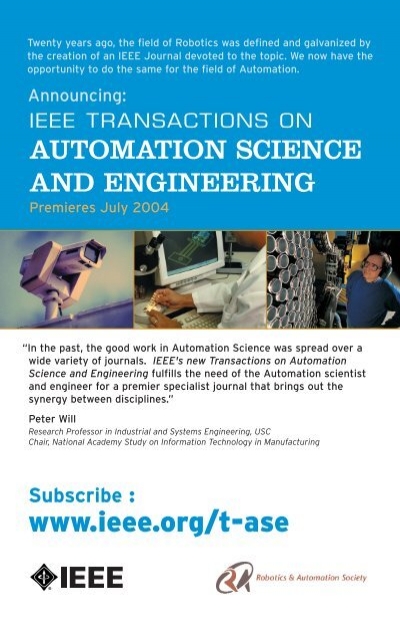
The IEEE Transactions on Automation Science and Engineering (T-ASE) publishes fundamental papers on Automation, emphasizing scientific results that advance efficiency, quality, productivity, and reliability. T-ASE encourages interdisciplinary approaches from computer science, control systems, electrical engineering, mathematics, mechanical engineering, operations research, and other fields. T-ASE welcomes results relevant to industries such as agriculture, biotechnology, healthcare, home automation, maintenance, manufacturing, pharmaceuticals, retail, security, service, supply chains, and transportation. T-ASE addresses a research community willing to integrate knowledge across disciplines and industries. For this purpose, each paper includes a Note to Practitioners that summarizes how its results can be applied or how they might be extended to apply in practice.




 京公网安备 11010802042870号
京ICP备2023020795号-1
京公网安备 11010802042870号
京ICP备2023020795号-1

 分享
分享
 求助内容:
求助内容: 应助结果提醒方式:
 扫码关注我们
