Ivona Lhotská, Aneta Kholová, František Švec, Dalibor Šatínský
{"title":"Nanofibers prepared from synthetic polymers and biopolymers as advanced extraction materials for sample preparation prior to liquid chromatography","authors":"Ivona Lhotská, Aneta Kholová, František Švec, Dalibor Šatínský","doi":"10.1016/j.trac.2024.117912","DOIUrl":null,"url":null,"abstract":"<div><p>Since the beginning of this millennium, there has been an increasing interest in nanofiber-based sorbents for extraction due to their accessibility, scalability, ease of handling, high surface area, variety of chemistries available, and applications in miniaturized methods. Organic and inorganic materials have been converted into nanofibers using various techniques to obtain sorbents for use in analytical chemistry, such as sensors, filter membranes, sorptive phases, and extraction media. Polymer nanofibers are mainly prepared by electrospinning of polystyrene, polyamides, and polyacrylonitrile. In contrast, this review aims to survey other polymers, including biopolymers and biodegradable polymers. In addition, the possibilities of innovative alternative fabrication techniques leading to fiber materials with unique mechanical properties are described. We also focus on unexplored extraction formats using polymer nanofibers. Examples of recent applications benefiting from desorption with minimal solvent volume and on-line hyphenation to chromatographic methods are reported. Finally, the future prospects of these nanosorbents are discussed.</p></div>","PeriodicalId":439,"journal":{"name":"Trends in Analytical Chemistry","volume":"180 ","pages":"Article 117912"},"PeriodicalIF":12.0000,"publicationDate":"2024-11-01","publicationTypes":"Journal Article","fieldsOfStudy":null,"isOpenAccess":false,"openAccessPdf":"https://www.sciencedirect.com/science/article/pii/S0165993624003959/pdfft?md5=55b6d4ae9c882a45d679e49de3a058dd&pid=1-s2.0-S0165993624003959-main.pdf","citationCount":"0","resultStr":null,"platform":"Semanticscholar","paperid":null,"PeriodicalName":"Trends in Analytical Chemistry","FirstCategoryId":"1","ListUrlMain":"https://www.sciencedirect.com/science/article/pii/S0165993624003959","RegionNum":1,"RegionCategory":"化学","ArticlePicture":[],"TitleCN":null,"AbstractTextCN":null,"PMCID":null,"EPubDate":"2024/8/13 0:00:00","PubModel":"Epub","JCR":"Q1","JCRName":"CHEMISTRY, ANALYTICAL","Score":null,"Total":0}
引用次数: 0
Abstract
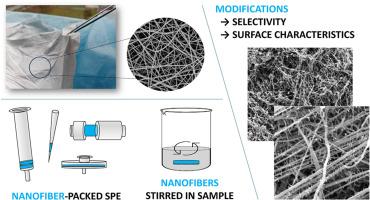
Since the beginning of this millennium, there has been an increasing interest in nanofiber-based sorbents for extraction due to their accessibility, scalability, ease of handling, high surface area, variety of chemistries available, and applications in miniaturized methods. Organic and inorganic materials have been converted into nanofibers using various techniques to obtain sorbents for use in analytical chemistry, such as sensors, filter membranes, sorptive phases, and extraction media. Polymer nanofibers are mainly prepared by electrospinning of polystyrene, polyamides, and polyacrylonitrile. In contrast, this review aims to survey other polymers, including biopolymers and biodegradable polymers. In addition, the possibilities of innovative alternative fabrication techniques leading to fiber materials with unique mechanical properties are described. We also focus on unexplored extraction formats using polymer nanofibers. Examples of recent applications benefiting from desorption with minimal solvent volume and on-line hyphenation to chromatographic methods are reported. Finally, the future prospects of these nanosorbents are discussed.
期刊介绍:
TrAC publishes succinct and critical overviews of recent advancements in analytical chemistry, designed to assist analytical chemists and other users of analytical techniques. These reviews offer excellent, up-to-date, and timely coverage of various topics within analytical chemistry. Encompassing areas such as analytical instrumentation, biomedical analysis, biomolecular analysis, biosensors, chemical analysis, chemometrics, clinical chemistry, drug discovery, environmental analysis and monitoring, food analysis, forensic science, laboratory automation, materials science, metabolomics, pesticide-residue analysis, pharmaceutical analysis, proteomics, surface science, and water analysis and monitoring, these critical reviews provide comprehensive insights for practitioners in the field.



 京公网安备 11010802042870号
京ICP备2023020795号-1
京公网安备 11010802042870号
京ICP备2023020795号-1

 分享
分享
 求助内容:
求助内容: 应助结果提醒方式:
 扫码关注我们
