Prognostic value of electroanatomic-guided endomyocardial biopsy in patients with myocarditis, arrhythmogenic cardiomyopathy and non dilated left ventricular cardiomyopathy
Maria Lucia Narducci , Roberto Scacciavillani , Roberta Lo Nano , Antonio Bisignani , Nicoletta D'Alessandris , Frediano Inzani , Francesco Danilo Tiziano , Francesco Perna , Gianluigi Bencardino , Francesco Burzotta , Gemma Pelargonio , Massimo Imazio
{"title":"Prognostic value of electroanatomic-guided endomyocardial biopsy in patients with myocarditis, arrhythmogenic cardiomyopathy and non dilated left ventricular cardiomyopathy","authors":"Maria Lucia Narducci , Roberto Scacciavillani , Roberta Lo Nano , Antonio Bisignani , Nicoletta D'Alessandris , Frediano Inzani , Francesco Danilo Tiziano , Francesco Perna , Gianluigi Bencardino , Francesco Burzotta , Gemma Pelargonio , Massimo Imazio","doi":"10.1016/j.ijcard.2024.132489","DOIUrl":null,"url":null,"abstract":"<div><p>A wide variety of non-invasive and invasive techniques for SCD risk stratification in non ischemic cardiomyopathy (NICM) have been proposed, including left ventricular (LV) ejection fraction, QRS duration, late gadolinium enhancement (LGE) on cardiac magnetic resonance (CMR) and invasive electrophysiologic study with or without three-dimensional electroanatomic mapping (3D-EAM), to identify and characterize the arrhythmogenic substrate. There is still no clear consensus on the risk stratification in this clinical setting.</p><p>The aim of our study is to characterize the 3D-EAM substrate in patients with the same clinical presentation of unexplained complex VAs and NICM using CMR, three-dimensional electranatomic mapping (3D-EAM) in association with endomyocardial biopsy (EMB) and genetic screening, as a more precise and early diagnostic assessment may provide important subsequent prognostic impact. The study was designed as a prospective multi-center observational evaluation and the patient follow-up was scheduled at 6 months interval. We enrolled 125 patients distinct into four different group by complete diagnostic work-up: myocarditis, non-dilated left ventricular cardiomyopathy, arrhythmogenic cardiomyopathy and control group. The four groups were compared in terms of clinical, imaging and 3D-EAM data. At multivariate analysis sustained VT/VF on admission [HR: 3.64 (1.79–7.4), <em>p</em> < 0.001], total bipolar scar area of left and right ventricle detected by 3D-EAM [HR: 2.24 (1.13–4.49), <em>p</em> = 0.02], histological diagnosis of myocarditis by 3D-EAM guided endomyocardial biopsy (EBM) [HR: 2.79 (1.04–7.44), <em>p</em> = 0.01] were independent predictors of complex VAs or death at follow-up. 3D-EAM guided EMB represent not only a valid diagnostic tool to identify the arrhythmogenic substrate in patients with NICM and ventricular arrhythmic phenotype but also an important predictor of complex Vas at long term follow-up.</p></div>","PeriodicalId":13710,"journal":{"name":"International journal of cardiology","volume":"416 ","pages":"Article 132489"},"PeriodicalIF":3.2000,"publicationDate":"2024-12-01","publicationTypes":"Journal Article","fieldsOfStudy":null,"isOpenAccess":false,"openAccessPdf":"","citationCount":"0","resultStr":null,"platform":"Semanticscholar","paperid":null,"PeriodicalName":"International journal of cardiology","FirstCategoryId":"3","ListUrlMain":"https://www.sciencedirect.com/science/article/pii/S0167527324011112","RegionNum":2,"RegionCategory":"医学","ArticlePicture":[],"TitleCN":null,"AbstractTextCN":null,"PMCID":null,"EPubDate":"2024/8/24 0:00:00","PubModel":"Epub","JCR":"Q2","JCRName":"CARDIAC & CARDIOVASCULAR SYSTEMS","Score":null,"Total":0}
引用次数: 0
Abstract
A wide variety of non-invasive and invasive techniques for SCD risk stratification in non ischemic cardiomyopathy (NICM) have been proposed, including left ventricular (LV) ejection fraction, QRS duration, late gadolinium enhancement (LGE) on cardiac magnetic resonance (CMR) and invasive electrophysiologic study with or without three-dimensional electroanatomic mapping (3D-EAM), to identify and characterize the arrhythmogenic substrate. There is still no clear consensus on the risk stratification in this clinical setting.
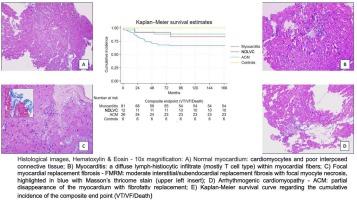
The aim of our study is to characterize the 3D-EAM substrate in patients with the same clinical presentation of unexplained complex VAs and NICM using CMR, three-dimensional electranatomic mapping (3D-EAM) in association with endomyocardial biopsy (EMB) and genetic screening, as a more precise and early diagnostic assessment may provide important subsequent prognostic impact. The study was designed as a prospective multi-center observational evaluation and the patient follow-up was scheduled at 6 months interval. We enrolled 125 patients distinct into four different group by complete diagnostic work-up: myocarditis, non-dilated left ventricular cardiomyopathy, arrhythmogenic cardiomyopathy and control group. The four groups were compared in terms of clinical, imaging and 3D-EAM data. At multivariate analysis sustained VT/VF on admission [HR: 3.64 (1.79–7.4), p < 0.001], total bipolar scar area of left and right ventricle detected by 3D-EAM [HR: 2.24 (1.13–4.49), p = 0.02], histological diagnosis of myocarditis by 3D-EAM guided endomyocardial biopsy (EBM) [HR: 2.79 (1.04–7.44), p = 0.01] were independent predictors of complex VAs or death at follow-up. 3D-EAM guided EMB represent not only a valid diagnostic tool to identify the arrhythmogenic substrate in patients with NICM and ventricular arrhythmic phenotype but also an important predictor of complex Vas at long term follow-up.
期刊介绍:
The International Journal of Cardiology is devoted to cardiology in the broadest sense. Both basic research and clinical papers can be submitted. The journal serves the interest of both practicing clinicians and researchers.
In addition to original papers, we are launching a range of new manuscript types, including Consensus and Position Papers, Systematic Reviews, Meta-analyses, and Short communications. Case reports are no longer acceptable. Controversial techniques, issues on health policy and social medicine are discussed and serve as useful tools for encouraging debate.



 京公网安备 11010802042870号
京ICP备2023020795号-1
京公网安备 11010802042870号
京ICP备2023020795号-1

 分享
分享
 求助内容:
求助内容: 应助结果提醒方式:
 扫码关注我们
