Hanna Schlegel, S Hartmann, S Kreikemeier, E Dalhoff, H Löwenheim, A Tropitzsch
{"title":"[Audiological outcome of bimodal CI users over time and depending on different influencing factors].","authors":"Hanna Schlegel, S Hartmann, S Kreikemeier, E Dalhoff, H Löwenheim, A Tropitzsch","doi":"10.1007/s00106-024-01508-w","DOIUrl":null,"url":null,"abstract":"<p><strong>Background: </strong>Hearing-impaired persons with asymmetric hearing loss and a unilateral indication for a cochlear implant (CI) generally benefit from a bimodal hearing solution. The influence of bimodal fitting on speech comprehension (SC) over time has not yet been sufficiently investigated. The present study examines the influence of bimodal fitting on SC in bimodally fitted CI users with postlingual deafness at least 36 months after implantation and analyzes possible influencing factors.</p><p><strong>Methods: </strong>Included in this retrospective longitudinal study were 54 bimodally fitted speech-competent CI users with at least 36 months of CI experience. Audiometric data of these CI users at predefined timepoints were compared.</p><p><strong>Results: </strong>The change in the results of the Freiburg monosyllabic test (FT) over 36 months was significant (p < 5%) for the deafness group at <10 years for both the 65 dB sound pressure level (SPL) and at 80 dB SPL and also significant for the deafness group ≥10 years for 65 dB SPL. In the Oldenburg sentence test (OlSa) there was a highly significant change (p < 0.1%) for S<sub>0</sub>, S<sub>0</sub>N<sub>0</sub>, and S<sub>0</sub>N<sub>CI</sub> configurations and a very significant change (p < 1%) for S<sub>0</sub>N<sub>HA</sub> (HA: hearing aid). Age at implantation as a possible influencing factor could not be confirmed in the FT. In contrast, the duration of deafness was a negative influencing factor for SC with CI in the FT, whereas a longer duration of deafness was associated with worse results in the FT. The degree of hearing loss in the ear fitted with an HA did not influence SC. The median bimodal benefit (here: difference in SC with bimodal fitting compared to unilateral HA fitting for FT at 65 dB SPL) was 10% over the total study period. For a median of 79% of the test subjects, the bimodal benefit was found over the entire period of 36 months.</p><p><strong>Conclusion: </strong>Over time, SC improves significantly with a CI for the bimodal test subjects. The investigated influencing factors (age, duration of deafness, and degree of hearing loss in the contralateral ear) support the indication for bimodal provision in accordance with the guideline in Germany for cochlear implantation-regardless of age, duration of deafness, and hearing ability of the contralateral ear.</p>","PeriodicalId":55052,"journal":{"name":"Hno","volume":" ","pages":"729-741"},"PeriodicalIF":1.3000,"publicationDate":"2024-10-01","publicationTypes":"Journal Article","fieldsOfStudy":null,"isOpenAccess":false,"openAccessPdf":"https://www.ncbi.nlm.nih.gov/pmc/articles/PMC11422442/pdf/","citationCount":"0","resultStr":null,"platform":"Semanticscholar","paperid":null,"PeriodicalName":"Hno","FirstCategoryId":"3","ListUrlMain":"https://doi.org/10.1007/s00106-024-01508-w","RegionNum":4,"RegionCategory":"医学","ArticlePicture":[],"TitleCN":null,"AbstractTextCN":null,"PMCID":null,"EPubDate":"2024/8/27 0:00:00","PubModel":"Epub","JCR":"Q4","JCRName":"OTORHINOLARYNGOLOGY","Score":null,"Total":0}
引用次数: 0
Abstract
Background: Hearing-impaired persons with asymmetric hearing loss and a unilateral indication for a cochlear implant (CI) generally benefit from a bimodal hearing solution. The influence of bimodal fitting on speech comprehension (SC) over time has not yet been sufficiently investigated. The present study examines the influence of bimodal fitting on SC in bimodally fitted CI users with postlingual deafness at least 36 months after implantation and analyzes possible influencing factors.
Methods: Included in this retrospective longitudinal study were 54 bimodally fitted speech-competent CI users with at least 36 months of CI experience. Audiometric data of these CI users at predefined timepoints were compared.
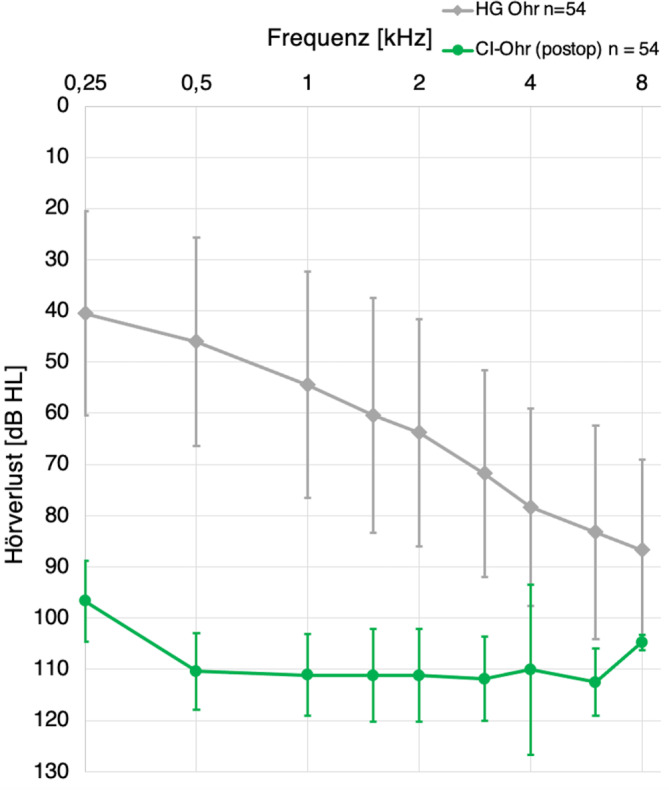
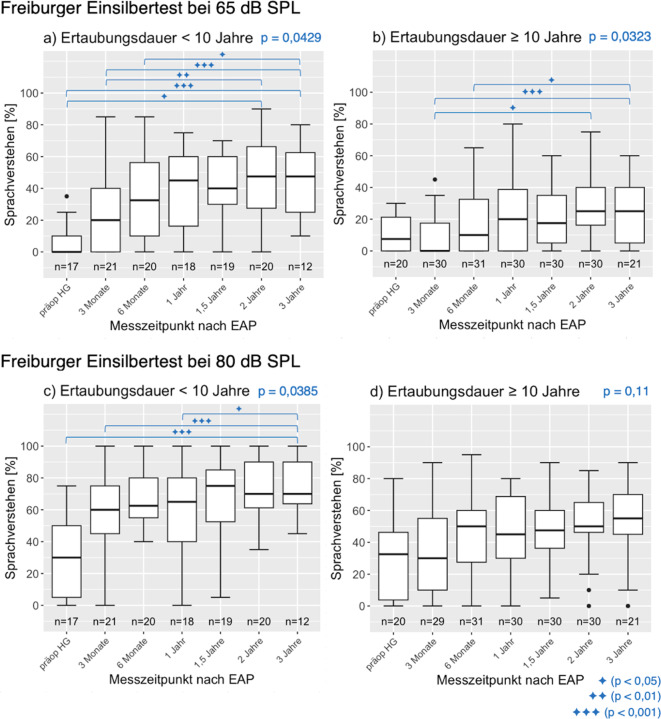
Results: The change in the results of the Freiburg monosyllabic test (FT) over 36 months was significant (p < 5%) for the deafness group at <10 years for both the 65 dB sound pressure level (SPL) and at 80 dB SPL and also significant for the deafness group ≥10 years for 65 dB SPL. In the Oldenburg sentence test (OlSa) there was a highly significant change (p < 0.1%) for S0, S0N0, and S0NCI configurations and a very significant change (p < 1%) for S0NHA (HA: hearing aid). Age at implantation as a possible influencing factor could not be confirmed in the FT. In contrast, the duration of deafness was a negative influencing factor for SC with CI in the FT, whereas a longer duration of deafness was associated with worse results in the FT. The degree of hearing loss in the ear fitted with an HA did not influence SC. The median bimodal benefit (here: difference in SC with bimodal fitting compared to unilateral HA fitting for FT at 65 dB SPL) was 10% over the total study period. For a median of 79% of the test subjects, the bimodal benefit was found over the entire period of 36 months.
Conclusion: Over time, SC improves significantly with a CI for the bimodal test subjects. The investigated influencing factors (age, duration of deafness, and degree of hearing loss in the contralateral ear) support the indication for bimodal provision in accordance with the guideline in Germany for cochlear implantation-regardless of age, duration of deafness, and hearing ability of the contralateral ear.
期刊介绍:
HNO is an internationally recognized journal and addresses all ENT specialists in practices and clinics dealing with all aspects of ENT medicine, e.g. prevention, diagnostic methods, complication management, modern therapy strategies and surgical procedures.
Review articles provide an overview on selected topics and offer the reader a summary of current findings from all fields of ENT medicine.
Freely submitted original papers allow the presentation of important clinical studies and serve the scientific exchange.
Case reports feature interesting cases and aim at optimizing diagnostic and therapeutic strategies.
Review articles under the rubric ''Continuing Medical Education'' present verified results of scientific research and their integration into daily practice.



 京公网安备 11010802042870号
京ICP备2023020795号-1
京公网安备 11010802042870号
京ICP备2023020795号-1

 分享
分享
 求助内容:
求助内容: 应助结果提醒方式:
 扫码关注我们
