Yuan Li , Feiyang Zhou , Wenli Song , Xiaodong Zhang , Jinglian Fan , Yong Han , Zhifeng Lei
{"title":"Ultrastrong, high plasticity, and softening-resistant refractory high-entropy alloy via stable isostructural coherent interfaces","authors":"Yuan Li , Feiyang Zhou , Wenli Song , Xiaodong Zhang , Jinglian Fan , Yong Han , Zhifeng Lei","doi":"10.1016/j.scriptamat.2024.116337","DOIUrl":null,"url":null,"abstract":"<div><p>Traditional approaches for improving the mechanical performance of alloys entail modifying interfaces, particularly grain boundaries, with elemental segregation or secondary phases. However, these methods face challenges in concurrently improving the strength, plasticity, and high-temperature softening resistance of alloys. Here, we uncovered that stable isostructural coherent interfaces effectively address these challenges. In the model body-centered cubic (BCC) MoTaVW refractory high-entropy alloy (RHEA) fabricated by mechanical alloying and spark plasma sintering, controlling the sintering temperature enhances the preferential segregation of W at interfaces. This results in a distinct BCC W-enriched nanolayer between micrometer-scale grains. This nanolayer facilitates dislocation slip and prevents grain growth, thereby improving both plasticity and resistance to high-temperature softening. Consequently, the MoTaVW RHEA featuring stable isostructural coherent interfaces achieves an ultrahigh yield strength of 1410 MPa and a plasticity of 22 % at ambient temperature. Even at 1200 °C, it maintains a yield strength of 575 MPa under hot compression.</p></div>","PeriodicalId":423,"journal":{"name":"Scripta Materialia","volume":"254 ","pages":"Article 116337"},"PeriodicalIF":5.6000,"publicationDate":"2025-01-01","publicationTypes":"Journal Article","fieldsOfStudy":null,"isOpenAccess":false,"openAccessPdf":"https://www.sciencedirect.com/science/article/pii/S1359646224003725/pdfft?md5=80b63750e8fc41974550ca98e6b2e816&pid=1-s2.0-S1359646224003725-main.pdf","citationCount":"0","resultStr":null,"platform":"Semanticscholar","paperid":null,"PeriodicalName":"Scripta Materialia","FirstCategoryId":"88","ListUrlMain":"https://www.sciencedirect.com/science/article/pii/S1359646224003725","RegionNum":2,"RegionCategory":"材料科学","ArticlePicture":[],"TitleCN":null,"AbstractTextCN":null,"PMCID":null,"EPubDate":"2024/8/26 0:00:00","PubModel":"Epub","JCR":"Q2","JCRName":"MATERIALS SCIENCE, MULTIDISCIPLINARY","Score":null,"Total":0}
引用次数: 0
Abstract
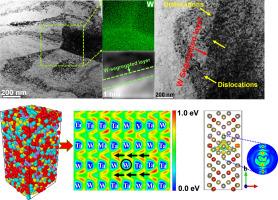
Traditional approaches for improving the mechanical performance of alloys entail modifying interfaces, particularly grain boundaries, with elemental segregation or secondary phases. However, these methods face challenges in concurrently improving the strength, plasticity, and high-temperature softening resistance of alloys. Here, we uncovered that stable isostructural coherent interfaces effectively address these challenges. In the model body-centered cubic (BCC) MoTaVW refractory high-entropy alloy (RHEA) fabricated by mechanical alloying and spark plasma sintering, controlling the sintering temperature enhances the preferential segregation of W at interfaces. This results in a distinct BCC W-enriched nanolayer between micrometer-scale grains. This nanolayer facilitates dislocation slip and prevents grain growth, thereby improving both plasticity and resistance to high-temperature softening. Consequently, the MoTaVW RHEA featuring stable isostructural coherent interfaces achieves an ultrahigh yield strength of 1410 MPa and a plasticity of 22 % at ambient temperature. Even at 1200 °C, it maintains a yield strength of 575 MPa under hot compression.
期刊介绍:
Scripta Materialia is a LETTERS journal of Acta Materialia, providing a forum for the rapid publication of short communications on the relationship between the structure and the properties of inorganic materials. The emphasis is on originality rather than incremental research. Short reports on the development of materials with novel or substantially improved properties are also welcomed. Emphasis is on either the functional or mechanical behavior of metals, ceramics and semiconductors at all length scales.



 京公网安备 11010802042870号
京ICP备2023020795号-1
京公网安备 11010802042870号
京ICP备2023020795号-1

 分享
分享
 求助内容:
求助内容: 应助结果提醒方式:
 扫码关注我们
