Yingyue Zhang , Dan Xiang , Jie Tang , Chuanning Peng , Siqi Chen , Siqi Huang , Qi Wen , Lin Liu , Wenliang Xiang , Qing Zhang , Ting Cai , Xuan Yu
{"title":"Expression of a novel hydrolase MhpC in Brevibacillus parabrevis BCP-09 and its characteristics for degrading synthetic pyrethroids","authors":"Yingyue Zhang , Dan Xiang , Jie Tang , Chuanning Peng , Siqi Chen , Siqi Huang , Qi Wen , Lin Liu , Wenliang Xiang , Qing Zhang , Ting Cai , Xuan Yu","doi":"10.1016/j.pestbp.2024.106100","DOIUrl":null,"url":null,"abstract":"<div><p>Synthetic pyrethroids are widely used insecticides which may cause chronic diseases in non-target organisms upon long-term exposure. Microbial degradation offers a reliable method to remove them from the environment. This study focused on <em>Brevibacillus parabrevis</em> BCP-09 and its enzymes for degrading pyrethroids. The predicted deltamethrin-degrading genes <em>phnA</em> and <em>mhpC</em> were used to construct recombinant plasmids. These plasmids, introduced into <em>Escherichia coli</em> BL21(DE3) cells and induced with L-arabinose. The results indicated that the intracellular crude enzyme efficiently degraded deltamethrin by 98.8 %, β-cypermethrin by 94.84 %, and cyfluthrin by 73.52 % within 24 h. The hydrolytic enzyme MhpC possesses a catalytic triad Ser/His/Asp and a typical “Gly-X-Ser-X-Gly” conservative sequence of the esterase family. Co-cultivation of induced <em>E. coli</em> PhnA and <em>E. coli</em> MhpC resulted in degradation rates of 41.44 ± 3.55 % and 60.30 ± 4.55 %, respectively, for deltamethrin after 7 d. This study states that the degrading enzymes from <em>B. parabrevis</em> BCP-09 are an effective method for the degradation of pyrethroids, providing available enzyme resources for food safety and environmental protection.</p></div>","PeriodicalId":19828,"journal":{"name":"Pesticide Biochemistry and Physiology","volume":"204 ","pages":"Article 106100"},"PeriodicalIF":4.0000,"publicationDate":"2024-09-01","publicationTypes":"Journal Article","fieldsOfStudy":null,"isOpenAccess":false,"openAccessPdf":"","citationCount":"0","resultStr":null,"platform":"Semanticscholar","paperid":null,"PeriodicalName":"Pesticide Biochemistry and Physiology","FirstCategoryId":"97","ListUrlMain":"https://www.sciencedirect.com/science/article/pii/S004835752400333X","RegionNum":1,"RegionCategory":"农林科学","ArticlePicture":[],"TitleCN":null,"AbstractTextCN":null,"PMCID":null,"EPubDate":"2024/8/26 0:00:00","PubModel":"Epub","JCR":"Q2","JCRName":"BIOCHEMISTRY & MOLECULAR BIOLOGY","Score":null,"Total":0}
引用次数: 0
Abstract
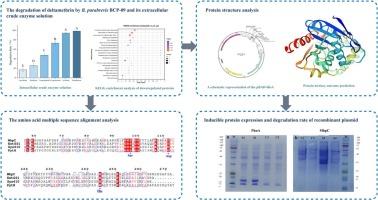
Synthetic pyrethroids are widely used insecticides which may cause chronic diseases in non-target organisms upon long-term exposure. Microbial degradation offers a reliable method to remove them from the environment. This study focused on Brevibacillus parabrevis BCP-09 and its enzymes for degrading pyrethroids. The predicted deltamethrin-degrading genes phnA and mhpC were used to construct recombinant plasmids. These plasmids, introduced into Escherichia coli BL21(DE3) cells and induced with L-arabinose. The results indicated that the intracellular crude enzyme efficiently degraded deltamethrin by 98.8 %, β-cypermethrin by 94.84 %, and cyfluthrin by 73.52 % within 24 h. The hydrolytic enzyme MhpC possesses a catalytic triad Ser/His/Asp and a typical “Gly-X-Ser-X-Gly” conservative sequence of the esterase family. Co-cultivation of induced E. coli PhnA and E. coli MhpC resulted in degradation rates of 41.44 ± 3.55 % and 60.30 ± 4.55 %, respectively, for deltamethrin after 7 d. This study states that the degrading enzymes from B. parabrevis BCP-09 are an effective method for the degradation of pyrethroids, providing available enzyme resources for food safety and environmental protection.
期刊介绍:
Pesticide Biochemistry and Physiology publishes original scientific articles pertaining to the mode of action of plant protection agents such as insecticides, fungicides, herbicides, and similar compounds, including nonlethal pest control agents, biosynthesis of pheromones, hormones, and plant resistance agents. Manuscripts may include a biochemical, physiological, or molecular study for an understanding of comparative toxicology or selective toxicity of both target and nontarget organisms. Particular interest will be given to studies on the molecular biology of pest control, toxicology, and pesticide resistance.
Research Areas Emphasized Include the Biochemistry and Physiology of:
• Comparative toxicity
• Mode of action
• Pathophysiology
• Plant growth regulators
• Resistance
• Other effects of pesticides on both parasites and hosts.



 京公网安备 11010802042870号
京ICP备2023020795号-1
京公网安备 11010802042870号
京ICP备2023020795号-1

 分享
分享
 求助内容:
求助内容: 应助结果提醒方式:
 扫码关注我们
