{"title":"Utilization of Infrared Drying as Alternative to Spray- and Freeze-Drying for Low Energy Consumption in the Production of Powdered Gelatin.","authors":"Ümran Cansu","doi":"10.3390/gels10080522","DOIUrl":null,"url":null,"abstract":"<p><p>This study evaluated possible utilization of infrared drying (ID) as an alternative to spray- (SD) and freeze-drying (FD) for fish skin-derived gelatins. Physical, functional, thermal, and spectroscopic analyses were conducted for characterization of the resulting gelatin powders. Energy consumption for the applied drying methods were 3.41, 8.46 and 25.33 kWh/kg for ID, SD and FD respectively, indicating that ID had the lowest energy consumption among the studied methods. Gel strength, on the other hand, was lower (398.4 g) in infrared-dried gelatin (ID-FG) compared to that (454.9 g) of freeze-dried gelatin (FD-FG) and that (472.7 g) of spray-dried gelatin (SD-FG). TGA curves indicated that ID-FG showed more resilience to thermal degradation. SDS-PAGE and UV-Vis spectra indicated that slight degradation was observed in the β-configuration of ID-FG. ID-FG and SD-FG gelatins had the highest water holding capacity (WHC), protein solubility and transparency values compared to that of FD-FG. Morphological structures of the samples were quite different as shown by SEM visuals. Ultimately, the findings showed that infrared drying may be a promising alternative for gelatin processing, maintaining product quality and supporting sustainable practices in food and other industries.</p>","PeriodicalId":12506,"journal":{"name":"Gels","volume":"10 8","pages":""},"PeriodicalIF":5.3000,"publicationDate":"2024-08-09","publicationTypes":"Journal Article","fieldsOfStudy":null,"isOpenAccess":false,"openAccessPdf":"https://www.ncbi.nlm.nih.gov/pmc/articles/PMC11353604/pdf/","citationCount":"0","resultStr":null,"platform":"Semanticscholar","paperid":null,"PeriodicalName":"Gels","FirstCategoryId":"92","ListUrlMain":"https://doi.org/10.3390/gels10080522","RegionNum":3,"RegionCategory":"化学","ArticlePicture":[],"TitleCN":null,"AbstractTextCN":null,"PMCID":null,"EPubDate":"","PubModel":"","JCR":"Q1","JCRName":"POLYMER SCIENCE","Score":null,"Total":0}
引用次数: 0
Abstract
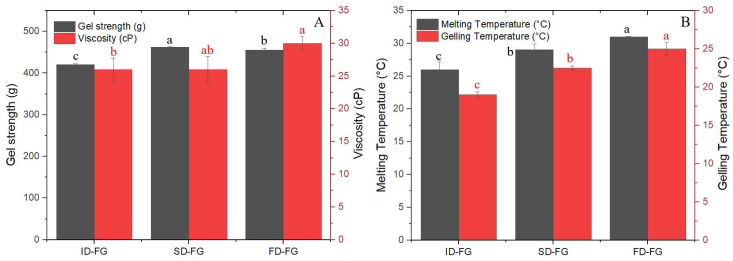
This study evaluated possible utilization of infrared drying (ID) as an alternative to spray- (SD) and freeze-drying (FD) for fish skin-derived gelatins. Physical, functional, thermal, and spectroscopic analyses were conducted for characterization of the resulting gelatin powders. Energy consumption for the applied drying methods were 3.41, 8.46 and 25.33 kWh/kg for ID, SD and FD respectively, indicating that ID had the lowest energy consumption among the studied methods. Gel strength, on the other hand, was lower (398.4 g) in infrared-dried gelatin (ID-FG) compared to that (454.9 g) of freeze-dried gelatin (FD-FG) and that (472.7 g) of spray-dried gelatin (SD-FG). TGA curves indicated that ID-FG showed more resilience to thermal degradation. SDS-PAGE and UV-Vis spectra indicated that slight degradation was observed in the β-configuration of ID-FG. ID-FG and SD-FG gelatins had the highest water holding capacity (WHC), protein solubility and transparency values compared to that of FD-FG. Morphological structures of the samples were quite different as shown by SEM visuals. Ultimately, the findings showed that infrared drying may be a promising alternative for gelatin processing, maintaining product quality and supporting sustainable practices in food and other industries.
期刊介绍:
The journal Gels (ISSN 2310-2861) is an international, open access journal on physical (supramolecular) and chemical gel-based materials. Our aim is to encourage scientists to publish their experimental and theoretical results in as much detail as possible. Therefore, there is no restriction on the maximum length of the papers, and full experimental details must be provided so that the results can be reproduced. Short communications, full research papers and review papers are accepted formats for the preparation of the manuscripts.
Gels aims to serve as a reference journal with a focus on gel materials for researchers working in both academia and industry. Therefore, papers demonstrating practical applications of these materials are particularly welcome. Occasionally, invited contributions (i.e., original research and review articles) on emerging issues and high-tech applications of gels are published as special issues.





 京公网安备 11010802042870号
京ICP备2023020795号-1
京公网安备 11010802042870号
京ICP备2023020795号-1

 分享
分享
 求助内容:
求助内容: 应助结果提醒方式:
 扫码关注我们
