Blackcurrant Pomace Extract as a Natural Antioxidant in Vienna Sausages Reformulated by Replacement of Pork Backfat with Emulsion Gels Based on High Oleic Sunflower and Flaxseed Oils.
Nicoleta Cîrstea Lazăr, Violeta Nour, Alexandru Radu Corbu, Georgiana Gabriela Codină
{"title":"Blackcurrant Pomace Extract as a Natural Antioxidant in Vienna Sausages Reformulated by Replacement of Pork Backfat with Emulsion Gels Based on High Oleic Sunflower and Flaxseed Oils.","authors":"Nicoleta Cîrstea Lazăr, Violeta Nour, Alexandru Radu Corbu, Georgiana Gabriela Codină","doi":"10.3390/gels10080534","DOIUrl":null,"url":null,"abstract":"<p><p>The incorporation of a blackcurrant pomace extract (BPE) at 2.5%, 5.0% and 10.0% into an emulsion gel based on high oleic sunflower and linseed oils was examined in order to obtain a functional ingredient to be used as a pork backfat replacer in Vienna sausages. The replacement of the pork backfat with the control emulsion gel reduced the cooking loss but negatively affected the color by decreasing L* and a* values as compared with the traditional product. A decrease in the n-6/n-3 ratio from 10.99 to around 1.54 (by 7 times) was achieved through reformulation, while the PUFA/SFA ratio increased from 0.49 to 1.09. The incorporation of BPE did not have a major impact on the fatty acid profile and improved color by increasing redness, but negatively affected the texture by increasing hardness, gumminess and share force as compared with the sausages reformulated without extract. BPE reduced the pH and the thermal stability of the emulsion gels, increased cooking loss and decreased moisture retention in sausages. BPE increased the oxidative stability of Vienna sausages enriched in polyunsaturated fatty acids; however, the incorporation of BPE into the emulsion gels above 5% affected the sensory scores for appearance, texture and general acceptability of the reformulated sausages.</p>","PeriodicalId":12506,"journal":{"name":"Gels","volume":"10 8","pages":""},"PeriodicalIF":5.3000,"publicationDate":"2024-08-13","publicationTypes":"Journal Article","fieldsOfStudy":null,"isOpenAccess":false,"openAccessPdf":"https://www.ncbi.nlm.nih.gov/pmc/articles/PMC11487386/pdf/","citationCount":"0","resultStr":null,"platform":"Semanticscholar","paperid":null,"PeriodicalName":"Gels","FirstCategoryId":"92","ListUrlMain":"https://doi.org/10.3390/gels10080534","RegionNum":3,"RegionCategory":"化学","ArticlePicture":[],"TitleCN":null,"AbstractTextCN":null,"PMCID":null,"EPubDate":"","PubModel":"","JCR":"Q1","JCRName":"POLYMER SCIENCE","Score":null,"Total":0}
引用次数: 0
Abstract
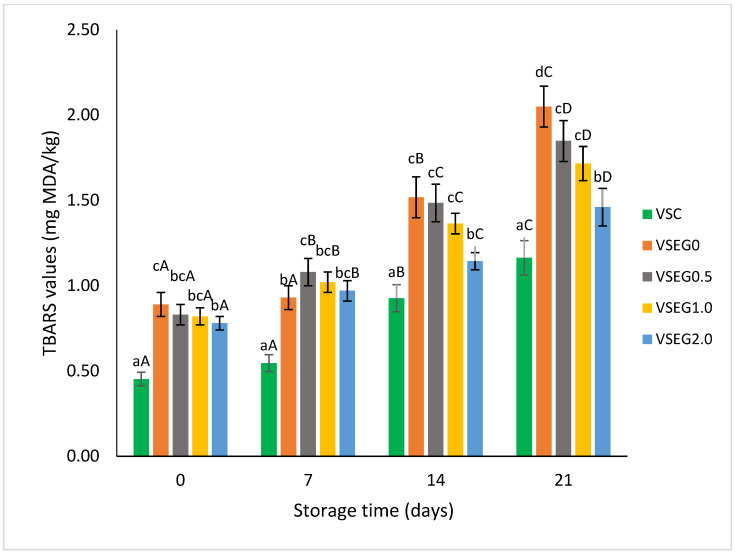
The incorporation of a blackcurrant pomace extract (BPE) at 2.5%, 5.0% and 10.0% into an emulsion gel based on high oleic sunflower and linseed oils was examined in order to obtain a functional ingredient to be used as a pork backfat replacer in Vienna sausages. The replacement of the pork backfat with the control emulsion gel reduced the cooking loss but negatively affected the color by decreasing L* and a* values as compared with the traditional product. A decrease in the n-6/n-3 ratio from 10.99 to around 1.54 (by 7 times) was achieved through reformulation, while the PUFA/SFA ratio increased from 0.49 to 1.09. The incorporation of BPE did not have a major impact on the fatty acid profile and improved color by increasing redness, but negatively affected the texture by increasing hardness, gumminess and share force as compared with the sausages reformulated without extract. BPE reduced the pH and the thermal stability of the emulsion gels, increased cooking loss and decreased moisture retention in sausages. BPE increased the oxidative stability of Vienna sausages enriched in polyunsaturated fatty acids; however, the incorporation of BPE into the emulsion gels above 5% affected the sensory scores for appearance, texture and general acceptability of the reformulated sausages.
期刊介绍:
The journal Gels (ISSN 2310-2861) is an international, open access journal on physical (supramolecular) and chemical gel-based materials. Our aim is to encourage scientists to publish their experimental and theoretical results in as much detail as possible. Therefore, there is no restriction on the maximum length of the papers, and full experimental details must be provided so that the results can be reproduced. Short communications, full research papers and review papers are accepted formats for the preparation of the manuscripts.
Gels aims to serve as a reference journal with a focus on gel materials for researchers working in both academia and industry. Therefore, papers demonstrating practical applications of these materials are particularly welcome. Occasionally, invited contributions (i.e., original research and review articles) on emerging issues and high-tech applications of gels are published as special issues.




 京公网安备 11010802042870号
京ICP备2023020795号-1
京公网安备 11010802042870号
京ICP备2023020795号-1

 分享
分享
 求助内容:
求助内容: 应助结果提醒方式:
 扫码关注我们
