{"title":"Solar interfacial evaporation systems with multi-field synergies boost water purification and blue energy harvesting technologies","authors":"Baichun Wang, Xinyu Huang, Zhe Liu, Jintai Zhang, Chuyun Wei, Bohan Cai, Pengchao Xie and Aijiao Zhou","doi":"10.1039/D3EE03922F","DOIUrl":null,"url":null,"abstract":"<p >The escalating water and energy crises have led to attempts at combining purifying water and blue energy harvesting using solar interfacial evaporation systems (SIESs) based on hybrid systems. The thermally-localized multi-stage recycling and water–energy co-generation devices that have been proposed have a solar-to-vapor efficiency exceeding the thermodynamic limit and achieve comprehensive energy utilization, harvesting sustainable gains. However, that breakthroughs in solar energy efficiency does not effectively mobilize the energy contained in water and its substance, and the need to explore practical application potential in diverse water scenarios. Actual high-entropy water contains thermal and chemical energy and extracting this <em>in situ</em> energy and feeding back to SIES through a photo–thermal–electric synergy mechanism could lead to a high-performance energy cycle. From this perspective, this study reviewed SIES research across light, thermal and hydrochemical fields and the corresponding energy units and then quantified the gain effect. A multi-field synergy concept is proposed to regulate the relationships between water molecules, electrons, and ions further exploring the possibilities for improving water yield, water quality, fuel and power. This study provides new insights into multi-disciplinary and multi-field water treatment technologies that are based on sustainable energy sources.</p>","PeriodicalId":72,"journal":{"name":"Energy & Environmental Science","volume":" 20","pages":" 7600-7626"},"PeriodicalIF":30.8000,"publicationDate":"2024-08-28","publicationTypes":"Journal Article","fieldsOfStudy":null,"isOpenAccess":false,"openAccessPdf":"","citationCount":"0","resultStr":null,"platform":"Semanticscholar","paperid":null,"PeriodicalName":"Energy & Environmental Science","FirstCategoryId":"88","ListUrlMain":"https://pubs.rsc.org/en/content/articlelanding/2024/ee/d3ee03922f","RegionNum":1,"RegionCategory":"材料科学","ArticlePicture":[],"TitleCN":null,"AbstractTextCN":null,"PMCID":null,"EPubDate":"","PubModel":"","JCR":"Q1","JCRName":"CHEMISTRY, MULTIDISCIPLINARY","Score":null,"Total":0}
引用次数: 0
Abstract
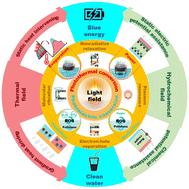
The escalating water and energy crises have led to attempts at combining purifying water and blue energy harvesting using solar interfacial evaporation systems (SIESs) based on hybrid systems. The thermally-localized multi-stage recycling and water–energy co-generation devices that have been proposed have a solar-to-vapor efficiency exceeding the thermodynamic limit and achieve comprehensive energy utilization, harvesting sustainable gains. However, that breakthroughs in solar energy efficiency does not effectively mobilize the energy contained in water and its substance, and the need to explore practical application potential in diverse water scenarios. Actual high-entropy water contains thermal and chemical energy and extracting this in situ energy and feeding back to SIES through a photo–thermal–electric synergy mechanism could lead to a high-performance energy cycle. From this perspective, this study reviewed SIES research across light, thermal and hydrochemical fields and the corresponding energy units and then quantified the gain effect. A multi-field synergy concept is proposed to regulate the relationships between water molecules, electrons, and ions further exploring the possibilities for improving water yield, water quality, fuel and power. This study provides new insights into multi-disciplinary and multi-field water treatment technologies that are based on sustainable energy sources.
期刊介绍:
Energy & Environmental Science, a peer-reviewed scientific journal, publishes original research and review articles covering interdisciplinary topics in the (bio)chemical and (bio)physical sciences, as well as chemical engineering disciplines. Published monthly by the Royal Society of Chemistry (RSC), a not-for-profit publisher, Energy & Environmental Science is recognized as a leading journal. It boasts an impressive impact factor of 8.500 as of 2009, ranking 8th among 140 journals in the category "Chemistry, Multidisciplinary," second among 71 journals in "Energy & Fuels," second among 128 journals in "Engineering, Chemical," and first among 181 scientific journals in "Environmental Sciences."
Energy & Environmental Science publishes various types of articles, including Research Papers (original scientific work), Review Articles, Perspectives, and Minireviews (feature review-type articles of broad interest), Communications (original scientific work of an urgent nature), Opinions (personal, often speculative viewpoints or hypotheses on current topics), and Analysis Articles (in-depth examination of energy-related issues).



 京公网安备 11010802042870号
京ICP备2023020795号-1
京公网安备 11010802042870号
京ICP备2023020795号-1

 分享
分享
 求助内容:
求助内容: 应助结果提醒方式:
 扫码关注我们
