A sense of urgency: Trait impulsivity in co-occurring bipolar and alcohol use disorder

IF 2.7 Q2 SUBSTANCE ABUSE Alcohol (Hanover, York County, Pa.) Pub Date : 2024-08-28 DOI:10.1111/acer.15430
Kaiya Brand, William Mellick, Bryan Tolliver, James J. Prisciandaro
{"title":"A sense of urgency: Trait impulsivity in co-occurring bipolar and alcohol use disorder","authors":"Kaiya Brand,&nbsp;William Mellick,&nbsp;Bryan Tolliver,&nbsp;James J. Prisciandaro","doi":"10.1111/acer.15430","DOIUrl":null,"url":null,"abstract":"<div>\n \n \n <section>\n \n <h3> Background</h3>\n \n <p>Bipolar disorder (BD) and alcohol use disorder (AUD) often co-occur, with BD + AUD characterized by higher levels of impulsivity relative to either disorder alone. Emotional facets of impulsivity (e.g., “urgency,” measured by the UPPS-P), however, remain underexplored in this population and could have distinct associations with clinical correlates.</p>\n </section>\n \n <section>\n \n <h3> Methods</h3>\n \n <p>This cross-sectional study used a two-by-two (BDxAD) factorial design, including groups with BD + AD (<i>n</i> = 28), BD (<i>n</i> = 29), AD (<i>n</i> = 28), and healthy controls (HC) (<i>n</i> = 27), to identify between-group differences among the five subscales of the UPPS-P. Associations of UPPS-P subscales with Barratt Impulsiveness Scale (BIS) total scores and clinical variables of interest were also examined.</p>\n </section>\n \n <section>\n \n <h3> Results</h3>\n \n <p>BD + AD had the highest scores for every UPPS-P subscale but Sensation Seeking, with the Positive and Negative Urgency subscales having the largest main effects for both BD and AD. BIS-11 total scores were most correlated with the urgency subscales of the UPPS-P. Negative Urgency was found to be uniquely relevant to clinical measures in the BD + AD group. Rapid cycling was associated with both urgency subscales and BIS-11 scores, and the Alcohol Dependence Scale was most correlated with the Premeditation subscale.</p>\n </section>\n \n <section>\n \n <h3> Limitations</h3>\n \n <p>Cross sectional design and predominantly white sample.</p>\n </section>\n \n <section>\n \n <h3> Conclusions</h3>\n \n <p>Unlike the BIS-11, UPPS-P is able to distinguish emotional from nonemotional facets of impulsivity, something especially relevant to people with co-occurring BD + AD, where fluid emotionality is a key part of symptom presentation. For this reason, the UPPS-P should be utilized in future studies and clinical settings measuring trait impulsivity in this population.</p>\n </section>\n </div>","PeriodicalId":72145,"journal":{"name":"Alcohol (Hanover, York County, Pa.)","volume":"48 10","pages":"1929-1940"},"PeriodicalIF":2.7000,"publicationDate":"2024-08-28","publicationTypes":"Journal Article","fieldsOfStudy":null,"isOpenAccess":false,"openAccessPdf":"","citationCount":"0","resultStr":null,"platform":"Semanticscholar","paperid":null,"PeriodicalName":"Alcohol (Hanover, York County, Pa.)","FirstCategoryId":"1085","ListUrlMain":"https://onlinelibrary.wiley.com/doi/10.1111/acer.15430","RegionNum":0,"RegionCategory":null,"ArticlePicture":[],"TitleCN":null,"AbstractTextCN":null,"PMCID":null,"EPubDate":"","PubModel":"","JCR":"Q2","JCRName":"SUBSTANCE ABUSE","Score":null,"Total":0}
引用次数: 0

Abstract

Background

Bipolar disorder (BD) and alcohol use disorder (AUD) often co-occur, with BD + AUD characterized by higher levels of impulsivity relative to either disorder alone. Emotional facets of impulsivity (e.g., “urgency,” measured by the UPPS-P), however, remain underexplored in this population and could have distinct associations with clinical correlates.

Methods

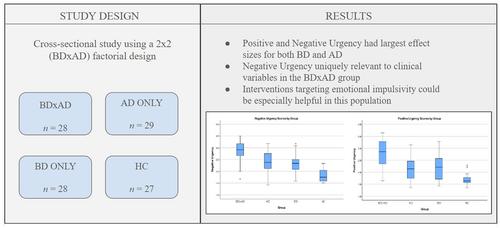
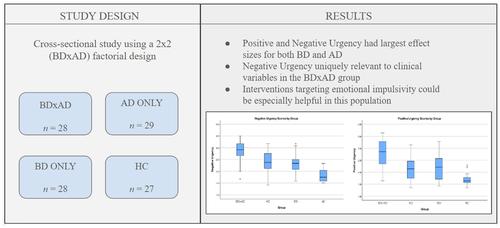
This cross-sectional study used a two-by-two (BDxAD) factorial design, including groups with BD + AD (n = 28), BD (n = 29), AD (n = 28), and healthy controls (HC) (n = 27), to identify between-group differences among the five subscales of the UPPS-P. Associations of UPPS-P subscales with Barratt Impulsiveness Scale (BIS) total scores and clinical variables of interest were also examined.

Results

BD + AD had the highest scores for every UPPS-P subscale but Sensation Seeking, with the Positive and Negative Urgency subscales having the largest main effects for both BD and AD. BIS-11 total scores were most correlated with the urgency subscales of the UPPS-P. Negative Urgency was found to be uniquely relevant to clinical measures in the BD + AD group. Rapid cycling was associated with both urgency subscales and BIS-11 scores, and the Alcohol Dependence Scale was most correlated with the Premeditation subscale.

Limitations

Cross sectional design and predominantly white sample.

Conclusions

Unlike the BIS-11, UPPS-P is able to distinguish emotional from nonemotional facets of impulsivity, something especially relevant to people with co-occurring BD + AD, where fluid emotionality is a key part of symptom presentation. For this reason, the UPPS-P should be utilized in future studies and clinical settings measuring trait impulsivity in this population.
Abstract Image

Abstract Image

查看原文
分享 分享
微信好友 朋友圈 QQ好友 复制链接
本刊更多论文
紧迫感:双相情感障碍和酒精使用障碍共存时的特质冲动。
背景:双相情感障碍(BD)和酒精使用障碍(AUD)经常同时存在,BD + AUD的特征是冲动性比单独存在的任何一种障碍都要高。然而,在这一人群中,冲动的情绪方面(如用 UPPS-P 测量的 "紧迫感")仍未得到充分探索,而且可能与临床相关性有不同的联系:这项横断面研究采用了二乘二(BDxAD)因子设计,包括BD + AD组(n = 28)、BD组(n = 29)、AD组(n = 28)和健康对照组(HC)(n = 27),以确定UPPS-P五个分量表之间的组间差异。此外,还研究了UPPS-P各分量表与巴拉特冲动量表(BIS)总分及相关临床变量的关系:除 "感觉寻求 "外,BD + AD 在 UPPS-P 各分量表中的得分均为最高,其中 "积极紧迫感 "和 "消极紧迫感 "分量表对 BD 和 AD 的主效应最大。BIS-11 总分与 UPPS-P 的紧迫感分量表的相关性最大。在 BD + AD 组中,阴性紧迫感与临床测量结果具有独特的相关性。快速循环与紧迫感分量表和BIS-11评分都有关联,酒精依赖量表与预谋分量表的相关性最大:局限性:横断面设计,样本主要为白人:与BIS-11不同,UPPS-P能够区分冲动的情绪和非情绪方面,这与BD+AD并发症患者尤其相关,因为情绪多变是症状表现的关键部分。因此,UPPS-P应在未来的研究和临床环境中用于测量这类人群的特质冲动性。
本文章由计算机程序翻译,如有差异,请以英文原文为准。
求助全文
约1分钟内获得全文 去求助
来源期刊
CiteScore
5.40
自引率
0.00%
发文量
0
期刊最新文献
The 10-year stability of three subscale scores of the Self-Report of the Effects of Alcohol measure and their relationship to changes in drinking quantities over the same period. Correction to "Effects of prenatal alcohol exposure on cognitive and behavioral development: Findings from a hierarchical meta-analysis of data from six prospective longitudinal U.S. cohorts". Dpp6 knockout mice exhibit increased ethanol conditioned place preference and acute ethanol-induced anxiolytic behavior. Aquaporin 9 regulates acetaldehyde uptake, alcohol-induced liver injury, and drinking behavior. The relationship between alcohol use disorder, measures of cognitive decline, and Alzheimer disease biomarkers in middle aged and older adults.
×
引用
GB/T 7714-2015
复制
MLA
复制
APA
复制
导出至
BibTeX EndNote RefMan NoteFirst NoteExpress
×
×
提示
您的信息不完整,为了账户安全,请先补充。
现在去补充
×
提示
您因"违规操作"
具体请查看互助需知
我知道了
×
提示
现在去查看 取消
×
提示
确定
0
微信
客服QQ
Book学术公众号 扫码关注我们
反馈
×
意见反馈
请填写您的意见或建议
请填写您的手机或邮箱
已复制链接
已复制链接
快去分享给好友吧!
我知道了
×
扫码分享
扫码分享
Book学术官方微信
Book学术文献互助
Book学术文献互助群
群 号:604180095
Book学术
文献互助 智能选刊 最新文献 互助须知 联系我们:info@booksci.cn
Book学术提供免费学术资源搜索服务,方便国内外学者检索中英文文献。致力于提供最便捷和优质的服务体验。
Copyright © 2023 Book学术 All rights reserved.
ghs 京公网安备 11010802042870号 京ICP备2023020795号-1






