Raul De Lucas MD, PhD, Helena Martínez MSc, Carlos Nieto MSc, Carlos Ruiz-Alonso MSc, Rafael Bermejo MD, Nerea Carrón MSc, Sergio Garcia-Segura PhD, Pedro Gonzalez-Torres PhD, David Palacios-Martínez MD, Aurora Guerra-Tapia MD, PhD, Lola Bou MD, Montse Pérez MD, PhD
{"title":"New clinical approach in facial mild–moderate acne: Re-stabilization of skin microbiota balance with a topical biotechnological phytocomplex","authors":"Raul De Lucas MD, PhD, Helena Martínez MSc, Carlos Nieto MSc, Carlos Ruiz-Alonso MSc, Rafael Bermejo MD, Nerea Carrón MSc, Sergio Garcia-Segura PhD, Pedro Gonzalez-Torres PhD, David Palacios-Martínez MD, Aurora Guerra-Tapia MD, PhD, Lola Bou MD, Montse Pérez MD, PhD","doi":"10.1111/jocd.16452","DOIUrl":null,"url":null,"abstract":"<div>\n \n \n <section>\n \n <h3> Objectives</h3>\n \n <p>Dysbiosis of the skin microbiota has been identified as a key factor in the development of acne. This study was aimed to evaluate the effect of a facial cream gel containing a biotechnological phytocomplex, niacinamide and succinic acid on the bacterial diversity of subjects with mild–moderate acne and its clinical benefits due to microbiota changes.</p>\n </section>\n \n <section>\n \n <h3> Methods</h3>\n \n <p>Open-label, clinical study in 44 subjects with mild–moderate acne treated with a facial cream gel for 8 weeks. Bacterial diversity was analyzed by <i>16S rRNA</i> gene sequencing of skin samples. Clinical effects were evaluated using the IGA acne severity scale, biometric measurements, and safety.</p>\n </section>\n \n <section>\n \n <h3> Results</h3>\n \n <p>After 56 days of product's use, an increase in alpha and beta diversity was found (<i>p</i> < 0.01), with a decrease in the relative abundance of <i>C. acnes</i> (48.99% vs. 38.83%, <i>p</i> < 0.001). Regarding clinical results, a decrease in acne severity on the IGA scale (27.33%, <i>p</i> < 0.001), number of non-inflammatory and inflammatory lesions (respectively: 31.12%, <i>p</i> = 0.05; 47.27%, <i>p</i> < 0.001), amount of sebum (89.00%, <i>p</i> < 0.01) and erythema (15.35%, <i>p</i> < 0.01), was found. [Correction added on 19 September 2024, after first online publication: In the preceding sentence, “42.27%” has been changed to “47.27%” in this version.] Responder analysis of the IGA score showed that 61.36% of patients improved by at least one point at day 56. The product was well tolerated throughout the study.</p>\n </section>\n \n <section>\n \n <h3> Conclusions</h3>\n \n <p>The use of the facial cream gel on skin was effective in rebalancing the microbiota, inhibiting biofilm formation and other virulence factors, reducing the number of mild–moderate acne lesions and sebum secretion, and consequently improving acne's severity.</p>\n </section>\n </div>","PeriodicalId":15546,"journal":{"name":"Journal of Cosmetic Dermatology","volume":"23 11","pages":"3616-3627"},"PeriodicalIF":2.5000,"publicationDate":"2024-08-28","publicationTypes":"Journal Article","fieldsOfStudy":null,"isOpenAccess":false,"openAccessPdf":"https://onlinelibrary.wiley.com/doi/epdf/10.1111/jocd.16452","citationCount":"0","resultStr":null,"platform":"Semanticscholar","paperid":null,"PeriodicalName":"Journal of Cosmetic Dermatology","FirstCategoryId":"3","ListUrlMain":"https://onlinelibrary.wiley.com/doi/10.1111/jocd.16452","RegionNum":4,"RegionCategory":"医学","ArticlePicture":[],"TitleCN":null,"AbstractTextCN":null,"PMCID":null,"EPubDate":"","PubModel":"","JCR":"Q2","JCRName":"DERMATOLOGY","Score":null,"Total":0}
引用次数: 0
Abstract
Objectives
Dysbiosis of the skin microbiota has been identified as a key factor in the development of acne. This study was aimed to evaluate the effect of a facial cream gel containing a biotechnological phytocomplex, niacinamide and succinic acid on the bacterial diversity of subjects with mild–moderate acne and its clinical benefits due to microbiota changes.
Methods
Open-label, clinical study in 44 subjects with mild–moderate acne treated with a facial cream gel for 8 weeks. Bacterial diversity was analyzed by 16S rRNA gene sequencing of skin samples. Clinical effects were evaluated using the IGA acne severity scale, biometric measurements, and safety.
Results
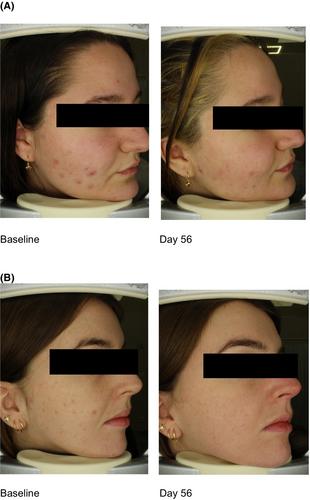
After 56 days of product's use, an increase in alpha and beta diversity was found (p < 0.01), with a decrease in the relative abundance of C. acnes (48.99% vs. 38.83%, p < 0.001). Regarding clinical results, a decrease in acne severity on the IGA scale (27.33%, p < 0.001), number of non-inflammatory and inflammatory lesions (respectively: 31.12%, p = 0.05; 47.27%, p < 0.001), amount of sebum (89.00%, p < 0.01) and erythema (15.35%, p < 0.01), was found. [Correction added on 19 September 2024, after first online publication: In the preceding sentence, “42.27%” has been changed to “47.27%” in this version.] Responder analysis of the IGA score showed that 61.36% of patients improved by at least one point at day 56. The product was well tolerated throughout the study.
Conclusions
The use of the facial cream gel on skin was effective in rebalancing the microbiota, inhibiting biofilm formation and other virulence factors, reducing the number of mild–moderate acne lesions and sebum secretion, and consequently improving acne's severity.
期刊介绍:
The Journal of Cosmetic Dermatology publishes high quality, peer-reviewed articles on all aspects of cosmetic dermatology with the aim to foster the highest standards of patient care in cosmetic dermatology. Published quarterly, the Journal of Cosmetic Dermatology facilitates continuing professional development and provides a forum for the exchange of scientific research and innovative techniques.
The scope of coverage includes, but will not be limited to: healthy skin; skin maintenance; ageing skin; photodamage and photoprotection; rejuvenation; biochemistry, endocrinology and neuroimmunology of healthy skin; imaging; skin measurement; quality of life; skin types; sensitive skin; rosacea and acne; sebum; sweat; fat; phlebology; hair conservation, restoration and removal; nails and nail surgery; pigment; psychological and medicolegal issues; retinoids; cosmetic chemistry; dermopharmacy; cosmeceuticals; toiletries; striae; cellulite; cosmetic dermatological surgery; blepharoplasty; liposuction; surgical complications; botulinum; fillers, peels and dermabrasion; local and tumescent anaesthesia; electrosurgery; lasers, including laser physics, laser research and safety, vascular lasers, pigment lasers, hair removal lasers, tattoo removal lasers, resurfacing lasers, dermal remodelling lasers and laser complications.



 京公网安备 11010802042870号
京ICP备2023020795号-1
京公网安备 11010802042870号
京ICP备2023020795号-1

 分享
分享
 求助内容:
求助内容: 应助结果提醒方式:
 扫码关注我们
