{"title":"Sensitive skin in Thailand: Validity of Thai versions of the sensitive scale and the burden of sensitive skin questionnaires","authors":"Waranya Boonchai MD, Silada Kanokrungsee MD, Suthasanee Prasertsook MD, Surachanee Likittanasombat MD, Noldtawat Viriyaskultorn MD, Pichanee Chaweekulrat MD","doi":"10.1111/jocd.16341","DOIUrl":null,"url":null,"abstract":"<p>Self-assessed questionnaires including the sensitive scale (SS) and the burden of sensitive skin (BoSS) questionnaires serve as instruments for gauging the intensity of sensitive skin symptoms and their subsequent effect on individuals' quality of life.<span><sup>1, 2</sup></span> However, no validated questionnaire is currently available for evaluating sensitive skin in the Thai population. This study aimed to establish reliability and validity of Thai versions of the SS and BoSS instruments in patients with sensitive skin.</p><p>This study was conducted at the Department of Dermatology, Faculty of Medicine Siriraj Hospital, Mahidol University, Bangkok. We recruited 100 Thai patients aged 18 years or older suspected of having sensitive and capable of completing a Thai questionnaire. The SS and BoSS questionnaires were translated into Thai, following the cross-cultural adaptation guideline of self-reported measures.<span><sup>3</sup></span> All participants were asked to rate their symptoms intensity as mild, moderate, or severe and complete the SS-14, SS-10, BoSS, and DLQI questionnaires. After 2 weeks, they were requested to complete the same questionnaires via email or the LINE mobile messenger application. For reliability assessment, the internal consistency was assessed using Cronbach's alpha coefficient. Test–retest reliability was evaluated using the intraclass correlation coefficient in a two-way mixed model with absolute agreement. Regarding validity, concurrent, and known-group validity were tested.</p><p>Of all participants, most patients classified their condition as moderate (50%), followed by mild (31%) and severe (19%) skin sensitivity. The mean scores for the SS-14, SS-10, and BoSS instruments were 35.26 ± 27.70, 29.48 ± 23.14, and 20.74 ± 11.10, respectively. The Kruskal–Wallis test confirmed significant differences in the SS-14, SS-10, and BoSS scores among the mild, moderate, and severe sensitive skin subgroups, attesting to the known-group validity of these tools (Figure 1).</p><p>The SS-14, SS-10, and BoSS questionnaires exhibited excellent and good internal consistency, with Cronbach's alpha coefficients of 0.91, 0.92, and 0.87, respectively. In our test–retest analysis, 73 participants completed the same questionnaires after a 2-week interval, revealing moderate and good intrarater reliability for the SS-14, SS-10, and BoSS instruments (ICC = 0.59, 95% confidence interval (CI) 0.42–0.72, ICC = 0.62, 95% CI 0.45–0.7, and ICC = 0.75, 95% CI 0.63–0.86, respectively). Validity assessment revealed very high correlation between SS-14 and SS-10 scores (<i>r</i> = 0.979, <i>p</i> < 0.001) and moderate correlation with the DLQI (<i>r</i> = 0.545 and 0.547, <i>p</i> < 0.001). The BoSS score correlated moderately with the DLQI score (<i>r</i> = 0.61, <i>p</i> < 0.001); however, the correlation between BoSS with SS-14 and SS-10 across all participants was weaker (<i>r</i> = 0.429 and 0.441, <i>p</i> < 0.001) (Table 1, Figure S1).</p><p>From the results, the Thai versions of the SS-14, SS-10, and BoSS questionnaires have demonstrated their noninvasiveness and reliability as assessment tools for sensitive skin conditions in the Thai population. The Thai versions of the SS-14, SS-10, and BoSS have shown satisfactory reliability and validity compared to the original versions of these questionnaires.<span><sup>1, 2</sup></span> The SS-14, SS-10, and BoSS questionnaires are particularly useful for assessing the severity of sensitive skin pre- and post-treatment, allowing for the evaluation of therapeutic efficacy. As for diagnostic tool, previous studies have proposed various cutoff values of SS-10 for identifying sensitive skin in different populations, emphasizing the impracticality of a universal threshold.<span><sup>4, 5</sup></span> With respect to life quality metrics, prior research identified a mean BoSS score of 23 and 25.6 in participants with very sensitive skin.<span><sup>2, 6</sup></span> Corroborating this, our study recorded mean BoSS scores of 23 and 25 for participants with moderate and severe sensitive skin, respectively. These findings reinforce earlier work positing that BoSS can serve not only as an assessment tool but also as a diagnostic instrument for sensitive skin conditions. Consequently, it is imperative to further calibrate SS and BoSS cutoff value specifically for each population to facilitate the diagnosis of sensitive skin.</p><p>W.B., S.K., P.C.—conception and design. P.C., S.P, S.L.—acquisition of data. S.P., S.L. —analysis and interpretation of data. P.C., N.V.—drafting the manuscript. P.C., S.K., W.B.—revising the manuscript for important intellectual content. All authors—final approval of the version to be published.</p><p>All authors have no conflicts of interest or financial support to declare.</p><p>This study was authorized by the Siriraj Institutional Review Board (approval number Si-1021/2021) on December 20, 2021.</p>","PeriodicalId":15546,"journal":{"name":"Journal of Cosmetic Dermatology","volume":"23 11","pages":"3776-3778"},"PeriodicalIF":2.5000,"publicationDate":"2024-08-29","publicationTypes":"Journal Article","fieldsOfStudy":null,"isOpenAccess":false,"openAccessPdf":"https://onlinelibrary.wiley.com/doi/epdf/10.1111/jocd.16341","citationCount":"0","resultStr":null,"platform":"Semanticscholar","paperid":null,"PeriodicalName":"Journal of Cosmetic Dermatology","FirstCategoryId":"3","ListUrlMain":"https://onlinelibrary.wiley.com/doi/10.1111/jocd.16341","RegionNum":4,"RegionCategory":"医学","ArticlePicture":[],"TitleCN":null,"AbstractTextCN":null,"PMCID":null,"EPubDate":"","PubModel":"","JCR":"Q2","JCRName":"DERMATOLOGY","Score":null,"Total":0}
引用次数: 0
Abstract
Self-assessed questionnaires including the sensitive scale (SS) and the burden of sensitive skin (BoSS) questionnaires serve as instruments for gauging the intensity of sensitive skin symptoms and their subsequent effect on individuals' quality of life.1, 2 However, no validated questionnaire is currently available for evaluating sensitive skin in the Thai population. This study aimed to establish reliability and validity of Thai versions of the SS and BoSS instruments in patients with sensitive skin.
This study was conducted at the Department of Dermatology, Faculty of Medicine Siriraj Hospital, Mahidol University, Bangkok. We recruited 100 Thai patients aged 18 years or older suspected of having sensitive and capable of completing a Thai questionnaire. The SS and BoSS questionnaires were translated into Thai, following the cross-cultural adaptation guideline of self-reported measures.3 All participants were asked to rate their symptoms intensity as mild, moderate, or severe and complete the SS-14, SS-10, BoSS, and DLQI questionnaires. After 2 weeks, they were requested to complete the same questionnaires via email or the LINE mobile messenger application. For reliability assessment, the internal consistency was assessed using Cronbach's alpha coefficient. Test–retest reliability was evaluated using the intraclass correlation coefficient in a two-way mixed model with absolute agreement. Regarding validity, concurrent, and known-group validity were tested.
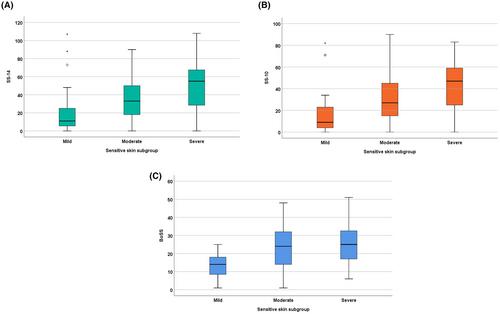
Of all participants, most patients classified their condition as moderate (50%), followed by mild (31%) and severe (19%) skin sensitivity. The mean scores for the SS-14, SS-10, and BoSS instruments were 35.26 ± 27.70, 29.48 ± 23.14, and 20.74 ± 11.10, respectively. The Kruskal–Wallis test confirmed significant differences in the SS-14, SS-10, and BoSS scores among the mild, moderate, and severe sensitive skin subgroups, attesting to the known-group validity of these tools (Figure 1).
The SS-14, SS-10, and BoSS questionnaires exhibited excellent and good internal consistency, with Cronbach's alpha coefficients of 0.91, 0.92, and 0.87, respectively. In our test–retest analysis, 73 participants completed the same questionnaires after a 2-week interval, revealing moderate and good intrarater reliability for the SS-14, SS-10, and BoSS instruments (ICC = 0.59, 95% confidence interval (CI) 0.42–0.72, ICC = 0.62, 95% CI 0.45–0.7, and ICC = 0.75, 95% CI 0.63–0.86, respectively). Validity assessment revealed very high correlation between SS-14 and SS-10 scores (r = 0.979, p < 0.001) and moderate correlation with the DLQI (r = 0.545 and 0.547, p < 0.001). The BoSS score correlated moderately with the DLQI score (r = 0.61, p < 0.001); however, the correlation between BoSS with SS-14 and SS-10 across all participants was weaker (r = 0.429 and 0.441, p < 0.001) (Table 1, Figure S1).
From the results, the Thai versions of the SS-14, SS-10, and BoSS questionnaires have demonstrated their noninvasiveness and reliability as assessment tools for sensitive skin conditions in the Thai population. The Thai versions of the SS-14, SS-10, and BoSS have shown satisfactory reliability and validity compared to the original versions of these questionnaires.1, 2 The SS-14, SS-10, and BoSS questionnaires are particularly useful for assessing the severity of sensitive skin pre- and post-treatment, allowing for the evaluation of therapeutic efficacy. As for diagnostic tool, previous studies have proposed various cutoff values of SS-10 for identifying sensitive skin in different populations, emphasizing the impracticality of a universal threshold.4, 5 With respect to life quality metrics, prior research identified a mean BoSS score of 23 and 25.6 in participants with very sensitive skin.2, 6 Corroborating this, our study recorded mean BoSS scores of 23 and 25 for participants with moderate and severe sensitive skin, respectively. These findings reinforce earlier work positing that BoSS can serve not only as an assessment tool but also as a diagnostic instrument for sensitive skin conditions. Consequently, it is imperative to further calibrate SS and BoSS cutoff value specifically for each population to facilitate the diagnosis of sensitive skin.
W.B., S.K., P.C.—conception and design. P.C., S.P, S.L.—acquisition of data. S.P., S.L. —analysis and interpretation of data. P.C., N.V.—drafting the manuscript. P.C., S.K., W.B.—revising the manuscript for important intellectual content. All authors—final approval of the version to be published.
All authors have no conflicts of interest or financial support to declare.
This study was authorized by the Siriraj Institutional Review Board (approval number Si-1021/2021) on December 20, 2021.
期刊介绍:
The Journal of Cosmetic Dermatology publishes high quality, peer-reviewed articles on all aspects of cosmetic dermatology with the aim to foster the highest standards of patient care in cosmetic dermatology. Published quarterly, the Journal of Cosmetic Dermatology facilitates continuing professional development and provides a forum for the exchange of scientific research and innovative techniques.
The scope of coverage includes, but will not be limited to: healthy skin; skin maintenance; ageing skin; photodamage and photoprotection; rejuvenation; biochemistry, endocrinology and neuroimmunology of healthy skin; imaging; skin measurement; quality of life; skin types; sensitive skin; rosacea and acne; sebum; sweat; fat; phlebology; hair conservation, restoration and removal; nails and nail surgery; pigment; psychological and medicolegal issues; retinoids; cosmetic chemistry; dermopharmacy; cosmeceuticals; toiletries; striae; cellulite; cosmetic dermatological surgery; blepharoplasty; liposuction; surgical complications; botulinum; fillers, peels and dermabrasion; local and tumescent anaesthesia; electrosurgery; lasers, including laser physics, laser research and safety, vascular lasers, pigment lasers, hair removal lasers, tattoo removal lasers, resurfacing lasers, dermal remodelling lasers and laser complications.



 京公网安备 11010802042870号
京ICP备2023020795号-1
京公网安备 11010802042870号
京ICP备2023020795号-1

 分享
分享
 求助内容:
求助内容: 应助结果提醒方式:
 扫码关注我们
