Maria Buti , Jeong Heo , Yasuhito Tanaka , Pietro Andreone , Masanori Atsukawa , Joaquín Cabezas , Eric Chak , Carla S. Coffin , Kei Fujiwara , Natalya Gankina , Stuart C. Gordon , Ewa Janczewska , Atsumasa Komori , Pietro Lampertico , Stuart McPherson , Vyacheslav Morozov , Robert Plesniak , Sébastien Poulin , Pablo Ryan , Olga Sagalova , Dickens Theodore
{"title":"Sequential Peg-IFN after bepirovirsen may reduce post-treatment relapse in chronic hepatitis B","authors":"Maria Buti , Jeong Heo , Yasuhito Tanaka , Pietro Andreone , Masanori Atsukawa , Joaquín Cabezas , Eric Chak , Carla S. Coffin , Kei Fujiwara , Natalya Gankina , Stuart C. Gordon , Ewa Janczewska , Atsumasa Komori , Pietro Lampertico , Stuart McPherson , Vyacheslav Morozov , Robert Plesniak , Sébastien Poulin , Pablo Ryan , Olga Sagalova , Dickens Theodore","doi":"10.1016/j.jhep.2024.08.010","DOIUrl":null,"url":null,"abstract":"<div><h3>Background & Aims</h3><div>Bepirovirsen, an antisense oligonucleotide, induces sustained reductions in hepatitis B surface antigen (HBsAg) and HBV DNA to below the lower limit of quantification (<LLOQ) in a subset of patients. The B-Together study investigated if sequential bepirovirsen and pegylated interferon-α-2a (Peg-IFN) therapy can reduce relapse rates and improve response rates.</div></div><div><h3>Methods</h3><div>In this phase IIb, multicentre, open-label trial, participants on stable nucleos(t)ide analogue (NA) therapy were randomised 1:1 to bepirovirsen 300 mg once weekly (plus loading dose on Days 4 and 11) for 24 (Arm 1) or 12 (Arm 2) weeks followed by Peg-IFN 180 μg once weekly for up to 24 weeks, with up to 36 weeks follow-up. Participants continued NA therapy throughout. The primary outcome was the proportion of participants with HBsAg <0.05 IU/ml and HBV DNA <LLOQ for 24 weeks after planned end of Peg-IFN treatment, in the absence of newly initiated antiviral therapy.</div></div><div><h3>Results</h3><div>The intent-to-treat population included 108 participants (Arm 1, n = 55; Arm 2, n = 53). The primary outcome was achieved by 5 (9%) participants in Arm 1 and 8 (15%) in Arm 2. All responders had baseline HBsAg ≤3,000 IU/ml. Indirect comparison with the phase IIb study B-Clear indicates that sequential addition of Peg-IFN may reduce the relapse rates previously observed with bepirovirsen alone. The proportions of participants with adverse events and treatment-related adverse events in both treatment windows were similar between treatment arms.</div></div><div><h3>Conclusions</h3><div>Sequential therapy with bepirovirsen followed by Peg-IFN is tolerable and effective in participants with chronic HBV infection on stable NA therapy. This proof-of-concept trial demonstrates a potential strategy to extend responses to bepirovirsen by reducing relapse.</div></div><div><h3>Impact and implications</h3><div>This phase IIb study investigated whether sequential therapy with bepirovirsen followed by Peg-IFN could improve off-treatment response rates to bepirovirsen alone by converting partial bepirovirsen responders to full responders and/or reducing relapse rates in participants with chronic HBV. These data show that sequential therapy with bepirovirsen followed by Peg-IFN is tolerable and effective; in patients with a bepirovirsen response, sequential treatment with Peg-IFN may help to reduce off-treatment relapses in participants on stable NA. Participants had a similar response during bepirovirsen treatment as seen in B-Clear, with increased response rates in participants with lower baseline HBsAg; all responders to the sequential regimen had baseline HBsAg <3000 IU/mL. As the first study of antisense oligonucleotide-mediated RNA silencing followed by interferon immunomodulation in patients with chronic HBV infection, this study is an important proof-of-concept for sequential therapy, shedding light on the therapeutic potential of utilising immunomodulators following suppression of HBV antigens.</div></div><div><h3>Clinical Trial Number</h3><div>NCT04676724.</div></div>","PeriodicalId":15888,"journal":{"name":"Journal of Hepatology","volume":"82 2","pages":"Pages 222-234"},"PeriodicalIF":33.0000,"publicationDate":"2025-02-01","publicationTypes":"Journal Article","fieldsOfStudy":null,"isOpenAccess":false,"openAccessPdf":"","citationCount":"0","resultStr":null,"platform":"Semanticscholar","paperid":null,"PeriodicalName":"Journal of Hepatology","FirstCategoryId":"3","ListUrlMain":"https://www.sciencedirect.com/science/article/pii/S0168827824024887","RegionNum":1,"RegionCategory":"医学","ArticlePicture":[],"TitleCN":null,"AbstractTextCN":null,"PMCID":null,"EPubDate":"2024/8/29 0:00:00","PubModel":"Epub","JCR":"Q1","JCRName":"GASTROENTEROLOGY & HEPATOLOGY","Score":null,"Total":0}
引用次数: 0
Abstract
Background & Aims
Bepirovirsen, an antisense oligonucleotide, induces sustained reductions in hepatitis B surface antigen (HBsAg) and HBV DNA to below the lower limit of quantification (<LLOQ) in a subset of patients. The B-Together study investigated if sequential bepirovirsen and pegylated interferon-α-2a (Peg-IFN) therapy can reduce relapse rates and improve response rates.
Methods
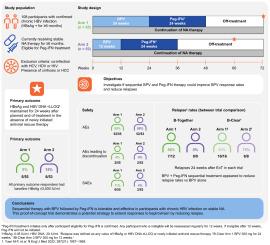
In this phase IIb, multicentre, open-label trial, participants on stable nucleos(t)ide analogue (NA) therapy were randomised 1:1 to bepirovirsen 300 mg once weekly (plus loading dose on Days 4 and 11) for 24 (Arm 1) or 12 (Arm 2) weeks followed by Peg-IFN 180 μg once weekly for up to 24 weeks, with up to 36 weeks follow-up. Participants continued NA therapy throughout. The primary outcome was the proportion of participants with HBsAg <0.05 IU/ml and HBV DNA <LLOQ for 24 weeks after planned end of Peg-IFN treatment, in the absence of newly initiated antiviral therapy.
Results
The intent-to-treat population included 108 participants (Arm 1, n = 55; Arm 2, n = 53). The primary outcome was achieved by 5 (9%) participants in Arm 1 and 8 (15%) in Arm 2. All responders had baseline HBsAg ≤3,000 IU/ml. Indirect comparison with the phase IIb study B-Clear indicates that sequential addition of Peg-IFN may reduce the relapse rates previously observed with bepirovirsen alone. The proportions of participants with adverse events and treatment-related adverse events in both treatment windows were similar between treatment arms.
Conclusions
Sequential therapy with bepirovirsen followed by Peg-IFN is tolerable and effective in participants with chronic HBV infection on stable NA therapy. This proof-of-concept trial demonstrates a potential strategy to extend responses to bepirovirsen by reducing relapse.
Impact and implications
This phase IIb study investigated whether sequential therapy with bepirovirsen followed by Peg-IFN could improve off-treatment response rates to bepirovirsen alone by converting partial bepirovirsen responders to full responders and/or reducing relapse rates in participants with chronic HBV. These data show that sequential therapy with bepirovirsen followed by Peg-IFN is tolerable and effective; in patients with a bepirovirsen response, sequential treatment with Peg-IFN may help to reduce off-treatment relapses in participants on stable NA. Participants had a similar response during bepirovirsen treatment as seen in B-Clear, with increased response rates in participants with lower baseline HBsAg; all responders to the sequential regimen had baseline HBsAg <3000 IU/mL. As the first study of antisense oligonucleotide-mediated RNA silencing followed by interferon immunomodulation in patients with chronic HBV infection, this study is an important proof-of-concept for sequential therapy, shedding light on the therapeutic potential of utilising immunomodulators following suppression of HBV antigens.
期刊介绍:
The Journal of Hepatology is the official publication of the European Association for the Study of the Liver (EASL). It is dedicated to presenting clinical and basic research in the field of hepatology through original papers, reviews, case reports, and letters to the Editor. The Journal is published in English and may consider supplements that pass an editorial review.




 京公网安备 11010802042870号
京ICP备2023020795号-1
京公网安备 11010802042870号
京ICP备2023020795号-1

 分享
分享
 求助内容:
求助内容: 应助结果提醒方式:
 扫码关注我们
