Luca Autelitano, Daniele Hamaui, Valeria M A Battista, Federico Biglioli, Maria C Meazzini
{"title":"Bone Formation in Unilateral Cleft Lip and Palate Patients after Early Secondary Gingivoalveoloplasty and Bone Graft: Long-Term Study.","authors":"Luca Autelitano, Daniele Hamaui, Valeria M A Battista, Federico Biglioli, Maria C Meazzini","doi":"10.1097/PRS.0000000000011684","DOIUrl":null,"url":null,"abstract":"<p><strong>Background: </strong>The aim of this study was to conduct a comparative analysis, using computed tomographic scans, of ossification patterns in unilateral cleft lip and palate patients who underwent early secondary gingivoalveoloplasty (esGAP) versus those who underwent traditional alveolar bone grafting harvested from the iliac crest (IC).</p><p><strong>Methods: </strong>Computed tomographic scans of 22 consecutively treated patients with esGAP were compared with those of 21 patients treated with bone grafting from the IC. Inclusion criteria were nonsyndromic unilateral cleft lip and palate patients in permanent dentition. Two parameters were considered: the alveolar thickness, measured at 3 levels, and the nasoalveolar height. All measurements were normalized and ratios of the affected versus nonaffected sides were provided as in addition to the statistical comparison between the 2 groups' ossification outcomes.</p><p><strong>Results: </strong>In the esGAP sample, nasoalveolar height was categorized as ideal and good in 86.36% and in 13.64% of the cases, and no mediocre or insufficient ossification was detected; whereas in the bone grafting sample, 38.10% had ideal and good ossification, 14.29% had mediocre ossification, and 9.52% had insufficient ossification. As regards the alveolar thickness, when we consider the average of 3 levels, the esGAP sample was ideal and good in 57.57% and in 30.30% of the cases; for the IC sample, the alveolar thickness was ideal and good 41.27% and in 25.40% of the cases, respectively. The analysis detected a statistically significant difference in the ossification outcomes in the 2 samples.</p><p><strong>Conclusion: </strong>The esGAP yields superior ossification grades in comparison to IC bone grafting.</p><p><strong>Clinical relevance statement: </strong>In unilateral cleft lip and palate patients, esGAP seems to allow for a higher grade of ossification compared to IC bone grafting.</p><p><strong>Clinical question/level of evidence: </strong>Therapeutic, III.</p>","PeriodicalId":20128,"journal":{"name":"Plastic and reconstructive surgery","volume":" ","pages":"523e-532e"},"PeriodicalIF":3.4000,"publicationDate":"2025-03-01","publicationTypes":"Journal Article","fieldsOfStudy":null,"isOpenAccess":false,"openAccessPdf":"","citationCount":"0","resultStr":null,"platform":"Semanticscholar","paperid":null,"PeriodicalName":"Plastic and reconstructive surgery","FirstCategoryId":"3","ListUrlMain":"https://doi.org/10.1097/PRS.0000000000011684","RegionNum":2,"RegionCategory":"医学","ArticlePicture":[],"TitleCN":null,"AbstractTextCN":null,"PMCID":null,"EPubDate":"2024/8/20 0:00:00","PubModel":"Epub","JCR":"Q1","JCRName":"SURGERY","Score":null,"Total":0}
引用次数: 0
Abstract
Background: The aim of this study was to conduct a comparative analysis, using computed tomographic scans, of ossification patterns in unilateral cleft lip and palate patients who underwent early secondary gingivoalveoloplasty (esGAP) versus those who underwent traditional alveolar bone grafting harvested from the iliac crest (IC).
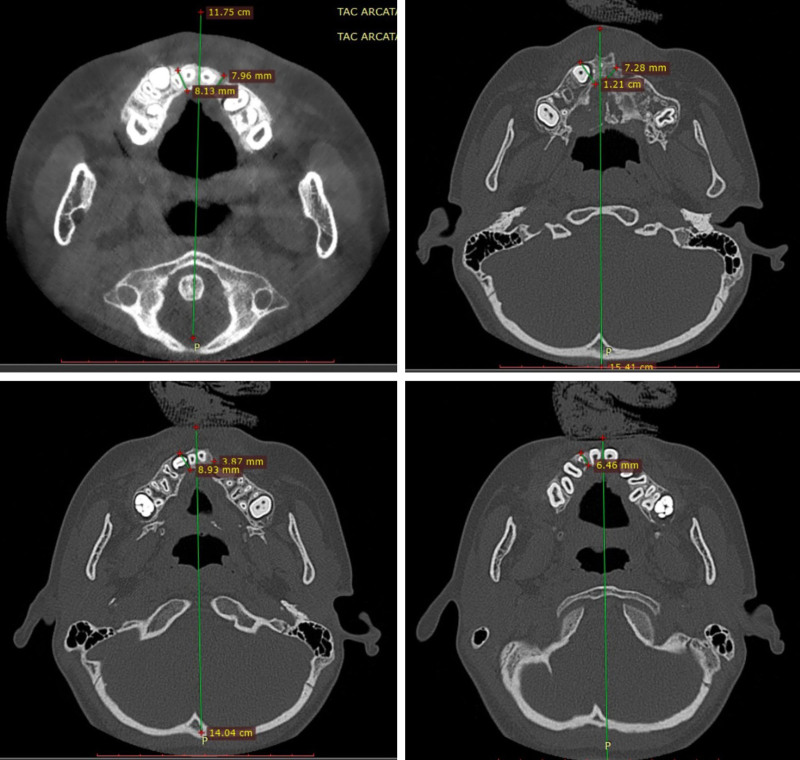
Methods: Computed tomographic scans of 22 consecutively treated patients with esGAP were compared with those of 21 patients treated with bone grafting from the IC. Inclusion criteria were nonsyndromic unilateral cleft lip and palate patients in permanent dentition. Two parameters were considered: the alveolar thickness, measured at 3 levels, and the nasoalveolar height. All measurements were normalized and ratios of the affected versus nonaffected sides were provided as in addition to the statistical comparison between the 2 groups' ossification outcomes.
Results: In the esGAP sample, nasoalveolar height was categorized as ideal and good in 86.36% and in 13.64% of the cases, and no mediocre or insufficient ossification was detected; whereas in the bone grafting sample, 38.10% had ideal and good ossification, 14.29% had mediocre ossification, and 9.52% had insufficient ossification. As regards the alveolar thickness, when we consider the average of 3 levels, the esGAP sample was ideal and good in 57.57% and in 30.30% of the cases; for the IC sample, the alveolar thickness was ideal and good 41.27% and in 25.40% of the cases, respectively. The analysis detected a statistically significant difference in the ossification outcomes in the 2 samples.
Conclusion: The esGAP yields superior ossification grades in comparison to IC bone grafting.
Clinical relevance statement: In unilateral cleft lip and palate patients, esGAP seems to allow for a higher grade of ossification compared to IC bone grafting.
Clinical question/level of evidence: Therapeutic, III.
期刊介绍:
For more than 70 years Plastic and Reconstructive Surgery® has been the one consistently excellent reference for every specialist who uses plastic surgery techniques or works in conjunction with a plastic surgeon. Plastic and Reconstructive Surgery® , the official journal of the American Society of Plastic Surgeons, is a benefit of Society membership, and is also available on a subscription basis.
Plastic and Reconstructive Surgery® brings subscribers up-to-the-minute reports on the latest techniques and follow-up for all areas of plastic and reconstructive surgery, including breast reconstruction, experimental studies, maxillofacial reconstruction, hand and microsurgery, burn repair, cosmetic surgery, as well as news on medicolegal issues. The cosmetic section provides expanded coverage on new procedures and techniques and offers more cosmetic-specific content than any other journal. All subscribers enjoy full access to the Journal''s website, which features broadcast quality videos of reconstructive and cosmetic procedures, podcasts, comprehensive article archives dating to 1946, and additional benefits offered by the newly-redesigned website.




 京公网安备 11010802042870号
京ICP备2023020795号-1
京公网安备 11010802042870号
京ICP备2023020795号-1

 分享
分享
 求助内容:
求助内容: 应助结果提醒方式:
 扫码关注我们
