{"title":"A phase II clinical trial of toripalimab in advanced solid tumors with polymerase epsilon/polymerase delta (POLE/POLD1) mutation.","authors":"Ying Jin, Run-Jie Huang, Wen-Long Guan, Zhi-Qiang Wang, Zong-Jiong Mai, Yu-Hong Li, Jian Xiao, Xing Zhang, Qi Zhao, Shi-Fu Chen, Ming Liu, Yan-Xia Shi, Feng Wang, Rui-Hua Xu","doi":"10.1038/s41392-024-01939-5","DOIUrl":null,"url":null,"abstract":"<p><p>Patients carrying mutations in polymerase epsilon/polymerase delta have shown positive responses to immune checkpoint inhibitors. Yet, prospective trials exploring the efficacy in those with polymerase epsilon/polymerase delta mutations are still lacking. A phase II clinical trial was initiated to evaluate the efficacy of toripalimab, a humanized IgG4K monoclonal antibody to human PD-1, in patients with advanced solid tumors with unselected polymerase epsilon/polymerase delta mutations but without microsatellite instability-high. A total of 15 patients were enrolled, 14 of whom were assessed for treatment efficacy. There was a 21.4% overall response rate, with a disease control rate of 57.1%. The median overall survival and median progression-free survival were 17.9 (95% CI 13.5-not reach) months and 2.5 (95% CI 1.4-not reach) months, respectively. For patients with exonuclease domain mutations, the objective response rate was 66.7% (2/3), with a disease control rate of 66.7% (2/3). For those with non-exonuclease domain mutations, the rates were 9.1% (1/11) and 54.5% (6/11), respectively. Notably, patients with PBRM1 gene mutations exhibited a high response rate to toripalimab at 75.0% (3/4). This study showed that neither the exonuclease domain mutations nor non-exonuclease domain mutations could fully predict the efficacy of immunotherapy, urging the need for more investigations to clarify potential immune sensitization differences within polymerase epsilon/polymerase delta mutation variants.</p>","PeriodicalId":21766,"journal":{"name":"Signal Transduction and Targeted Therapy","volume":"9 1","pages":"227"},"PeriodicalIF":52.7000,"publicationDate":"2024-09-02","publicationTypes":"Journal Article","fieldsOfStudy":null,"isOpenAccess":false,"openAccessPdf":"https://www.ncbi.nlm.nih.gov/pmc/articles/PMC11366758/pdf/","citationCount":"0","resultStr":null,"platform":"Semanticscholar","paperid":null,"PeriodicalName":"Signal Transduction and Targeted Therapy","FirstCategoryId":"3","ListUrlMain":"https://doi.org/10.1038/s41392-024-01939-5","RegionNum":1,"RegionCategory":"医学","ArticlePicture":[],"TitleCN":null,"AbstractTextCN":null,"PMCID":null,"EPubDate":"","PubModel":"","JCR":"Q1","JCRName":"BIOCHEMISTRY & MOLECULAR BIOLOGY","Score":null,"Total":0}
引用次数: 0
Abstract
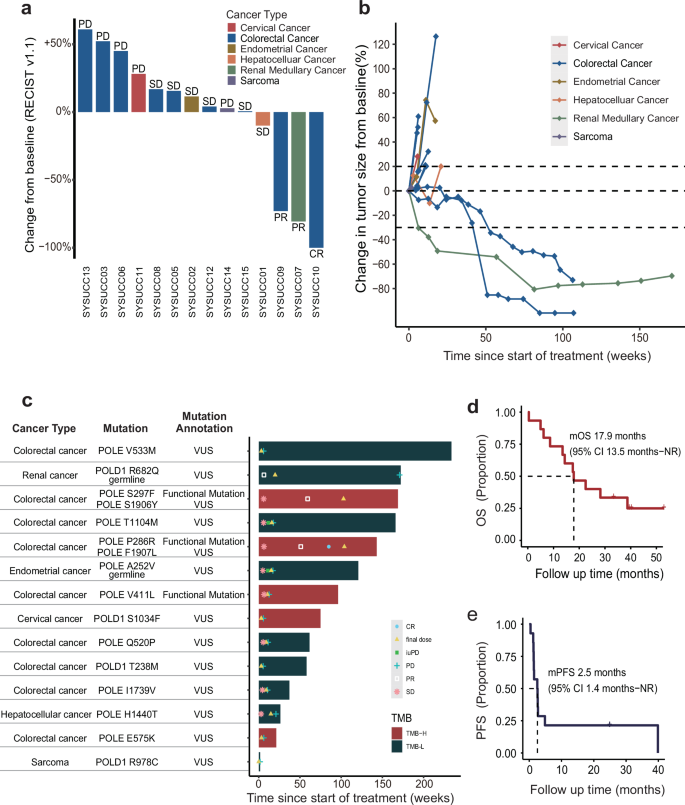
Patients carrying mutations in polymerase epsilon/polymerase delta have shown positive responses to immune checkpoint inhibitors. Yet, prospective trials exploring the efficacy in those with polymerase epsilon/polymerase delta mutations are still lacking. A phase II clinical trial was initiated to evaluate the efficacy of toripalimab, a humanized IgG4K monoclonal antibody to human PD-1, in patients with advanced solid tumors with unselected polymerase epsilon/polymerase delta mutations but without microsatellite instability-high. A total of 15 patients were enrolled, 14 of whom were assessed for treatment efficacy. There was a 21.4% overall response rate, with a disease control rate of 57.1%. The median overall survival and median progression-free survival were 17.9 (95% CI 13.5-not reach) months and 2.5 (95% CI 1.4-not reach) months, respectively. For patients with exonuclease domain mutations, the objective response rate was 66.7% (2/3), with a disease control rate of 66.7% (2/3). For those with non-exonuclease domain mutations, the rates were 9.1% (1/11) and 54.5% (6/11), respectively. Notably, patients with PBRM1 gene mutations exhibited a high response rate to toripalimab at 75.0% (3/4). This study showed that neither the exonuclease domain mutations nor non-exonuclease domain mutations could fully predict the efficacy of immunotherapy, urging the need for more investigations to clarify potential immune sensitization differences within polymerase epsilon/polymerase delta mutation variants.
携带聚合酶epsilon/聚合酶δ突变的患者对免疫检查点抑制剂产生了积极的反应。然而,探索聚合酶epsilon/聚合酶δ突变患者疗效的前瞻性试验仍然缺乏。我们启动了一项II期临床试验,评估人PD-1人源化IgG4K单克隆抗体托瑞帕利单抗(toripalimab)对未选择聚合酶ε/聚合酶δ突变但无微卫星不稳定性高的晚期实体瘤患者的疗效。共有15名患者入组,其中14人接受了疗效评估。总体反应率为21.4%,疾病控制率为57.1%。中位总生存期和中位无进展生存期分别为17.9个月(95% CI 13.5个月,未达标)和2.5个月(95% CI 1.4个月,未达标)。外切酶结构域突变患者的客观反应率为66.7%(2/3),疾病控制率为66.7%(2/3)。而非外切酶结构域突变患者的客观反应率分别为9.1%(1/11)和54.5%(6/11)。值得注意的是,PBRM1 基因突变患者对托瑞帕单抗的反应率很高,达到 75.0%(3/4)。这项研究表明,无论是外切酶结构域突变还是非外切酶结构域突变,都不能完全预测免疫疗法的疗效,因此需要进行更多研究,以明确聚合酶epsilon/聚合酶delta突变变体之间潜在的免疫敏感性差异。
期刊介绍:
Signal Transduction and Targeted Therapy is an open access journal that focuses on timely publication of cutting-edge discoveries and advancements in basic science and clinical research related to signal transduction and targeted therapy.
Scope: The journal covers research on major human diseases, including, but not limited to:
Cancer,Cardiovascular diseases,Autoimmune diseases,Nervous system diseases.



 京公网安备 11010802042870号
京ICP备2023020795号-1
京公网安备 11010802042870号
京ICP备2023020795号-1

 分享
分享
 求助内容:
求助内容: 应助结果提醒方式:
 扫码关注我们
