{"title":"Meiosis requires m6A modification for selection of targets in plants","authors":"Cong Wang, Yingxiang Wang","doi":"10.1111/nph.20089","DOIUrl":null,"url":null,"abstract":"<p>Meiosis, a specialized form of cell division, halves diploid chromosome numbers to generate haploid gametophytes, which is essential for sexual reproduction in most eukaryotes. Meiotic recombination not only facilitates the exchange of genetic information between homologous chromosomes (homologs), but also assures their subsequent proper segregation, which has a great impact on the genetic diversity and genomic integrity of progenies. Meiotic recombination is initiated from the programmed formation of DSBs, catalyzed by the evolutionarily conserved type-II DNA topoisomerase SPO11-1 and MTOPVIB complex. The repair of DSBs can result in exchange of DNA between homologs known as crossovers (COs) and noncrossovers (NCOs) (Wang & Copenhaver, <span>2018</span>; Zickler & Kleckner, <span>2023</span>). In the past 30 years, molecular genetic studies have identified dozens of genes involved in regulating the formation and repair of meiotic DSBs in plants, including some epigenetic factors (Wang & Copenhaver, <span>2018</span>). However, the function of RNA modification related to this process is largely unknown.</p><p>Xue <i>et al</i>. have made a first step towards understanding the mechanism of the m<sup>6</sup>A eraser ALKBH5 in regulating DSB formation and repair in rice meiosis. They started this project by identifying a male sterile mutant from a gamma-irradiated rice mutant library. The author further cloned the target <i>OsALKBH5</i> gene and demonstrated that its mutations affected DSB formation and repair during meiosis I, thus leading to male sterility. OsALKBH5 preferentially localizes in the cytoplasm and nucleoplasm of pollen mother cells (PMCs), microspores, and tapetal cells. They confirmed the m<sup>6</sup>A demethylase activity of OsALKBH5 <i>in vitro</i> and <i>in vivo</i>, and that the mutation of OsALKBH5 impacts on m<sup>6</sup>A modifications and stability of mRNA during meiosis. Further observations showed that the <i>Osalkbh5</i> mutant displays upmethylated m<sup>6</sup>A modification on associated downregulated genes, such as <i>PAIR2</i>, <i>PAIR3</i>, <i>OsCOM1</i>, <i>OsZIP4</i>, and <i>HEIP1</i>, which are required for meiotic recombination. These results suggest that OsALKBH5 participates in meiotic recombination by mediating m<sup>6</sup>A modification on targeted genes to maintain their mRNA stability (Fig. 1). Similarly, deficiency of the mice <i>Alkbh5</i> homolog resulted in increased m<sup>6</sup>A modifications and infertility of spermatocytes (Zheng <i>et al</i>., <span>2013</span>). Further study demonstrated that ALKBH5-mediated m<sup>6</sup>A erasure from mRNAs is required for correct splicing and the selective degradation of long 3′UTR transcripts in spermatocytes and spermatids (Tang <i>et al</i>., <span>2018</span>). Therefore, the molecular mechanism of ALKBH5-mediated m<sup>6</sup>A may serve as a fundamental basis shared between plants and animals, while the target genes involved in meiosis appear to be diversified across different species (Zheng <i>et al</i>., <span>2013</span>; Tang <i>et al</i>., <span>2018</span>). As expected, a very recent study revealed comprehensive maps of m<sup>6</sup>A at single-base precision in different tissues throughout the life cycle of both rice and <i>Arabidopsis</i>. Comparative analysis with mammals uncovered the existence of comparable distribution patterns and modification sites across species and tissues (Wang <i>et al</i>., <span>2024</span>).</p><p>It has been observed that the expression of numerous meiotic genes occurs before the initiation of maize meiosis, and certain genes exhibit varying levels of transcript abundance during different stages of meiosis (Nelms & Walbot, <span>2019</span>). In mammals, both the m<sup>6</sup>A ‘writer’ Mettl3 and the ‘eraser’ Alkbh5 have been reported to regulate mRNA splicing and stability (Xu <i>et al</i>., <span>2017</span>; Tang <i>et al</i>., <span>2018</span>). By contrast, <i>Mettl3</i> regulates spermatogonia differentiation and meiosis initiation, whereas <i>Alkbh5</i> functions in meiotic spermatogenic cells and round spermatids. Consistently, the inactivation of METTL3 in mice causes a much earlier meiotic arrest than <i>Alkbh5</i>-knockout mice (Zheng <i>et al</i>., <span>2013</span>; Xu <i>et al</i>., <span>2017</span>). These observations provide evidence that posttranscriptional m<sup>6</sup>A modification is required for maintaining the activity of meiotic genes, and the stage-specific deposition and removal of m<sup>6</sup>A ensures the orderly progression of meiosis. This conclusion is supported by the finding of Xue <i>et al</i>. that multiple meiosis-specific genes related to DSB formation and repair are regulated by OsALKBH5-induced m<sup>6</sup>A erasure. The identification of the ‘writer’ responsible for m<sup>6</sup>A modification during meiosis in plants, as well as the relationship between this ‘writer’ and the ‘eraser’, including their special targets, needs to be further investigated.</p><p>Xue <i>et al</i>.'s study also raises other interesting questions. For example, during meiosis, OsALKBH5 is expressed not only in meiocytes but also in the tapetum, indicating a potential role in mediating genes for either tapetum or pollen development. They also pointed out that, a large number of meiosis-specific genes with downregulated expression showed unexpected decreased m<sup>6</sup>A methylation in the <i>Osalkbh5</i> mutant, including <i>OsMTOPVIB</i> required for meiotic DSB formation. This presents the question: how does the knockout of a demethylase reduce the m<sup>6</sup>A of certain mRNA transcripts. Recent studies revealed that RNA m<sup>6</sup>A methylation is closely correlated with other epigenetic factors, including DNA methylation, histone modifications, microRNAs, long noncoding RNAs, and chromatin remodeling (Hu <i>et al</i>., <span>2024</span>), which regulates gene expression in a more complex manner. A study in tomatoes showed that RNA demethylase SlALKBH2 and DNA demethylase SlDML2 form a feedback loop to regulate fruit ripening (Zhou <i>et al</i>., <span>2019</span>). In mammalian cells, histone H3K36me3 is recognized and bound directly by m<sup>6</sup>A writer complex, which subsequently facilitates the deposition of m<sup>6</sup>A mark onto actively transcribed RNAs (Huang <i>et al</i>., <span>2019</span>). The bidirectional interactions between mRNA m<sup>6</sup>A methylation and other epigenetic regulators commonly exist among species (Hu <i>et al</i>., <span>2024</span>), and deserves further exploration in meiosis.</p>","PeriodicalId":214,"journal":{"name":"New Phytologist","volume":"244 6","pages":"2118-2120"},"PeriodicalIF":8.1000,"publicationDate":"2024-09-02","publicationTypes":"Journal Article","fieldsOfStudy":null,"isOpenAccess":false,"openAccessPdf":"https://onlinelibrary.wiley.com/doi/epdf/10.1111/nph.20089","citationCount":"0","resultStr":null,"platform":"Semanticscholar","paperid":null,"PeriodicalName":"New Phytologist","FirstCategoryId":"99","ListUrlMain":"https://nph.onlinelibrary.wiley.com/doi/10.1111/nph.20089","RegionNum":1,"RegionCategory":"生物学","ArticlePicture":[],"TitleCN":null,"AbstractTextCN":null,"PMCID":null,"EPubDate":"","PubModel":"","JCR":"Q1","JCRName":"PLANT SCIENCES","Score":null,"Total":0}
引用次数: 0
Abstract
Meiosis, a specialized form of cell division, halves diploid chromosome numbers to generate haploid gametophytes, which is essential for sexual reproduction in most eukaryotes. Meiotic recombination not only facilitates the exchange of genetic information between homologous chromosomes (homologs), but also assures their subsequent proper segregation, which has a great impact on the genetic diversity and genomic integrity of progenies. Meiotic recombination is initiated from the programmed formation of DSBs, catalyzed by the evolutionarily conserved type-II DNA topoisomerase SPO11-1 and MTOPVIB complex. The repair of DSBs can result in exchange of DNA between homologs known as crossovers (COs) and noncrossovers (NCOs) (Wang & Copenhaver, 2018; Zickler & Kleckner, 2023). In the past 30 years, molecular genetic studies have identified dozens of genes involved in regulating the formation and repair of meiotic DSBs in plants, including some epigenetic factors (Wang & Copenhaver, 2018). However, the function of RNA modification related to this process is largely unknown.
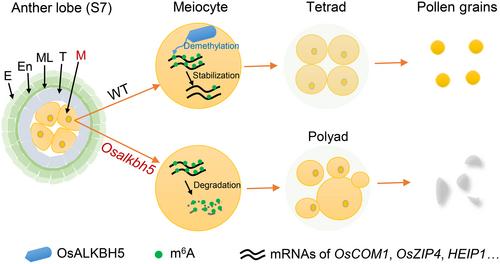
Xue et al. have made a first step towards understanding the mechanism of the m6A eraser ALKBH5 in regulating DSB formation and repair in rice meiosis. They started this project by identifying a male sterile mutant from a gamma-irradiated rice mutant library. The author further cloned the target OsALKBH5 gene and demonstrated that its mutations affected DSB formation and repair during meiosis I, thus leading to male sterility. OsALKBH5 preferentially localizes in the cytoplasm and nucleoplasm of pollen mother cells (PMCs), microspores, and tapetal cells. They confirmed the m6A demethylase activity of OsALKBH5 in vitro and in vivo, and that the mutation of OsALKBH5 impacts on m6A modifications and stability of mRNA during meiosis. Further observations showed that the Osalkbh5 mutant displays upmethylated m6A modification on associated downregulated genes, such as PAIR2, PAIR3, OsCOM1, OsZIP4, and HEIP1, which are required for meiotic recombination. These results suggest that OsALKBH5 participates in meiotic recombination by mediating m6A modification on targeted genes to maintain their mRNA stability (Fig. 1). Similarly, deficiency of the mice Alkbh5 homolog resulted in increased m6A modifications and infertility of spermatocytes (Zheng et al., 2013). Further study demonstrated that ALKBH5-mediated m6A erasure from mRNAs is required for correct splicing and the selective degradation of long 3′UTR transcripts in spermatocytes and spermatids (Tang et al., 2018). Therefore, the molecular mechanism of ALKBH5-mediated m6A may serve as a fundamental basis shared between plants and animals, while the target genes involved in meiosis appear to be diversified across different species (Zheng et al., 2013; Tang et al., 2018). As expected, a very recent study revealed comprehensive maps of m6A at single-base precision in different tissues throughout the life cycle of both rice and Arabidopsis. Comparative analysis with mammals uncovered the existence of comparable distribution patterns and modification sites across species and tissues (Wang et al., 2024).
It has been observed that the expression of numerous meiotic genes occurs before the initiation of maize meiosis, and certain genes exhibit varying levels of transcript abundance during different stages of meiosis (Nelms & Walbot, 2019). In mammals, both the m6A ‘writer’ Mettl3 and the ‘eraser’ Alkbh5 have been reported to regulate mRNA splicing and stability (Xu et al., 2017; Tang et al., 2018). By contrast, Mettl3 regulates spermatogonia differentiation and meiosis initiation, whereas Alkbh5 functions in meiotic spermatogenic cells and round spermatids. Consistently, the inactivation of METTL3 in mice causes a much earlier meiotic arrest than Alkbh5-knockout mice (Zheng et al., 2013; Xu et al., 2017). These observations provide evidence that posttranscriptional m6A modification is required for maintaining the activity of meiotic genes, and the stage-specific deposition and removal of m6A ensures the orderly progression of meiosis. This conclusion is supported by the finding of Xue et al. that multiple meiosis-specific genes related to DSB formation and repair are regulated by OsALKBH5-induced m6A erasure. The identification of the ‘writer’ responsible for m6A modification during meiosis in plants, as well as the relationship between this ‘writer’ and the ‘eraser’, including their special targets, needs to be further investigated.
Xue et al.'s study also raises other interesting questions. For example, during meiosis, OsALKBH5 is expressed not only in meiocytes but also in the tapetum, indicating a potential role in mediating genes for either tapetum or pollen development. They also pointed out that, a large number of meiosis-specific genes with downregulated expression showed unexpected decreased m6A methylation in the Osalkbh5 mutant, including OsMTOPVIB required for meiotic DSB formation. This presents the question: how does the knockout of a demethylase reduce the m6A of certain mRNA transcripts. Recent studies revealed that RNA m6A methylation is closely correlated with other epigenetic factors, including DNA methylation, histone modifications, microRNAs, long noncoding RNAs, and chromatin remodeling (Hu et al., 2024), which regulates gene expression in a more complex manner. A study in tomatoes showed that RNA demethylase SlALKBH2 and DNA demethylase SlDML2 form a feedback loop to regulate fruit ripening (Zhou et al., 2019). In mammalian cells, histone H3K36me3 is recognized and bound directly by m6A writer complex, which subsequently facilitates the deposition of m6A mark onto actively transcribed RNAs (Huang et al., 2019). The bidirectional interactions between mRNA m6A methylation and other epigenetic regulators commonly exist among species (Hu et al., 2024), and deserves further exploration in meiosis.
期刊介绍:
New Phytologist is an international electronic journal published 24 times a year. It is owned by the New Phytologist Foundation, a non-profit-making charitable organization dedicated to promoting plant science. The journal publishes excellent, novel, rigorous, and timely research and scholarship in plant science and its applications. The articles cover topics in five sections: Physiology & Development, Environment, Interaction, Evolution, and Transformative Plant Biotechnology. These sections encompass intracellular processes, global environmental change, and encourage cross-disciplinary approaches. The journal recognizes the use of techniques from molecular and cell biology, functional genomics, modeling, and system-based approaches in plant science. Abstracting and Indexing Information for New Phytologist includes Academic Search, AgBiotech News & Information, Agroforestry Abstracts, Biochemistry & Biophysics Citation Index, Botanical Pesticides, CAB Abstracts®, Environment Index, Global Health, and Plant Breeding Abstracts, and others.




 京公网安备 11010802042870号
京ICP备2023020795号-1
京公网安备 11010802042870号
京ICP备2023020795号-1

 分享
分享
 求助内容:
求助内容: 应助结果提醒方式:
 扫码关注我们
