{"title":"Signal peptidase SpsB coordinates staphylococcal cell cycle, surface protein septal trafficking and LTA synthesis.","authors":"Ran Zhang, Yaosheng Jia, Salvatore J Scaffidi, Jesper J Madsen, Wenqi Yu","doi":"10.1101/2024.08.20.608893","DOIUrl":null,"url":null,"abstract":"<p><p>Many cell wall anchored surface proteins of Gram-positive bacteria harbor a highly conserved YSIRK/G-S signal peptide (SP<sub>YSIRK+</sub>), which deposits surface protein precursors at the cell division septum where they are subsequently anchored to septal peptidoglycan. Previously we identified that LtaS-mediated lipoteichoic acid (LTA) synthesis regulates septal trafficking of YSIRK+ proteins in <i>S. aureus</i>. Interestingly, both LtaS and SP<sub>YSIRK+</sub> are cleaved by the signal peptidase SpsB, but the biological implications remain unclear. Here we show that SpsB is required for cleaving SP<sub>SpA(YSIRK+)</sub> of staphylococcal surface protein A (SpA). Depletion of <i>spsB</i> not only diminished SP<sub>SpA</sub> processing but also abolished SpA septal localization. The mis-localization is attributed to the cleavage activity of SpsB, as an A37P mutation of SP<sub>SpA</sub> that disrupted SpsB cleavage also abrogated SpA septal localization. Strikingly, depletion of <i>spsB</i> led to aberrant cell morphology, cell cycle arrest and daughter cell separation defects. Localization studies showed that SpsB predominantly localized at the septum of dividing staphylococcal cells. Finally, we show that SpsB spatially regulates LtaS as <i>spsB</i> depletion enriched LtaS at the septum. Collectively, the data suggest a new dual-mechanism model mediated by SpsB: the abundant YSIRK+ proteins are efficiently processed by septal localized SpsB; SpsB cleaves LtaS at the septum, which spatially regulates LtaS activity contributing to YSIRK+ proteins septal trafficking. The study identifies SpsB as a novel and key regulator orchestrating protein secretion, cell cycle and cell envelope biogenesis.</p>","PeriodicalId":519960,"journal":{"name":"bioRxiv : the preprint server for biology","volume":" ","pages":""},"PeriodicalIF":0.0000,"publicationDate":"2024-08-21","publicationTypes":"Journal Article","fieldsOfStudy":null,"isOpenAccess":false,"openAccessPdf":"https://www.ncbi.nlm.nih.gov/pmc/articles/PMC11370438/pdf/","citationCount":"0","resultStr":null,"platform":"Semanticscholar","paperid":null,"PeriodicalName":"bioRxiv : the preprint server for biology","FirstCategoryId":"1085","ListUrlMain":"https://doi.org/10.1101/2024.08.20.608893","RegionNum":0,"RegionCategory":null,"ArticlePicture":[],"TitleCN":null,"AbstractTextCN":null,"PMCID":null,"EPubDate":"","PubModel":"","JCR":"","JCRName":"","Score":null,"Total":0}
引用次数: 0
Abstract
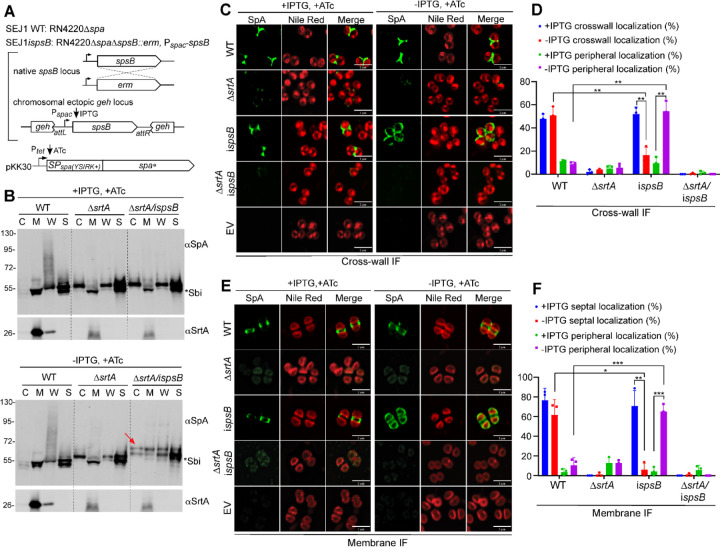
Many cell wall anchored surface proteins of Gram-positive bacteria harbor a highly conserved YSIRK/G-S signal peptide (SPYSIRK+), which deposits surface protein precursors at the cell division septum where they are subsequently anchored to septal peptidoglycan. Previously we identified that LtaS-mediated lipoteichoic acid (LTA) synthesis regulates septal trafficking of YSIRK+ proteins in S. aureus. Interestingly, both LtaS and SPYSIRK+ are cleaved by the signal peptidase SpsB, but the biological implications remain unclear. Here we show that SpsB is required for cleaving SPSpA(YSIRK+) of staphylococcal surface protein A (SpA). Depletion of spsB not only diminished SPSpA processing but also abolished SpA septal localization. The mis-localization is attributed to the cleavage activity of SpsB, as an A37P mutation of SPSpA that disrupted SpsB cleavage also abrogated SpA septal localization. Strikingly, depletion of spsB led to aberrant cell morphology, cell cycle arrest and daughter cell separation defects. Localization studies showed that SpsB predominantly localized at the septum of dividing staphylococcal cells. Finally, we show that SpsB spatially regulates LtaS as spsB depletion enriched LtaS at the septum. Collectively, the data suggest a new dual-mechanism model mediated by SpsB: the abundant YSIRK+ proteins are efficiently processed by septal localized SpsB; SpsB cleaves LtaS at the septum, which spatially regulates LtaS activity contributing to YSIRK+ proteins septal trafficking. The study identifies SpsB as a novel and key regulator orchestrating protein secretion, cell cycle and cell envelope biogenesis.





 京公网安备 11010802042870号
京ICP备2023020795号-1
京公网安备 11010802042870号
京ICP备2023020795号-1

 分享
分享

 求助内容:
求助内容: 应助结果提醒方式:
 扫码关注我们
