{"title":"Flexible molecules dedicate to release strain of inverted inorganic perovskite solar cell","authors":"Hongrui Sun, Sanlong Wang, Pengyang Wang, Yali Liu, Shanshan Qi, Biao Shi, Ying Zhao, Xiaodan Zhang","doi":"10.1016/j.jechem.2024.08.034","DOIUrl":null,"url":null,"abstract":"<div><p>The tensile strain in inorganic perovskite films induced by thermal annealing is one of the primary factors contributing to the inefficiency and instability of inorganic perovskite solar cells (IPSCs), which reduces the defect formation energy. Here, a flexible molecule 5-maleimidovaleric acid (5-MVA) was introduced as a strain buffer to release the residual strain of CsPbI<sub>2.85</sub>Br<sub>0.15</sub> perovskite. Maleic anhydride and carboxyl groups in 5-MVA interact strongly with the uncoordinated Pb<sup>2+</sup> through Lewis acid-base reaction, thus tightly “pull” the perovskite lattice. The in-between soft carbon chain increased the structural flexibility of CsPbI<sub>2.85</sub>Br<sub>0.15</sub> perovskite materials, which effectively relieved the intrinsic internal strain of CsPbI<sub>2.85</sub>Br<sub>0.15</sub>, resisted the corrosion of external strain, and also reduced the formation of defects such as V<sub>I</sub> and Pb<sup>0</sup>. In addition, the introduction of 5-MVA improved crystal quality, passivated residual defects, and narrowed energy level barriers. Eventually, power conversion efficiency (PCE) of NiO<sub>x</sub>-based inverted IPSCs increased from 19.25% to 20.82% with the open-circuit voltage enhanced from 1.164 V to 1.230 V. The release of strain also improved the stability of CsPbI<sub>2.85</sub>Br<sub>0.15</sub> perovskite films and devices.</p></div>","PeriodicalId":15728,"journal":{"name":"Journal of Energy Chemistry","volume":"100 ","pages":"Pages 87-93"},"PeriodicalIF":14.9000,"publicationDate":"2024-08-26","publicationTypes":"Journal Article","fieldsOfStudy":null,"isOpenAccess":false,"openAccessPdf":"","citationCount":"0","resultStr":null,"platform":"Semanticscholar","paperid":null,"PeriodicalName":"Journal of Energy Chemistry","FirstCategoryId":"92","ListUrlMain":"https://www.sciencedirect.com/science/article/pii/S2095495624005904","RegionNum":1,"RegionCategory":"化学","ArticlePicture":[],"TitleCN":null,"AbstractTextCN":null,"PMCID":null,"EPubDate":"","PubModel":"","JCR":"Q1","JCRName":"Energy","Score":null,"Total":0}
引用次数: 0
Abstract
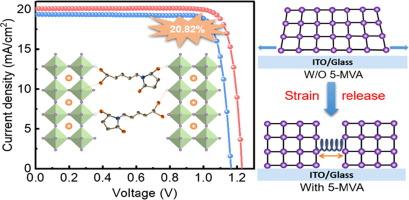
The tensile strain in inorganic perovskite films induced by thermal annealing is one of the primary factors contributing to the inefficiency and instability of inorganic perovskite solar cells (IPSCs), which reduces the defect formation energy. Here, a flexible molecule 5-maleimidovaleric acid (5-MVA) was introduced as a strain buffer to release the residual strain of CsPbI2.85Br0.15 perovskite. Maleic anhydride and carboxyl groups in 5-MVA interact strongly with the uncoordinated Pb2+ through Lewis acid-base reaction, thus tightly “pull” the perovskite lattice. The in-between soft carbon chain increased the structural flexibility of CsPbI2.85Br0.15 perovskite materials, which effectively relieved the intrinsic internal strain of CsPbI2.85Br0.15, resisted the corrosion of external strain, and also reduced the formation of defects such as VI and Pb0. In addition, the introduction of 5-MVA improved crystal quality, passivated residual defects, and narrowed energy level barriers. Eventually, power conversion efficiency (PCE) of NiOx-based inverted IPSCs increased from 19.25% to 20.82% with the open-circuit voltage enhanced from 1.164 V to 1.230 V. The release of strain also improved the stability of CsPbI2.85Br0.15 perovskite films and devices.
期刊介绍:
The Journal of Energy Chemistry, the official publication of Science Press and the Dalian Institute of Chemical Physics, Chinese Academy of Sciences, serves as a platform for reporting creative research and innovative applications in energy chemistry. It mainly reports on creative researches and innovative applications of chemical conversions of fossil energy, carbon dioxide, electrochemical energy and hydrogen energy, as well as the conversions of biomass and solar energy related with chemical issues to promote academic exchanges in the field of energy chemistry and to accelerate the exploration, research and development of energy science and technologies.
This journal focuses on original research papers covering various topics within energy chemistry worldwide, including:
Optimized utilization of fossil energy
Hydrogen energy
Conversion and storage of electrochemical energy
Capture, storage, and chemical conversion of carbon dioxide
Materials and nanotechnologies for energy conversion and storage
Chemistry in biomass conversion
Chemistry in the utilization of solar energy



 京公网安备 11010802042870号
京ICP备2023020795号-1
京公网安备 11010802042870号
京ICP备2023020795号-1

 分享
分享
 求助内容:
求助内容: 应助结果提醒方式:
 扫码关注我们
