Shaking table test of TLD/TLCD vibration control for offshore wind turbine support structure

IF 4.4 2区 工程技术 Q1 ENGINEERING, OCEAN Applied Ocean Research Pub Date : 2024-09-04 DOI:10.1016/j.apor.2024.104207
Yijing Lu , Wenbo Xie , Yuhang He , Huiqi Liang , Zhiqiang Zhang , Xin Chen , Jiale Yuan , Huiyuan Tian
{"title":"Shaking table test of TLD/TLCD vibration control for offshore wind turbine support structure","authors":"Yijing Lu ,&nbsp;Wenbo Xie ,&nbsp;Yuhang He ,&nbsp;Huiqi Liang ,&nbsp;Zhiqiang Zhang ,&nbsp;Xin Chen ,&nbsp;Jiale Yuan ,&nbsp;Huiyuan Tian","doi":"10.1016/j.apor.2024.104207","DOIUrl":null,"url":null,"abstract":"<div><p>In this research, a scale-model with a similarity-ratio of 1:15 is specifically designed for shaking table test based on a 6.45MW OWT (Offshore wind turbine). The scale-model is equipped with a TLD (Tuned liquid damper) at the top and a TLCD (Tuned liquid column damper) at 2/3 of its height. Various external excitations with distinct spectral characteristics are applied to analyze the vibration characteristics of the OWT and the damping performance of the TLD/TLCD. The results indicate that the dynamic characteristics satisfy the similarity-ratio between the prototype-model and scale-model. The acceleration response of the OWT is significantly influenced by the external excitation spectrum, whereas the displacement response is primarily governed by the model 1<sup>st</sup>-order natural-frequency. With the mass eccentricity applied at the tower top and bidirectional excitation input, torsional deformation occurs in the tower, resulting in a ‘beat vibration’ phenomenon. Upon the incorporation of TLD/TLCD, the vibration response attenuation-ratio can reach up to 70 % under harmonic excitation, up to 25 % under seismic excitation and up to 50 % under equivalent base acceleration. After the implementation of vibration attenuation, there is a significant reduction in the time-domain response, and the rate of reduction is accelerated. In the frequency-domain response, the spectral peak at the natural-frequency disappears.</p></div>","PeriodicalId":8261,"journal":{"name":"Applied Ocean Research","volume":"153 ","pages":"Article 104207"},"PeriodicalIF":4.4000,"publicationDate":"2024-09-04","publicationTypes":"Journal Article","fieldsOfStudy":null,"isOpenAccess":false,"openAccessPdf":"","citationCount":"0","resultStr":null,"platform":"Semanticscholar","paperid":null,"PeriodicalName":"Applied Ocean Research","FirstCategoryId":"5","ListUrlMain":"https://www.sciencedirect.com/science/article/pii/S0141118724003286","RegionNum":2,"RegionCategory":"工程技术","ArticlePicture":[],"TitleCN":null,"AbstractTextCN":null,"PMCID":null,"EPubDate":"","PubModel":"","JCR":"Q1","JCRName":"ENGINEERING, OCEAN","Score":null,"Total":0}
引用次数: 0

Abstract

In this research, a scale-model with a similarity-ratio of 1:15 is specifically designed for shaking table test based on a 6.45MW OWT (Offshore wind turbine). The scale-model is equipped with a TLD (Tuned liquid damper) at the top and a TLCD (Tuned liquid column damper) at 2/3 of its height. Various external excitations with distinct spectral characteristics are applied to analyze the vibration characteristics of the OWT and the damping performance of the TLD/TLCD. The results indicate that the dynamic characteristics satisfy the similarity-ratio between the prototype-model and scale-model. The acceleration response of the OWT is significantly influenced by the external excitation spectrum, whereas the displacement response is primarily governed by the model 1st-order natural-frequency. With the mass eccentricity applied at the tower top and bidirectional excitation input, torsional deformation occurs in the tower, resulting in a ‘beat vibration’ phenomenon. Upon the incorporation of TLD/TLCD, the vibration response attenuation-ratio can reach up to 70 % under harmonic excitation, up to 25 % under seismic excitation and up to 50 % under equivalent base acceleration. After the implementation of vibration attenuation, there is a significant reduction in the time-domain response, and the rate of reduction is accelerated. In the frequency-domain response, the spectral peak at the natural-frequency disappears.
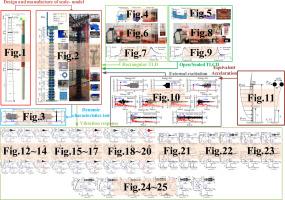

Abstract Image

查看原文
分享 分享
微信好友 朋友圈 QQ好友 复制链接
本刊更多论文
用于海上风力涡轮机支撑结构的 TLD/TLCD 振动控制振动台试验
本研究以 6.45MW OWT(海上风力涡轮机)为基础,专门设计了一个相似比为 1:15 的比例模型,用于振动台试验。该比例模型的顶部装有一个 TLD(调谐液体阻尼器),高度的 2/3 处装有一个 TLCD(调谐液柱阻尼器)。应用各种具有不同频谱特性的外部激励来分析 OWT 的振动特性和 TLD/TLCD 的阻尼性能。结果表明,动态特性满足原型模型和比例模型之间的相似比。OWT 的加速度响应受外部激励频谱的影响很大,而位移响应则主要受模型一阶固有频率的影响。在塔顶施加质量偏心和双向激励输入时,塔身会发生扭转变形,从而产生 "拍击振动 "现象。采用 TLD/TLCD 后,谐波激励下的振动响应衰减率可达 70%,地震激励下的衰减率可达 25%,等效基底加速度下的衰减率可达 50%。实施振动衰减后,时域响应显著降低,而且降低速度加快。在频域响应中,固有频率处的频谱峰值消失了。
本文章由计算机程序翻译,如有差异,请以英文原文为准。
求助全文
约1分钟内获得全文 去求助
来源期刊
Applied Ocean Research
Applied Ocean Research 地学-工程:大洋
CiteScore
8.70
自引率
7.00%
发文量
316
审稿时长
59 days
期刊介绍: The aim of Applied Ocean Research is to encourage the submission of papers that advance the state of knowledge in a range of topics relevant to ocean engineering.
期刊最新文献
Flow-induced buckling of a viscoelastic bistable structure in time varying flow Optimized time increments for stress time series in the substructure of a floating offshore wind turbine using a hybrid frequency–time domain approach Spatiotemporal numerical modeling of wave overtopping flow over dike crests and landward slopes Numerical and experimental investigation into field joint strain concentration in concrete-weight coated pipelines under bending Structural dynamics and resonance mitigation in upscaled floating offshore wind turbines: From 15 MW to 22 MW
×
引用
GB/T 7714-2015
复制
MLA
复制
APA
复制
导出至
BibTeX EndNote RefMan NoteFirst NoteExpress
×
×
提示
您的信息不完整,为了账户安全,请先补充。
现在去补充
×
提示
您因"违规操作"
具体请查看互助需知
我知道了
×
提示
现在去查看 取消
×
提示
确定
0
微信
客服QQ
Book学术公众号 扫码关注我们
反馈
×
意见反馈
请填写您的意见或建议
请填写您的手机或邮箱
已复制链接
已复制链接
快去分享给好友吧!
我知道了
×
扫码分享
扫码分享
Book学术官方微信
Book学术文献互助
Book学术文献互助群
群 号:604180095
Book学术
文献互助 智能选刊 最新文献 互助须知 联系我们:info@booksci.cn
Book学术提供免费学术资源搜索服务,方便国内外学者检索中英文文献。致力于提供最便捷和优质的服务体验。
Copyright © 2023 Book学术 All rights reserved.
ghs 京公网安备 11010802042870号 京ICP备2023020795号-1





