Porntip Sirayapiwat , Christiani A. Amorim , Wisan Sereepapong , Punkavee Tuntiviriyapun , Chanakarn Suebthawinkul , Paweena Thuwanut
{"title":"Application of fibrin-based biomaterial for human ovarian tissue encapsulation and cryopreservation as alternative approach for fertility preservation","authors":"Porntip Sirayapiwat , Christiani A. Amorim , Wisan Sereepapong , Punkavee Tuntiviriyapun , Chanakarn Suebthawinkul , Paweena Thuwanut","doi":"10.1016/j.cryobiol.2024.104955","DOIUrl":null,"url":null,"abstract":"<div><p>This study aimed to investigate the effects of fibrin-based hydrogel encapsulation, with or without vascular endothelial growth factor (VEGF), on follicle quality and cell survival signaling pathways after ovarian tissue cryopreservation. Ovarian cortex donated by seven patients (ages 44–47 years old) was divided into four groups: I) fresh control, II) ovarian tissue without encapsulation (non-FT), III) fibrin (10 mg/mL fibrinogen plus 50 IU/mL thrombin; 10FT) encapsulated tissue without VEGF, and IV) encapsulated tissue with 0.1 μg/mL VEGF (10FT-VEGF), followed by a slow freezing process. Evaluation criteria included normal follicle morphology, density, cell proliferation, apoptosis, and metabolism signaling pathways (<em>BAX/BCL-2</em> ratio, <em>CASPASE-3</em> and <em>9</em>, <em>ATP-6</em> genes, VEGF-A, and ERK-1/2 protein expression levels). Major outcomes revealed that the percentages of morphologically normal follicles and density were significantly decreased by cryopreservation. Ovarian tissue encapsulation using the 10FT formulation (with or without VEGF) could maintain the ERK-signaling cascade, which was comparable to the fresh control. Among the frozen-thawed cohorts, the <em>BAX/BCL-2</em> ratio, <em>CASPASE-3</em>, <em>CASPASE-9</em>, and <em>ATP-6</em> expression levels were unfavorable in the non-FT group. However, statistically different results, including VEGF-A expression levels, were not detected. Collectively, our present data demonstrated the first applicable biomaterial matrix for human ovarian tissue encapsulation which might create an optimal intra-ovarian cortex environment during cryopreservation. Further studies to optimize hydrogel polymerization should be expanded, given the potential benefits for cancer patients who wish to preserve fertility through ovarian tissue cryopreservation.</p></div>","PeriodicalId":10897,"journal":{"name":"Cryobiology","volume":"117 ","pages":"Article 104955"},"PeriodicalIF":2.1000,"publicationDate":"2024-12-01","publicationTypes":"Journal Article","fieldsOfStudy":null,"isOpenAccess":false,"openAccessPdf":"","citationCount":"0","resultStr":null,"platform":"Semanticscholar","paperid":null,"PeriodicalName":"Cryobiology","FirstCategoryId":"99","ListUrlMain":"https://www.sciencedirect.com/science/article/pii/S001122402400110X","RegionNum":3,"RegionCategory":"生物学","ArticlePicture":[],"TitleCN":null,"AbstractTextCN":null,"PMCID":null,"EPubDate":"2024/9/12 0:00:00","PubModel":"Epub","JCR":"Q2","JCRName":"BIOLOGY","Score":null,"Total":0}
引用次数: 0
Abstract
This study aimed to investigate the effects of fibrin-based hydrogel encapsulation, with or without vascular endothelial growth factor (VEGF), on follicle quality and cell survival signaling pathways after ovarian tissue cryopreservation. Ovarian cortex donated by seven patients (ages 44–47 years old) was divided into four groups: I) fresh control, II) ovarian tissue without encapsulation (non-FT), III) fibrin (10 mg/mL fibrinogen plus 50 IU/mL thrombin; 10FT) encapsulated tissue without VEGF, and IV) encapsulated tissue with 0.1 μg/mL VEGF (10FT-VEGF), followed by a slow freezing process. Evaluation criteria included normal follicle morphology, density, cell proliferation, apoptosis, and metabolism signaling pathways (BAX/BCL-2 ratio, CASPASE-3 and 9, ATP-6 genes, VEGF-A, and ERK-1/2 protein expression levels). Major outcomes revealed that the percentages of morphologically normal follicles and density were significantly decreased by cryopreservation. Ovarian tissue encapsulation using the 10FT formulation (with or without VEGF) could maintain the ERK-signaling cascade, which was comparable to the fresh control. Among the frozen-thawed cohorts, the BAX/BCL-2 ratio, CASPASE-3, CASPASE-9, and ATP-6 expression levels were unfavorable in the non-FT group. However, statistically different results, including VEGF-A expression levels, were not detected. Collectively, our present data demonstrated the first applicable biomaterial matrix for human ovarian tissue encapsulation which might create an optimal intra-ovarian cortex environment during cryopreservation. Further studies to optimize hydrogel polymerization should be expanded, given the potential benefits for cancer patients who wish to preserve fertility through ovarian tissue cryopreservation.
期刊介绍:
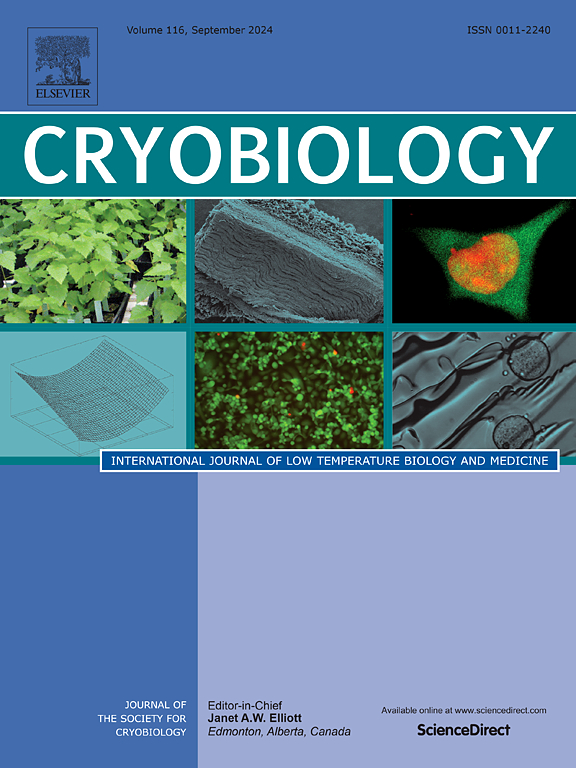
Cryobiology: International Journal of Low Temperature Biology and Medicine publishes research articles on all aspects of low temperature biology and medicine.
Research Areas include:
• Cryoprotective additives and their pharmacological actions
• Cryosurgery
• Freeze-drying
• Freezing
• Frost hardiness in plants
• Hibernation
• Hypothermia
• Medical applications of reduced temperature
• Perfusion of organs
• All pertinent methodologies
Cryobiology is the official journal of the Society for Cryobiology.



 京公网安备 11010802042870号
京ICP备2023020795号-1
京公网安备 11010802042870号
京ICP备2023020795号-1

 分享
分享
 求助内容:
求助内容: 应助结果提醒方式:
 扫码关注我们
