Yudha Gusti Wibowo , Mirza Trinanda Sahnur , Putri Sinar Al-Aziza , Hana Safitri , Dedy Anwar , Jarwinda , Anis Tatik Maryani , Sugeng Priyanto , Sudibyo , Ahmad Tawfiequrrahman Yuliansyah , Himawan Tri Bayu Murti Petrus
{"title":"Zeolite functionalized with macroalgae as novel material for Fe and Mn removal from real acid mine drainage","authors":"Yudha Gusti Wibowo , Mirza Trinanda Sahnur , Putri Sinar Al-Aziza , Hana Safitri , Dedy Anwar , Jarwinda , Anis Tatik Maryani , Sugeng Priyanto , Sudibyo , Ahmad Tawfiequrrahman Yuliansyah , Himawan Tri Bayu Murti Petrus","doi":"10.1016/j.biteb.2024.101951","DOIUrl":null,"url":null,"abstract":"<div><p>The treatment of heavy metals such as Fe and manganese Mn remains a critical global issue, necessitating solutions that are not only effective and efficient but also cost- effective and easy to implement. Adsorption has been identified as one of the most efficient techniques for removing heavy metals. This study investigates adsorption method applied to real AMD, characterized by high levels of heavy metal contamination and low pH. Key parameters analyzed include adsorption performance, isotherm and kinetic models, thermodynamic properties, and adsorption characteristics. The adsorbent used was zeolite functionalized with carboxyl, hydroxyl, and sulfate groups derived from macroalgae. Material characterization was conducted using SEM, XRD, and FTIR. The results indicate that zeolite functionalized with carboxyl, hydroxyl, and sulfate groups from macroalgae effectively reduced Fe and Mn concentrations by up to 99 % within just five minutes. Furthermore, the adsorption process followed a pseudo-second-order kinetic model and conformed to the Langmuir isotherm model.</p></div>","PeriodicalId":8947,"journal":{"name":"Bioresource Technology Reports","volume":"27 ","pages":"Article 101951"},"PeriodicalIF":0.0000,"publicationDate":"2024-09-01","publicationTypes":"Journal Article","fieldsOfStudy":null,"isOpenAccess":false,"openAccessPdf":"","citationCount":"0","resultStr":null,"platform":"Semanticscholar","paperid":null,"PeriodicalName":"Bioresource Technology Reports","FirstCategoryId":"1085","ListUrlMain":"https://www.sciencedirect.com/science/article/pii/S2589014X24001920","RegionNum":0,"RegionCategory":null,"ArticlePicture":[],"TitleCN":null,"AbstractTextCN":null,"PMCID":null,"EPubDate":"2024/9/2 0:00:00","PubModel":"Epub","JCR":"Q1","JCRName":"Environmental Science","Score":null,"Total":0}
引用次数: 0
Abstract
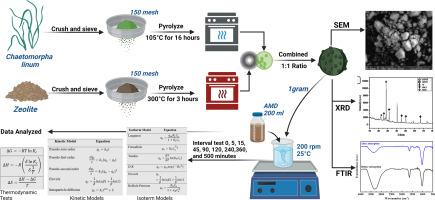
The treatment of heavy metals such as Fe and manganese Mn remains a critical global issue, necessitating solutions that are not only effective and efficient but also cost- effective and easy to implement. Adsorption has been identified as one of the most efficient techniques for removing heavy metals. This study investigates adsorption method applied to real AMD, characterized by high levels of heavy metal contamination and low pH. Key parameters analyzed include adsorption performance, isotherm and kinetic models, thermodynamic properties, and adsorption characteristics. The adsorbent used was zeolite functionalized with carboxyl, hydroxyl, and sulfate groups derived from macroalgae. Material characterization was conducted using SEM, XRD, and FTIR. The results indicate that zeolite functionalized with carboxyl, hydroxyl, and sulfate groups from macroalgae effectively reduced Fe and Mn concentrations by up to 99 % within just five minutes. Furthermore, the adsorption process followed a pseudo-second-order kinetic model and conformed to the Langmuir isotherm model.





 京公网安备 11010802042870号
京ICP备2023020795号-1
京公网安备 11010802042870号
京ICP备2023020795号-1

 分享
分享
 求助内容:
求助内容: 应助结果提醒方式:
 扫码关注我们
