{"title":"Sushi Domain Containing 2 Dysfunction Contributes to Cancer Progression in Patients with Bladder Cancer.","authors":"Wei-Ting Kuo, Yi-Chen Lee, Yi-Fang Yang, Ching-Feng Cheng, Ching-Jiunn Tseng, Kuo-Wang Tsai","doi":"10.7150/jca.97537","DOIUrl":null,"url":null,"abstract":"<p><p>Bladder cancer is the most prevalent type of cancer in Taiwan, and therefore, enhancing the diagnostic sensitivity of biomarkers for early-stage tumors and identifying therapeutic targets to improve patient survival rates are essential. Although Sushi Domain Containing 2 (SUSD2) dysfunction has been identified in several types of human cancer, its biological role in bladder cancer remains unclear. Analysis of The Cancer Genome Atlas revealed significantly higher expression of SUSD2 mRNA in bladder cancer tissues than in adjacent normal tissues. This elevated expression of SUSD2 significantly correlated with pathological stage (<i>p</i> = 0.029), pN stage (<i>p</i> < 0.001), and pM stage (<i>p</i> = 0.047). Univariate analysis revealed that high SUSD2 expression was associated with decreased overall survival (crude hazard ratio = 1.70, 95% confidence interval = 1.13-2.56, <i>p</i> = 0.01). Multivariate analysis revealed a significant correlation between high SUSD2 expression and poor survival outcomes (adjusted hazard ratio = 1.53, 95% confidence interval = 1.01-2.31, <i>p</i> = 0.043). IHC analysis revealed a significant correlation between elevated SUSD2 protein levels and unfavorable pathological stages (<i>p</i> < 0.001). SUSD2 suppression significantly reduced the proliferation, colony formation, and invasion of bladder cancer cells. In addition, cell cycle analysis revealed that SUSD2 knockdown induced G2/M phase arrestin bladder cancer cells. Tumor Immune Estimation Resource analysis indicated that expression of SUSD2 was significantly associated with macrophage infiltration and M2 macrophage polarization in bladder cancer. In addition, miR-383-5p directly targeted the 3'UTR of SUSD2, with its ectopic expression inhibiting the growth and motility of bladder cancer cells. Our study revealed that miR-383-5p/SUSD2 axis dysfunction may contribute to a poor prognosis for bladder cancer by affecting cell growth, metastasis, and the tumor microenvironment.</p>","PeriodicalId":15183,"journal":{"name":"Journal of Cancer","volume":"15 16","pages":"5318-5328"},"PeriodicalIF":3.2000,"publicationDate":"2024-08-13","publicationTypes":"Journal Article","fieldsOfStudy":null,"isOpenAccess":false,"openAccessPdf":"https://www.ncbi.nlm.nih.gov/pmc/articles/PMC11375537/pdf/","citationCount":"0","resultStr":null,"platform":"Semanticscholar","paperid":null,"PeriodicalName":"Journal of Cancer","FirstCategoryId":"3","ListUrlMain":"https://doi.org/10.7150/jca.97537","RegionNum":3,"RegionCategory":"医学","ArticlePicture":[],"TitleCN":null,"AbstractTextCN":null,"PMCID":null,"EPubDate":"2024/1/1 0:00:00","PubModel":"eCollection","JCR":"Q2","JCRName":"ONCOLOGY","Score":null,"Total":0}
引用次数: 0
Abstract
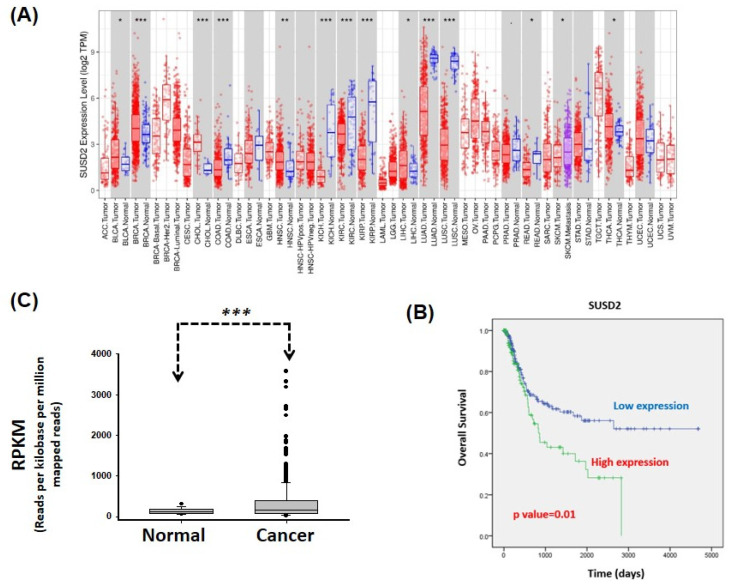
Bladder cancer is the most prevalent type of cancer in Taiwan, and therefore, enhancing the diagnostic sensitivity of biomarkers for early-stage tumors and identifying therapeutic targets to improve patient survival rates are essential. Although Sushi Domain Containing 2 (SUSD2) dysfunction has been identified in several types of human cancer, its biological role in bladder cancer remains unclear. Analysis of The Cancer Genome Atlas revealed significantly higher expression of SUSD2 mRNA in bladder cancer tissues than in adjacent normal tissues. This elevated expression of SUSD2 significantly correlated with pathological stage (p = 0.029), pN stage (p < 0.001), and pM stage (p = 0.047). Univariate analysis revealed that high SUSD2 expression was associated with decreased overall survival (crude hazard ratio = 1.70, 95% confidence interval = 1.13-2.56, p = 0.01). Multivariate analysis revealed a significant correlation between high SUSD2 expression and poor survival outcomes (adjusted hazard ratio = 1.53, 95% confidence interval = 1.01-2.31, p = 0.043). IHC analysis revealed a significant correlation between elevated SUSD2 protein levels and unfavorable pathological stages (p < 0.001). SUSD2 suppression significantly reduced the proliferation, colony formation, and invasion of bladder cancer cells. In addition, cell cycle analysis revealed that SUSD2 knockdown induced G2/M phase arrestin bladder cancer cells. Tumor Immune Estimation Resource analysis indicated that expression of SUSD2 was significantly associated with macrophage infiltration and M2 macrophage polarization in bladder cancer. In addition, miR-383-5p directly targeted the 3'UTR of SUSD2, with its ectopic expression inhibiting the growth and motility of bladder cancer cells. Our study revealed that miR-383-5p/SUSD2 axis dysfunction may contribute to a poor prognosis for bladder cancer by affecting cell growth, metastasis, and the tumor microenvironment.
期刊介绍:
Journal of Cancer is an open access, peer-reviewed journal with broad scope covering all areas of cancer research, especially novel concepts, new methods, new regimens, new therapeutic agents, and alternative approaches for early detection and intervention of cancer. The Journal is supported by an international editorial board consisting of a distinguished team of cancer researchers. Journal of Cancer aims at rapid publication of high quality results in cancer research while maintaining rigorous peer-review process.





 京公网安备 11010802042870号
京ICP备2023020795号-1
京公网安备 11010802042870号
京ICP备2023020795号-1

 分享
分享
 求助内容:
求助内容: 应助结果提醒方式:
 扫码关注我们
