Mahalakshmi Kamalakannan, John Thomas and Natarajan Chandrasekaran
{"title":"Humic acid alleviates the toxicity of polystyrene nanoplastics in combination with their copper nanoparticle co-pollutants in Artemia salina","authors":"Mahalakshmi Kamalakannan, John Thomas and Natarajan Chandrasekaran","doi":"10.1039/D4EN00437J","DOIUrl":null,"url":null,"abstract":"<p >Polystyrene nanoplastics (PSNPs) have become a ubiquitous environmental threat that can harm living organisms. Other pollutants such as copper nanoparticles (CuNPs) bind with PSNPs and humic acid (HA), alleviating the toxicity of PSNPs. In this study, individual PSNPs were interacted with CuNPs and HA to study their combined toxicity on <em>Artemia salina</em>. The size of PSNPs increased after 72 h of interaction with CuNPs. FTIR spectroscopy analysis confirmed that CuNPs bind to the surface of PSNPs. It was found that HA adsorbed more strongly onto PSNPs than CuNPs. Field emission scanning electron microscopy (FESEM) and energy-dispersive X-ray (EDX) spectroscopy confirmed the adsorption of HA and CuNPs onto the surface of PSNPs. Toxicity experiments showed a decreased toxicity of PSNPs and CuNPs upon their combination with HA (humic acid). Microscopic analysis showed particle accumulation in <em>Artemia salina</em>. The mortality rate of <em>Artemia salina</em> is higher in PSNP + CuNP combination. PSNPs + CuNPs showed higher production of antioxidant enzymes, and PSNPs + CuNPs + HA showed lower toxicity. This study shows that the presence of HA can lead to a reduction in the toxicity of PSNPs and CuNPs, suggesting their potential application in environmental remediation.</p>","PeriodicalId":73,"journal":{"name":"Environmental Science: Nano","volume":" 10","pages":" 4074-4088"},"PeriodicalIF":5.1000,"publicationDate":"2024-09-09","publicationTypes":"Journal Article","fieldsOfStudy":null,"isOpenAccess":false,"openAccessPdf":"","citationCount":"0","resultStr":null,"platform":"Semanticscholar","paperid":null,"PeriodicalName":"Environmental Science: Nano","FirstCategoryId":"6","ListUrlMain":"https://pubs.rsc.org/en/content/articlelanding/2024/en/d4en00437j","RegionNum":2,"RegionCategory":"环境科学与生态学","ArticlePicture":[],"TitleCN":null,"AbstractTextCN":null,"PMCID":null,"EPubDate":"","PubModel":"","JCR":"Q1","JCRName":"CHEMISTRY, MULTIDISCIPLINARY","Score":null,"Total":0}
引用次数: 0
Abstract
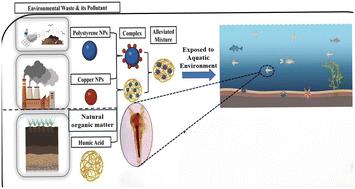
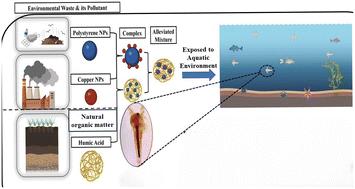
Polystyrene nanoplastics (PSNPs) have become a ubiquitous environmental threat that can harm living organisms. Other pollutants such as copper nanoparticles (CuNPs) bind with PSNPs and humic acid (HA), alleviating the toxicity of PSNPs. In this study, individual PSNPs were interacted with CuNPs and HA to study their combined toxicity on Artemia salina. The size of PSNPs increased after 72 h of interaction with CuNPs. FTIR spectroscopy analysis confirmed that CuNPs bind to the surface of PSNPs. It was found that HA adsorbed more strongly onto PSNPs than CuNPs. Field emission scanning electron microscopy (FESEM) and energy-dispersive X-ray (EDX) spectroscopy confirmed the adsorption of HA and CuNPs onto the surface of PSNPs. Toxicity experiments showed a decreased toxicity of PSNPs and CuNPs upon their combination with HA (humic acid). Microscopic analysis showed particle accumulation in Artemia salina. The mortality rate of Artemia salina is higher in PSNP + CuNP combination. PSNPs + CuNPs showed higher production of antioxidant enzymes, and PSNPs + CuNPs + HA showed lower toxicity. This study shows that the presence of HA can lead to a reduction in the toxicity of PSNPs and CuNPs, suggesting their potential application in environmental remediation.
期刊介绍:
Environmental Science: Nano serves as a comprehensive and high-impact peer-reviewed source of information on the design and demonstration of engineered nanomaterials for environment-based applications. It also covers the interactions between engineered, natural, and incidental nanomaterials with biological and environmental systems. This scope includes, but is not limited to, the following topic areas:
Novel nanomaterial-based applications for water, air, soil, food, and energy sustainability
Nanomaterial interactions with biological systems and nanotoxicology
Environmental fate, reactivity, and transformations of nanoscale materials
Nanoscale processes in the environment
Sustainable nanotechnology including rational nanomaterial design, life cycle assessment, risk/benefit analysis




 京公网安备 11010802042870号
京ICP备2023020795号-1
京公网安备 11010802042870号
京ICP备2023020795号-1

 分享
分享
 求助内容:
求助内容: 应助结果提醒方式:
 扫码关注我们
