Kai Tong Woo , Rashid Shamsuddin , Mohd Hakimi , M. Devendran Manogaran , Lee Wen Looi , Ze Sen Tan , Abdulhalim Musa Abubakar
{"title":"Co-composting of Black Soldier Fly Frass (BSFF) with various organics additives for nutrient enhancement","authors":"Kai Tong Woo , Rashid Shamsuddin , Mohd Hakimi , M. Devendran Manogaran , Lee Wen Looi , Ze Sen Tan , Abdulhalim Musa Abubakar","doi":"10.1016/j.biteb.2024.101944","DOIUrl":null,"url":null,"abstract":"<div><p>Black soldier fly frass is the nutrient-rich waste produced by black soldier fly larvae. This study aimed to enhance the frass by co-composting it with fish meal, bone meal, boiler ash, and sawdust. The co-composting process involved blending frass with the selected materials to achieve C:N ratio of 20, 25 and 30. After co-composting, characterization of total carbon, nitrogen, phosphorus and potassium contents and germination test were conducted. Fish meal increased nitrogen from 2.47 % to 3.10 %, bone meal improved phosphorus from 0.024 % to 0.042 %, and boiler ash raised potassium from 0.0023 % to 0.0039 %. Nevertheless, all the NPK source additives are required to balance and enhance all the nutrient level. Additionally, composts BSFF, fish meal, bone meal, and boiler ash, resulted in 100 % seed germination. The study demonstrates that co-composting frass with these materials effectively improves its nutrient content, providing a sustainable alternative for organic waste management and nutrient recycling.</p></div>","PeriodicalId":8947,"journal":{"name":"Bioresource Technology Reports","volume":"27 ","pages":"Article 101944"},"PeriodicalIF":0.0000,"publicationDate":"2024-09-01","publicationTypes":"Journal Article","fieldsOfStudy":null,"isOpenAccess":false,"openAccessPdf":"https://www.sciencedirect.com/science/article/pii/S2589014X24001853/pdfft?md5=6df966286c6186e5c341b870b741c022&pid=1-s2.0-S2589014X24001853-main.pdf","citationCount":"0","resultStr":null,"platform":"Semanticscholar","paperid":null,"PeriodicalName":"Bioresource Technology Reports","FirstCategoryId":"1085","ListUrlMain":"https://www.sciencedirect.com/science/article/pii/S2589014X24001853","RegionNum":0,"RegionCategory":null,"ArticlePicture":[],"TitleCN":null,"AbstractTextCN":null,"PMCID":null,"EPubDate":"2024/8/26 0:00:00","PubModel":"Epub","JCR":"Q1","JCRName":"Environmental Science","Score":null,"Total":0}
引用次数: 0
Abstract
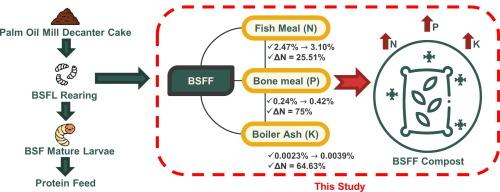
Black soldier fly frass is the nutrient-rich waste produced by black soldier fly larvae. This study aimed to enhance the frass by co-composting it with fish meal, bone meal, boiler ash, and sawdust. The co-composting process involved blending frass with the selected materials to achieve C:N ratio of 20, 25 and 30. After co-composting, characterization of total carbon, nitrogen, phosphorus and potassium contents and germination test were conducted. Fish meal increased nitrogen from 2.47 % to 3.10 %, bone meal improved phosphorus from 0.024 % to 0.042 %, and boiler ash raised potassium from 0.0023 % to 0.0039 %. Nevertheless, all the NPK source additives are required to balance and enhance all the nutrient level. Additionally, composts BSFF, fish meal, bone meal, and boiler ash, resulted in 100 % seed germination. The study demonstrates that co-composting frass with these materials effectively improves its nutrient content, providing a sustainable alternative for organic waste management and nutrient recycling.




 京公网安备 11010802042870号
京ICP备2023020795号-1
京公网安备 11010802042870号
京ICP备2023020795号-1

 分享
分享
 求助内容:
求助内容: 应助结果提醒方式:
 扫码关注我们
