{"title":"Noninvasive EEG-Based Intelligent Mobile Robots: A Systematic Review","authors":"Hongqi Li;Xiaoya Li;José R. del Millán","doi":"10.1109/TASE.2024.3441055","DOIUrl":null,"url":null,"abstract":"Brain-controlled mobile robotics can provide restoration of mobility for individuals with severe physical disabilities and empower healthy people with a broader reachable range in particular environments, which have been flourished over the past twenty years. This paper conducts a systematic state-of-the-art overview of noninvasive EEG-based intelligent mobile robots. We first present the general architecture and basic concepts, typical system types, and main research efforts on the whole-system design. Then, relevant key techniques associated with the brain-machine interfaces (BMIs), control strategies, and robot intelligence are reviewed to elucidate the research progress of the overall system. System performance evaluation is critical and complicated, here we summarize the conditions of the recruited participants, the experimental protocol, tasks and environments, with an emphasis on evaluation metrics regarding BMI performance, navigation performance, system robustness, and the user. We further highlight the remaining challenges and the potential research directions of future work. This study with informative outline is envisioned to enhance current understanding and suggest the future perspectives on EEG-based mobile robotic devices. Note to Practitioners—The brain-computer interfaces (BCIs) can provide a novel and feasible way to convey the users’ intentions to the terminal devices through the brain signals, which has exhibited emerging prospects in both civil and military applications thus having attracted increasing interests in researchers, industries, and government. The integration of noninvasive electroencephalogram (EEG)-based BCIs and expanded wheeled robotics have potentials to improve the human daily life with enhanced level of mobility, exhibiting significant socioeconomic impacts. This paper provides a systematic review of the EEG-based intelligent mobile robots from the aspects of key milestones, key techniques, and performance evaluation. To bring such the next generation assistive products from the laboratory to real applications, this paper further highlights the remaining challenges and shed light on the potential future work.","PeriodicalId":51060,"journal":{"name":"IEEE Transactions on Automation Science and Engineering","volume":"22 ","pages":"6291-6315"},"PeriodicalIF":6.4000,"publicationDate":"2024-09-12","publicationTypes":"Journal Article","fieldsOfStudy":null,"isOpenAccess":false,"openAccessPdf":"","citationCount":"0","resultStr":null,"platform":"Semanticscholar","paperid":null,"PeriodicalName":"IEEE Transactions on Automation Science and Engineering","FirstCategoryId":"94","ListUrlMain":"https://ieeexplore.ieee.org/document/10679603/","RegionNum":2,"RegionCategory":"计算机科学","ArticlePicture":[],"TitleCN":null,"AbstractTextCN":null,"PMCID":null,"EPubDate":"","PubModel":"","JCR":"Q1","JCRName":"AUTOMATION & CONTROL SYSTEMS","Score":null,"Total":0}
引用次数: 0
Abstract
Brain-controlled mobile robotics can provide restoration of mobility for individuals with severe physical disabilities and empower healthy people with a broader reachable range in particular environments, which have been flourished over the past twenty years. This paper conducts a systematic state-of-the-art overview of noninvasive EEG-based intelligent mobile robots. We first present the general architecture and basic concepts, typical system types, and main research efforts on the whole-system design. Then, relevant key techniques associated with the brain-machine interfaces (BMIs), control strategies, and robot intelligence are reviewed to elucidate the research progress of the overall system. System performance evaluation is critical and complicated, here we summarize the conditions of the recruited participants, the experimental protocol, tasks and environments, with an emphasis on evaluation metrics regarding BMI performance, navigation performance, system robustness, and the user. We further highlight the remaining challenges and the potential research directions of future work. This study with informative outline is envisioned to enhance current understanding and suggest the future perspectives on EEG-based mobile robotic devices. Note to Practitioners—The brain-computer interfaces (BCIs) can provide a novel and feasible way to convey the users’ intentions to the terminal devices through the brain signals, which has exhibited emerging prospects in both civil and military applications thus having attracted increasing interests in researchers, industries, and government. The integration of noninvasive electroencephalogram (EEG)-based BCIs and expanded wheeled robotics have potentials to improve the human daily life with enhanced level of mobility, exhibiting significant socioeconomic impacts. This paper provides a systematic review of the EEG-based intelligent mobile robots from the aspects of key milestones, key techniques, and performance evaluation. To bring such the next generation assistive products from the laboratory to real applications, this paper further highlights the remaining challenges and shed light on the potential future work.
期刊介绍:
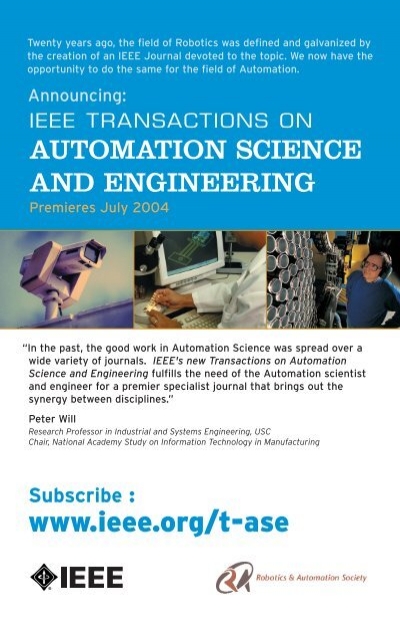
The IEEE Transactions on Automation Science and Engineering (T-ASE) publishes fundamental papers on Automation, emphasizing scientific results that advance efficiency, quality, productivity, and reliability. T-ASE encourages interdisciplinary approaches from computer science, control systems, electrical engineering, mathematics, mechanical engineering, operations research, and other fields. T-ASE welcomes results relevant to industries such as agriculture, biotechnology, healthcare, home automation, maintenance, manufacturing, pharmaceuticals, retail, security, service, supply chains, and transportation. T-ASE addresses a research community willing to integrate knowledge across disciplines and industries. For this purpose, each paper includes a Note to Practitioners that summarizes how its results can be applied or how they might be extended to apply in practice.



 京公网安备 11010802042870号
京ICP备2023020795号-1
京公网安备 11010802042870号
京ICP备2023020795号-1

 分享
分享
 求助内容:
求助内容: 应助结果提醒方式:
 扫码关注我们
