{"title":"Conflict-Free Routing of Twin Reclaimers in the Stockyard Based on a Time-Space Network Model","authors":"Jianbin Xin;Chang Liu;Andrea D’Ariano;Shi Qiang Liu;Jing Liang","doi":"10.1109/TASE.2024.3454226","DOIUrl":null,"url":null,"abstract":"In the stockyard of dry bulk materials such as coal and iron ore, multiple stacker-reclaimers operate collaboratively to enhance stockyard productivity. However, effectively planning the routes for these interconnected machines presents a significant challenge. We propose a new modeling framework for this conflict-free routing problem in which the reclaiming process is modeled in a so-called time-space network (TSN) framework. The formulated optimization problem is mixed integer programming (MIP), which has been proven NP-hard. To address its computational efficiency, we develop a two-level metaheuristic algorithm to simplify the encoding complexity of the original problem. In the developed two-level algorithm, a task priority ordering candidate is listed at the top level, while the detailed conflict-free routes are constructed at the bottom level using an insertion-based conflict-free reclaiming and customized route improvement. The developed metaheuristic is tested on a large number of instances in comparison with the Gurobi solver and three commonly used methods for such a routing problem. The experimental results show that the proposed algorithm outperforms the other four methods regarding the solution quality and the computation time. Note to Practitioners—This study is motivated by the need for efficient route planning of interconnected reclaimers in the stockyard of dry bulk materials such as coal and iron ore. To address this problem, we present a novel modeling framework for addressing the conflict-free routing problem, wherein the reclaiming process is intricately modeled within a so-called time-space network framework. Solving the resulting mixed-integer programming is of high computational complexity; therefore, we have engineered a two-level metaheuristic framework to reduce its complexity. The developed methodology has been extensively tested on instances featuring real-world stockyard operations and contributes to terminal operators by improving productivity and resulting in more economic benefits. Future research will integrate real-time data and dynamic optimization techniques to facilitate routing decisions that can adapt to evolving operational conditions and stockyard configurations.","PeriodicalId":51060,"journal":{"name":"IEEE Transactions on Automation Science and Engineering","volume":"22 ","pages":"7335-7348"},"PeriodicalIF":6.4000,"publicationDate":"2024-09-12","publicationTypes":"Journal Article","fieldsOfStudy":null,"isOpenAccess":false,"openAccessPdf":"","citationCount":"0","resultStr":null,"platform":"Semanticscholar","paperid":null,"PeriodicalName":"IEEE Transactions on Automation Science and Engineering","FirstCategoryId":"94","ListUrlMain":"https://ieeexplore.ieee.org/document/10679623/","RegionNum":2,"RegionCategory":"计算机科学","ArticlePicture":[],"TitleCN":null,"AbstractTextCN":null,"PMCID":null,"EPubDate":"","PubModel":"","JCR":"Q1","JCRName":"AUTOMATION & CONTROL SYSTEMS","Score":null,"Total":0}
引用次数: 0
Abstract
In the stockyard of dry bulk materials such as coal and iron ore, multiple stacker-reclaimers operate collaboratively to enhance stockyard productivity. However, effectively planning the routes for these interconnected machines presents a significant challenge. We propose a new modeling framework for this conflict-free routing problem in which the reclaiming process is modeled in a so-called time-space network (TSN) framework. The formulated optimization problem is mixed integer programming (MIP), which has been proven NP-hard. To address its computational efficiency, we develop a two-level metaheuristic algorithm to simplify the encoding complexity of the original problem. In the developed two-level algorithm, a task priority ordering candidate is listed at the top level, while the detailed conflict-free routes are constructed at the bottom level using an insertion-based conflict-free reclaiming and customized route improvement. The developed metaheuristic is tested on a large number of instances in comparison with the Gurobi solver and three commonly used methods for such a routing problem. The experimental results show that the proposed algorithm outperforms the other four methods regarding the solution quality and the computation time. Note to Practitioners—This study is motivated by the need for efficient route planning of interconnected reclaimers in the stockyard of dry bulk materials such as coal and iron ore. To address this problem, we present a novel modeling framework for addressing the conflict-free routing problem, wherein the reclaiming process is intricately modeled within a so-called time-space network framework. Solving the resulting mixed-integer programming is of high computational complexity; therefore, we have engineered a two-level metaheuristic framework to reduce its complexity. The developed methodology has been extensively tested on instances featuring real-world stockyard operations and contributes to terminal operators by improving productivity and resulting in more economic benefits. Future research will integrate real-time data and dynamic optimization techniques to facilitate routing decisions that can adapt to evolving operational conditions and stockyard configurations.
期刊介绍:
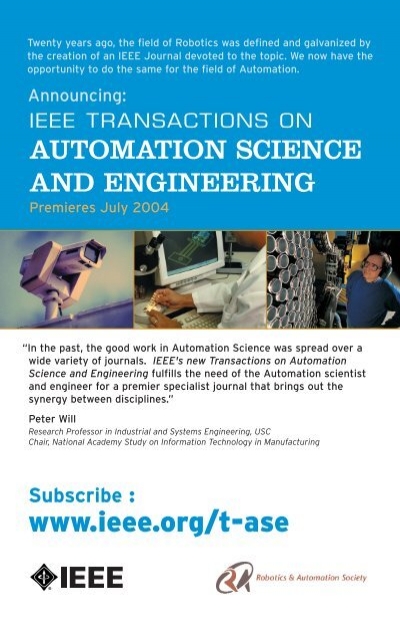
The IEEE Transactions on Automation Science and Engineering (T-ASE) publishes fundamental papers on Automation, emphasizing scientific results that advance efficiency, quality, productivity, and reliability. T-ASE encourages interdisciplinary approaches from computer science, control systems, electrical engineering, mathematics, mechanical engineering, operations research, and other fields. T-ASE welcomes results relevant to industries such as agriculture, biotechnology, healthcare, home automation, maintenance, manufacturing, pharmaceuticals, retail, security, service, supply chains, and transportation. T-ASE addresses a research community willing to integrate knowledge across disciplines and industries. For this purpose, each paper includes a Note to Practitioners that summarizes how its results can be applied or how they might be extended to apply in practice.



 京公网安备 11010802042870号
京ICP备2023020795号-1
京公网安备 11010802042870号
京ICP备2023020795号-1

 分享
分享
 求助内容:
求助内容: 应助结果提醒方式:
 扫码关注我们
