M. Johnsi, V. J. Asha Shalini, M. Azhagulakshmi, B. Kavin Kumar, N. Balasubramanian
{"title":"Exploration of Optimization Strategies for Locking Sulfur in 2D Layered/Polymer-Enveloped Cathode Composite for High Power Li-S Batteries","authors":"M. Johnsi, V. J. Asha Shalini, M. Azhagulakshmi, B. Kavin Kumar, N. Balasubramanian","doi":"10.1002/cphc.202400415","DOIUrl":null,"url":null,"abstract":"<p>In Lithium sulfur (Li−S) batteries the sulfur host material is a significant area of research that could impart enhanced conductivity and alleviate the shuttling of polysulfides. In the present study, graphene oxide- sulfur, GO-S was synthesized in melt diffusion method by exploring the two different strategies: Ambient (G2-M) and Inert (G2-T) conditions. Within the cathode, efficient storage of S with sufficient space in GO interlayers was outperformed by G2-T method. Further with PEDOT nanostructures enveloped by oxidative polymerisation proves to be a robust conductive layer and an adsorbing agent. It is evidenced physicochemically by XRD, FTIR, TGA, HR-SEM. Moreover, in addition to the supporting studies, high binding energies of 168.3 and 169.5 eV confirms the superior performance of PEDOT/GO-S (G3-T) as most suitable cathode within the system. The electrochemical behaviour of G3-T possess very low cell impedance with an excellent cyclic reversibility in CV during (de)lithiation process. At 0.1 C, an initial discharge capacity of 868 mAh g<sup>−1</sup> has been achieved confirming a high catalytic activity with a low polarisation potential of (ΔE=0.25) inducing fast reaction kinetics. Thus potential locking of sulfur under inert condition is explored with a proven OCV of 2.3 V with red LED glow.</p>","PeriodicalId":9819,"journal":{"name":"Chemphyschem","volume":"25 22","pages":""},"PeriodicalIF":2.2000,"publicationDate":"2024-09-11","publicationTypes":"Journal Article","fieldsOfStudy":null,"isOpenAccess":false,"openAccessPdf":"","citationCount":"0","resultStr":null,"platform":"Semanticscholar","paperid":null,"PeriodicalName":"Chemphyschem","FirstCategoryId":"92","ListUrlMain":"https://chemistry-europe.onlinelibrary.wiley.com/doi/10.1002/cphc.202400415","RegionNum":3,"RegionCategory":"化学","ArticlePicture":[],"TitleCN":null,"AbstractTextCN":null,"PMCID":null,"EPubDate":"","PubModel":"","JCR":"Q3","JCRName":"CHEMISTRY, PHYSICAL","Score":null,"Total":0}
引用次数: 0
Abstract
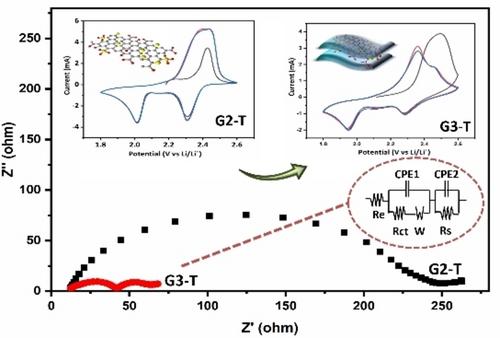
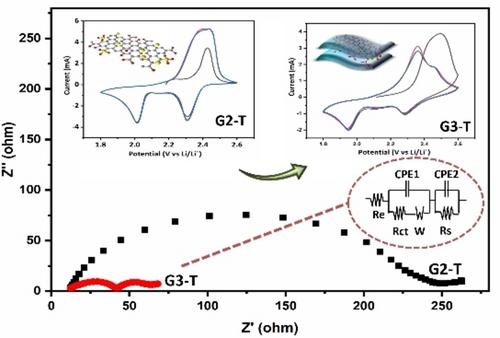
In Lithium sulfur (Li−S) batteries the sulfur host material is a significant area of research that could impart enhanced conductivity and alleviate the shuttling of polysulfides. In the present study, graphene oxide- sulfur, GO-S was synthesized in melt diffusion method by exploring the two different strategies: Ambient (G2-M) and Inert (G2-T) conditions. Within the cathode, efficient storage of S with sufficient space in GO interlayers was outperformed by G2-T method. Further with PEDOT nanostructures enveloped by oxidative polymerisation proves to be a robust conductive layer and an adsorbing agent. It is evidenced physicochemically by XRD, FTIR, TGA, HR-SEM. Moreover, in addition to the supporting studies, high binding energies of 168.3 and 169.5 eV confirms the superior performance of PEDOT/GO-S (G3-T) as most suitable cathode within the system. The electrochemical behaviour of G3-T possess very low cell impedance with an excellent cyclic reversibility in CV during (de)lithiation process. At 0.1 C, an initial discharge capacity of 868 mAh g−1 has been achieved confirming a high catalytic activity with a low polarisation potential of (ΔE=0.25) inducing fast reaction kinetics. Thus potential locking of sulfur under inert condition is explored with a proven OCV of 2.3 V with red LED glow.
期刊介绍:
ChemPhysChem is one of the leading chemistry/physics interdisciplinary journals (ISI Impact Factor 2018: 3.077) for physical chemistry and chemical physics. It is published on behalf of Chemistry Europe, an association of 16 European chemical societies.
ChemPhysChem is an international source for important primary and critical secondary information across the whole field of physical chemistry and chemical physics. It integrates this wide and flourishing field ranging from Solid State and Soft-Matter Research, Electro- and Photochemistry, Femtochemistry and Nanotechnology, Complex Systems, Single-Molecule Research, Clusters and Colloids, Catalysis and Surface Science, Biophysics and Physical Biochemistry, Atmospheric and Environmental Chemistry, and many more topics. ChemPhysChem is peer-reviewed.



 京公网安备 11010802042870号
京ICP备2023020795号-1
京公网安备 11010802042870号
京ICP备2023020795号-1

 分享
分享
 求助内容:
求助内容: 应助结果提醒方式:
 扫码关注我们
