Geoffrey Yuet Mun Wong, Jun Li, Matthew McKay, Miguel Castaneda, Nazim Bhimani, Connie Diakos, Thomas J. Hugh, Mark P. Molloy
{"title":"Proteogenomic Characterization of Early Intrahepatic Recurrence after Curative-Intent Treatment of Colorectal Liver Metastases","authors":"Geoffrey Yuet Mun Wong, Jun Li, Matthew McKay, Miguel Castaneda, Nazim Bhimani, Connie Diakos, Thomas J. Hugh, Mark P. Molloy","doi":"10.1021/acs.jproteome.4c00440","DOIUrl":null,"url":null,"abstract":"Clinical and pathological factors are insufficient to accurately identify patients at risk of early recurrence after curative-intent treatment of colorectal liver metastases (CRLM). This study aimed to identify candidate prognostic proteogenomic biomarkers for early intrahepatic recurrence after curative-intent resection of CRLM. Patients diagnosed with intrahepatic recurrence within 6 months of liver resection were categorized as the “early recurrence” group, while those who achieved a recurrence-free status for 10 years were designated as “durable remission”. Comprehensive genomic and proteomic profiling of fresh frozen samples from these prognostically distinct groups was performed using the TruSight Oncology 500 assay and label-free data-dependent acquisition liquid chromatography–mass spectrometry. Genetic alterations were identified in 117 of the 523 profiled genes in patients with early recurrence. The most common somatic mutations linked to early recurrence were <i>TP53</i> (88%), <i>APC</i> (71%), <i>KRAS</i> (38%), and <i>SMAD4</i> (21%). <i>SMAD4</i> alterations were absent in samples from patients with a durable remission. Calponin-2, versican core protein, glutathione peroxidase 3, fibulin-5, and amyloid-β precursor protein were upregulated more than 2-fold in early recurrence. Exploratory analysis of these proteogenomic biomarkers suggests that <i>SMAD4</i>, calponin-2, and glutathione peroxidase 3 may have the potential to predict early recurrence, enabling improved prognostication and precision oncology in CRLM.","PeriodicalId":48,"journal":{"name":"Journal of Proteome Research","volume":"11 1","pages":""},"PeriodicalIF":3.6000,"publicationDate":"2024-09-12","publicationTypes":"Journal Article","fieldsOfStudy":null,"isOpenAccess":false,"openAccessPdf":"","citationCount":"0","resultStr":null,"platform":"Semanticscholar","paperid":null,"PeriodicalName":"Journal of Proteome Research","FirstCategoryId":"99","ListUrlMain":"https://doi.org/10.1021/acs.jproteome.4c00440","RegionNum":2,"RegionCategory":"生物学","ArticlePicture":[],"TitleCN":null,"AbstractTextCN":null,"PMCID":null,"EPubDate":"","PubModel":"","JCR":"Q1","JCRName":"BIOCHEMICAL RESEARCH METHODS","Score":null,"Total":0}
引用次数: 0
Abstract
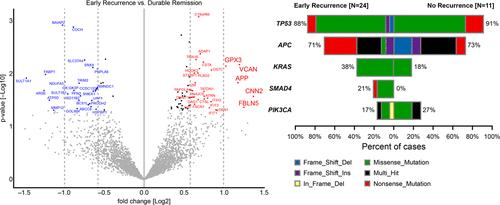
Clinical and pathological factors are insufficient to accurately identify patients at risk of early recurrence after curative-intent treatment of colorectal liver metastases (CRLM). This study aimed to identify candidate prognostic proteogenomic biomarkers for early intrahepatic recurrence after curative-intent resection of CRLM. Patients diagnosed with intrahepatic recurrence within 6 months of liver resection were categorized as the “early recurrence” group, while those who achieved a recurrence-free status for 10 years were designated as “durable remission”. Comprehensive genomic and proteomic profiling of fresh frozen samples from these prognostically distinct groups was performed using the TruSight Oncology 500 assay and label-free data-dependent acquisition liquid chromatography–mass spectrometry. Genetic alterations were identified in 117 of the 523 profiled genes in patients with early recurrence. The most common somatic mutations linked to early recurrence were TP53 (88%), APC (71%), KRAS (38%), and SMAD4 (21%). SMAD4 alterations were absent in samples from patients with a durable remission. Calponin-2, versican core protein, glutathione peroxidase 3, fibulin-5, and amyloid-β precursor protein were upregulated more than 2-fold in early recurrence. Exploratory analysis of these proteogenomic biomarkers suggests that SMAD4, calponin-2, and glutathione peroxidase 3 may have the potential to predict early recurrence, enabling improved prognostication and precision oncology in CRLM.
期刊介绍:
Journal of Proteome Research publishes content encompassing all aspects of global protein analysis and function, including the dynamic aspects of genomics, spatio-temporal proteomics, metabonomics and metabolomics, clinical and agricultural proteomics, as well as advances in methodology including bioinformatics. The theme and emphasis is on a multidisciplinary approach to the life sciences through the synergy between the different types of "omics".



 京公网安备 11010802042870号
京ICP备2023020795号-1
京公网安备 11010802042870号
京ICP备2023020795号-1

 分享
分享
 求助内容:
求助内容: 应助结果提醒方式:
 扫码关注我们
