{"title":"Bilateral Proxy Federated Domain Generalization for Privacy-Preserving Medical Image Diagnosis","authors":"Huilin Lai;Ye Luo;Bo Li;Jianwei Lu;Junsong Yuan","doi":"10.1109/JBHI.2024.3456440","DOIUrl":null,"url":null,"abstract":"Contemporary domain generalization methods have demonstrated effectiveness in aiding the generalized diagnosis of medical images with multi-source data by joint optimization. However, the centralized training paradigm employed by these approaches becomes infeasible when data are non-shared across domains due to the high privacy of medical data. Despite attempts by existing federated domain generalization methods to address this issue, the simultaneous attainment of strict privacy protection and a satisfactory level of generalization ability on out-of-distribution data remains a persistent challenge. In this paper, to tackle this challenging problem, we propose a novel approach called the Bilateral Proxy Framework (BPF). The BPF leverages the client-side proxies to facilitate the strict privacy-preserving communications with the server and ensure smoother and more stable convergences of local models through mutual distillation. Meanwhile, the server-side proxy adopts a distance-based strategy and a parameter moving average scheme, which enhances the stability and robustness of the global model, particularly by averting abrupt parameter changes that could result in fluctuations or overfitting. Through these advancements, our framework strives to enhance the generalization capability of the global model, enabling more accurate and reliable medical image diagnosis in federated settings. The effectiveness of our method is demonstrated with superior performance over state-of-the-arts on both simulated and real-world distribution medical image diagnosis tasks.","PeriodicalId":13073,"journal":{"name":"IEEE Journal of Biomedical and Health Informatics","volume":"29 4","pages":"2784-2797"},"PeriodicalIF":6.8000,"publicationDate":"2024-09-11","publicationTypes":"Journal Article","fieldsOfStudy":null,"isOpenAccess":false,"openAccessPdf":"","citationCount":"0","resultStr":null,"platform":"Semanticscholar","paperid":null,"PeriodicalName":"IEEE Journal of Biomedical and Health Informatics","FirstCategoryId":"5","ListUrlMain":"https://ieeexplore.ieee.org/document/10675516/","RegionNum":2,"RegionCategory":"医学","ArticlePicture":[],"TitleCN":null,"AbstractTextCN":null,"PMCID":null,"EPubDate":"","PubModel":"","JCR":"Q1","JCRName":"COMPUTER SCIENCE, INFORMATION SYSTEMS","Score":null,"Total":0}
引用次数: 0
Abstract
Contemporary domain generalization methods have demonstrated effectiveness in aiding the generalized diagnosis of medical images with multi-source data by joint optimization. However, the centralized training paradigm employed by these approaches becomes infeasible when data are non-shared across domains due to the high privacy of medical data. Despite attempts by existing federated domain generalization methods to address this issue, the simultaneous attainment of strict privacy protection and a satisfactory level of generalization ability on out-of-distribution data remains a persistent challenge. In this paper, to tackle this challenging problem, we propose a novel approach called the Bilateral Proxy Framework (BPF). The BPF leverages the client-side proxies to facilitate the strict privacy-preserving communications with the server and ensure smoother and more stable convergences of local models through mutual distillation. Meanwhile, the server-side proxy adopts a distance-based strategy and a parameter moving average scheme, which enhances the stability and robustness of the global model, particularly by averting abrupt parameter changes that could result in fluctuations or overfitting. Through these advancements, our framework strives to enhance the generalization capability of the global model, enabling more accurate and reliable medical image diagnosis in federated settings. The effectiveness of our method is demonstrated with superior performance over state-of-the-arts on both simulated and real-world distribution medical image diagnosis tasks.
期刊介绍:
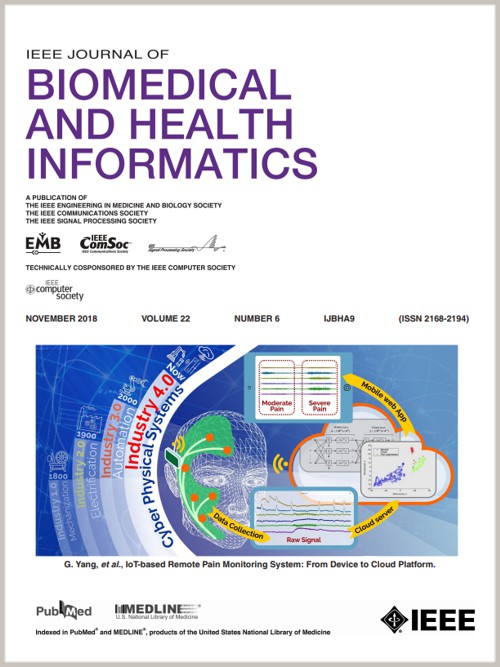
IEEE Journal of Biomedical and Health Informatics publishes original papers presenting recent advances where information and communication technologies intersect with health, healthcare, life sciences, and biomedicine. Topics include acquisition, transmission, storage, retrieval, management, and analysis of biomedical and health information. The journal covers applications of information technologies in healthcare, patient monitoring, preventive care, early disease diagnosis, therapy discovery, and personalized treatment protocols. It explores electronic medical and health records, clinical information systems, decision support systems, medical and biological imaging informatics, wearable systems, body area/sensor networks, and more. Integration-related topics like interoperability, evidence-based medicine, and secure patient data are also addressed.



 京公网安备 11010802042870号
京ICP备2023020795号-1
京公网安备 11010802042870号
京ICP备2023020795号-1

 分享
分享
 求助内容:
求助内容: 应助结果提醒方式:
 扫码关注我们
