{"title":"General electron–donor–acceptor complex mediated thioesterification reaction via site-selective C–H functionalization using aryl sulfonium Salts†","authors":"Roshan I. Patel , Barakha Saxena , Anuj Sharma","doi":"10.1039/d4gc03768e","DOIUrl":null,"url":null,"abstract":"<div><div>Contemporary methods for synthesizing thioesters often necessitate expensive catalysts and harsh conditions, making their synthesis from chemical feedstocks challenging. Herein, we report a sustainable metal-, photocatalyst-, and oxidant-free electron donor–acceptor (EDA) mediated synthesis of thioesters <em>via</em> site-selective C–H functionalization using aryl sulfonium salts (acceptor) with potassium thioacid salts (donor) under visible light irradiation. Our approach enables rapid access to thioesters from a wide variety of arenes, including pharmaceutical and agrochemical compounds, as well as a diverse range of alkyl, aryl, and heteroaryl potassium thioacid salts with excellent efficiency and regioselectivity. Mechanistic studies supported the formation of an EDA-complex, and radical trapping experiments corroborated the involvement of a radical-based mechanism for the product formation. Moreover, our method demonstrates excellent atom economy and <em>E</em>-factor scores, which are considered excellent in terms of safety, economic and ecological yardsticks.</div></div>","PeriodicalId":78,"journal":{"name":"Green Chemistry","volume":"26 19","pages":"Pages 10265-10274"},"PeriodicalIF":9.2000,"publicationDate":"2024-09-30","publicationTypes":"Journal Article","fieldsOfStudy":null,"isOpenAccess":false,"openAccessPdf":"","citationCount":"0","resultStr":null,"platform":"Semanticscholar","paperid":null,"PeriodicalName":"Green Chemistry","FirstCategoryId":"92","ListUrlMain":"https://www.sciencedirect.com/org/science/article/pii/S1463926224007817","RegionNum":1,"RegionCategory":"化学","ArticlePicture":[],"TitleCN":null,"AbstractTextCN":null,"PMCID":null,"EPubDate":"","PubModel":"","JCR":"Q1","JCRName":"CHEMISTRY, MULTIDISCIPLINARY","Score":null,"Total":0}
引用次数: 0
Abstract
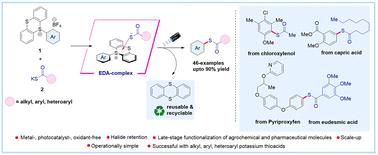
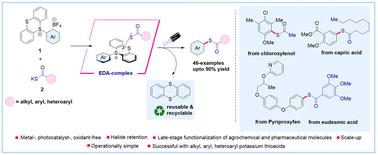
Contemporary methods for synthesizing thioesters often necessitate expensive catalysts and harsh conditions, making their synthesis from chemical feedstocks challenging. Herein, we report a sustainable metal-, photocatalyst-, and oxidant-free electron donor–acceptor (EDA) mediated synthesis of thioesters via site-selective C–H functionalization using aryl sulfonium salts (acceptor) with potassium thioacid salts (donor) under visible light irradiation. Our approach enables rapid access to thioesters from a wide variety of arenes, including pharmaceutical and agrochemical compounds, as well as a diverse range of alkyl, aryl, and heteroaryl potassium thioacid salts with excellent efficiency and regioselectivity. Mechanistic studies supported the formation of an EDA-complex, and radical trapping experiments corroborated the involvement of a radical-based mechanism for the product formation. Moreover, our method demonstrates excellent atom economy and E-factor scores, which are considered excellent in terms of safety, economic and ecological yardsticks.
期刊介绍:
Green Chemistry is a journal that provides a unique forum for the publication of innovative research on the development of alternative green and sustainable technologies. The scope of Green Chemistry is based on the definition proposed by Anastas and Warner (Green Chemistry: Theory and Practice, P T Anastas and J C Warner, Oxford University Press, Oxford, 1998), which defines green chemistry as the utilisation of a set of principles that reduces or eliminates the use or generation of hazardous substances in the design, manufacture and application of chemical products. Green Chemistry aims to reduce the environmental impact of the chemical enterprise by developing a technology base that is inherently non-toxic to living things and the environment. The journal welcomes submissions on all aspects of research relating to this endeavor and publishes original and significant cutting-edge research that is likely to be of wide general appeal. For a work to be published, it must present a significant advance in green chemistry, including a comparison with existing methods and a demonstration of advantages over those methods.



 京公网安备 11010802042870号
京ICP备2023020795号-1
京公网安备 11010802042870号
京ICP备2023020795号-1

 分享
分享
 求助内容:
求助内容: 应助结果提醒方式:
 扫码关注我们
