Janika Gosmann, Johannes Kleemann, Roland Kaufmann
{"title":"Modified Mustardé rotation cheek flap with full-thickness skin graft for reconstruction of large cheek defects","authors":"Janika Gosmann, Johannes Kleemann, Roland Kaufmann","doi":"10.1111/ddg.15530","DOIUrl":null,"url":null,"abstract":"<p>Defect closure in the cheek and adjacent lower eyelid region is demanding from a functional and aesthetic point of view and represents a frequent challenge in older patients undergoing skin cancer surgery. In addition to the consideration of contour, volume, color and texture, the symmetry to the opposite side and the risk of ectropion must be taken into account.<span><sup>1</sup></span> While primary closure, preferentially along wrinkle lines, might be an option in smaller defects, larger cheek wounds will require a closure by flaps, skin grafts or a combination of both.<span><sup>2, 3</sup></span> Flaps are generally preferred as they blend in better in terms of color and texture. Also, flap thickness can be better adjusted to local requirements, whereas skin grafts frequently tend to develop pigmentary changes and late shrinkage, which is of particular disadvantage near the eyelids.<span><sup>4</sup></span> In the area of the cheek and adjacent lower eyelid region, a Mustardé flap rotated from laterally into the defect is usually the favored option.<span><sup>5</sup></span></p><p>Here, we present two cases in which, due to multiple co-morbidities, continued anticoagulation and impaired compliance, a simplified approach was required. Following micrographically controlled skin cancer removal in the cheek and adjacent lower eyelid area, a modified Mustardé rotation flap with a combined full-thickness skin graft was chosen for wound closure. In our hands, this simultaneous approach has repeatedly proven to be successful in repairing comparable defects of the central cheek and adjacent lower eyelid area.</p><p>Case 1 was an 83-year-old female patient with a lentigo maligna in the area of the left lateral cheek, which extended to the canthus and lateral lower eyelid skin. After micrographically controlled surgery, the size of the wound was approximately 6 × 6 cm (Figure 1a).<span><sup>6</sup></span> Case 2 was an 82-year-old patient with a moderately differentiated squamous cell carcinoma on the right lateral cheek that also involved the lateral lower eyelid. Wound size after complete excision was approximately 3 × 3.5 cm (Figure 2a). Due to the localization and size of the defect, in both cases a modified rotation flap was chosen in combination with a full-thickness skin graft taken from the inferior compensatory triangle to close the secondary lateral defect resulting after flap movement.</p><p>When using the Mustardé-technique, the skin is incised from the cranial defect pole laterally along the zygomatic arch and then downwards along the preauricular skin. The generously mobilized flap is then rotated medially into the defect and in addition fixed at the lateral upper corner to avoid tensile stress perpendicular to the lid. If needed, a compensatory triangle is removed caudally to the primary defect (Figure 3a). Ectropion as a complication of the flap did not occur in either case (Figures 1, 2). The follow-up period was four months in case 1 and 3 months in case 2.</p><p>In our cases, however, the flap was moved into the cheek defect with comparatively little tension after creating a generous compensatory triangle along with an extensive subcutaneous undermining, hereby accepting a secondary defect resulting along the lateral cutting edge (Figure 2b). This defect was only closed to an extent that was possible without tension. The remaining laterocranial wound could be easily covered in the same session by using the carefully defatted skin of the excised triangle as a full-thickness graft (Figures 1, 3).</p><p>Our simplified cheek rotation flap is particularly suitable for older patients in whom the elasticity and stretchability of the cheek skin is limited due to previous operations, scars or age-related atrophy and also in those in whom the adjacent lower eyelid appears to be at increased risk of ectropion due to atrophy. A generously dimensioned inferior compensation triangle together with an omission of closing the secondary defect allows a particularly tension-free flap movement and sufficient padding of the eyelid region. Independently of this, the flap can be fixed laterocranially in depth, analogous to a Mustardé procedure, in order to avoid any tension on the lower eyelid. The excess full-thickness skin of the additional triangle can be easily inserted into the lateral defect and simply fixed with few interrupted sutures. The region of the secondary defect is ideally suited as a recipient site for the full-thickness graft harvested from the ipsilateral adjacent cheek region. In addition to a one-stage wound closure, this combined procedure ensures an aesthetically optimized result (Figures 1, 2). It can be easily performed under local anesthesia, even in multimorbid and immobile patients, whereby a generous infiltration in the sense of a hydro-dissection considerably facilitates mobilization and bleeding control. Patients are usually followed up 3 to 6 months post surgery.</p><p>The Mustardé technique is a modification of the cheek rotation flap according to Esser (1918). In Esser's flap, the incision runs infraorbitally from the lateral defect edge into the temporal region. The incision is continued along the lateral hairline towards the preauricular region. In contrast to the Mustardé technique, the incision ends submandibularly. Temporal, preauricular or mandibular skin can be resected with a Burow triangle.<span><sup>7</sup></span></p><p>Juri and Juri (1979) combined the cervical advancement flap with the cheek rotation flap to create an anteriorly pedicled cervicofacial rotation advancement flap. The advantages of this flap are less conspicuous scars and a primary closure of the secondary defect by mobilization of the flap edges.<span><sup>8</sup></span></p><p>The implementation of our modification by adding a full-thickness skin graft in the area of the secondary defect would also be conceivable in the surgical techniques according to Esser or Juri and Juri, especially for tension relief in large defects.<span><sup>8</sup></span></p><p>None.</p>","PeriodicalId":14758,"journal":{"name":"Journal Der Deutschen Dermatologischen Gesellschaft","volume":"22 11","pages":"1573-1575"},"PeriodicalIF":3.8000,"publicationDate":"2024-09-10","publicationTypes":"Journal Article","fieldsOfStudy":null,"isOpenAccess":false,"openAccessPdf":"https://onlinelibrary.wiley.com/doi/epdf/10.1111/ddg.15530","citationCount":"0","resultStr":null,"platform":"Semanticscholar","paperid":null,"PeriodicalName":"Journal Der Deutschen Dermatologischen Gesellschaft","FirstCategoryId":"3","ListUrlMain":"https://onlinelibrary.wiley.com/doi/10.1111/ddg.15530","RegionNum":4,"RegionCategory":"医学","ArticlePicture":[],"TitleCN":null,"AbstractTextCN":null,"PMCID":null,"EPubDate":"","PubModel":"","JCR":"Q1","JCRName":"DERMATOLOGY","Score":null,"Total":0}
引用次数: 0
Abstract
Defect closure in the cheek and adjacent lower eyelid region is demanding from a functional and aesthetic point of view and represents a frequent challenge in older patients undergoing skin cancer surgery. In addition to the consideration of contour, volume, color and texture, the symmetry to the opposite side and the risk of ectropion must be taken into account.1 While primary closure, preferentially along wrinkle lines, might be an option in smaller defects, larger cheek wounds will require a closure by flaps, skin grafts or a combination of both.2, 3 Flaps are generally preferred as they blend in better in terms of color and texture. Also, flap thickness can be better adjusted to local requirements, whereas skin grafts frequently tend to develop pigmentary changes and late shrinkage, which is of particular disadvantage near the eyelids.4 In the area of the cheek and adjacent lower eyelid region, a Mustardé flap rotated from laterally into the defect is usually the favored option.5
Here, we present two cases in which, due to multiple co-morbidities, continued anticoagulation and impaired compliance, a simplified approach was required. Following micrographically controlled skin cancer removal in the cheek and adjacent lower eyelid area, a modified Mustardé rotation flap with a combined full-thickness skin graft was chosen for wound closure. In our hands, this simultaneous approach has repeatedly proven to be successful in repairing comparable defects of the central cheek and adjacent lower eyelid area.
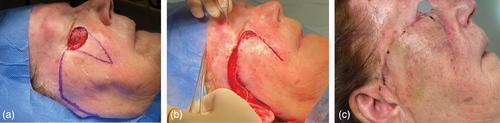
Case 1 was an 83-year-old female patient with a lentigo maligna in the area of the left lateral cheek, which extended to the canthus and lateral lower eyelid skin. After micrographically controlled surgery, the size of the wound was approximately 6 × 6 cm (Figure 1a).6 Case 2 was an 82-year-old patient with a moderately differentiated squamous cell carcinoma on the right lateral cheek that also involved the lateral lower eyelid. Wound size after complete excision was approximately 3 × 3.5 cm (Figure 2a). Due to the localization and size of the defect, in both cases a modified rotation flap was chosen in combination with a full-thickness skin graft taken from the inferior compensatory triangle to close the secondary lateral defect resulting after flap movement.
When using the Mustardé-technique, the skin is incised from the cranial defect pole laterally along the zygomatic arch and then downwards along the preauricular skin. The generously mobilized flap is then rotated medially into the defect and in addition fixed at the lateral upper corner to avoid tensile stress perpendicular to the lid. If needed, a compensatory triangle is removed caudally to the primary defect (Figure 3a). Ectropion as a complication of the flap did not occur in either case (Figures 1, 2). The follow-up period was four months in case 1 and 3 months in case 2.
In our cases, however, the flap was moved into the cheek defect with comparatively little tension after creating a generous compensatory triangle along with an extensive subcutaneous undermining, hereby accepting a secondary defect resulting along the lateral cutting edge (Figure 2b). This defect was only closed to an extent that was possible without tension. The remaining laterocranial wound could be easily covered in the same session by using the carefully defatted skin of the excised triangle as a full-thickness graft (Figures 1, 3).
Our simplified cheek rotation flap is particularly suitable for older patients in whom the elasticity and stretchability of the cheek skin is limited due to previous operations, scars or age-related atrophy and also in those in whom the adjacent lower eyelid appears to be at increased risk of ectropion due to atrophy. A generously dimensioned inferior compensation triangle together with an omission of closing the secondary defect allows a particularly tension-free flap movement and sufficient padding of the eyelid region. Independently of this, the flap can be fixed laterocranially in depth, analogous to a Mustardé procedure, in order to avoid any tension on the lower eyelid. The excess full-thickness skin of the additional triangle can be easily inserted into the lateral defect and simply fixed with few interrupted sutures. The region of the secondary defect is ideally suited as a recipient site for the full-thickness graft harvested from the ipsilateral adjacent cheek region. In addition to a one-stage wound closure, this combined procedure ensures an aesthetically optimized result (Figures 1, 2). It can be easily performed under local anesthesia, even in multimorbid and immobile patients, whereby a generous infiltration in the sense of a hydro-dissection considerably facilitates mobilization and bleeding control. Patients are usually followed up 3 to 6 months post surgery.
The Mustardé technique is a modification of the cheek rotation flap according to Esser (1918). In Esser's flap, the incision runs infraorbitally from the lateral defect edge into the temporal region. The incision is continued along the lateral hairline towards the preauricular region. In contrast to the Mustardé technique, the incision ends submandibularly. Temporal, preauricular or mandibular skin can be resected with a Burow triangle.7
Juri and Juri (1979) combined the cervical advancement flap with the cheek rotation flap to create an anteriorly pedicled cervicofacial rotation advancement flap. The advantages of this flap are less conspicuous scars and a primary closure of the secondary defect by mobilization of the flap edges.8
The implementation of our modification by adding a full-thickness skin graft in the area of the secondary defect would also be conceivable in the surgical techniques according to Esser or Juri and Juri, especially for tension relief in large defects.8
期刊介绍:
The JDDG publishes scientific papers from a wide range of disciplines, such as dermatovenereology, allergology, phlebology, dermatosurgery, dermatooncology, and dermatohistopathology. Also in JDDG: information on medical training, continuing education, a calendar of events, book reviews and society announcements.
Papers can be submitted in German or English language. In the print version, all articles are published in German. In the online version, all key articles are published in English.



 京公网安备 11010802042870号
京ICP备2023020795号-1
京公网安备 11010802042870号
京ICP备2023020795号-1

 分享
分享
 求助内容:
求助内容: 应助结果提醒方式:
 扫码关注我们
