Unraveling the secrets of harnessing a surfactant-modified strategy in organosolv pretreatment of lignocellulosic biomass for efficient fermentable sugar production†
Guojie Song , Hui Zhang , Meysam Madadi , Zhixiangpeng Chen , Hao Wang , Ao Xia , Abdolreza Samimi , Chihe Sun , Xianzhi Meng , Arthur J. Ragauskas , Fubao Sun
{"title":"Unraveling the secrets of harnessing a surfactant-modified strategy in organosolv pretreatment of lignocellulosic biomass for efficient fermentable sugar production†","authors":"Guojie Song , Hui Zhang , Meysam Madadi , Zhixiangpeng Chen , Hao Wang , Ao Xia , Abdolreza Samimi , Chihe Sun , Xianzhi Meng , Arthur J. Ragauskas , Fubao Sun","doi":"10.1039/d4gc02775b","DOIUrl":null,"url":null,"abstract":"<div><div>Alkaline-catalyzed organosolv pretreatment of lignocellulosic biomass affords excellent delignification, yielding a holocellulose-rich substrate for fermentable sugar production. However, complete lignin removal is impractical, and residual lignin also exacerbates negative effects on subsequent enzymatic hydrolysis. Herein, a novel strategy of developing surfactant-assisted organosolv pretreatment (Triton-X 100, AEO 9 and Tween 80) for <em>in situ</em> lignin modification was proposed to overcome this issue. The results indicated that the pretreated substrates showed considerable enzymatic hydrolyzability with a 15.7%–38.3% higher sugar yield compared to the control group without surfactants. Surfactants could graft on both residual and dissolved lignin through etherification, forming α-etherified lignin, though without significantly changing the component distribution and substrate-related properties. Quantum chemical calculations provided theoretical evidence of strong H-bonding and pronounced interaction energy between lignin and surfactants (maximally at −48.4 kcal mol<sup>−1</sup>). In particular, this surfactant modification decreased the aliphatic –OH and phenolic –OH contents of residual lignin by 16.0%–22.4% and 13.8%–28.8%, respectively. The reduction of –OH groups mitigated non-productive adsorption between lignin and cellulases <em>via</em> H-bonding interaction, which exhibited a significant correlation with the increased enzymatic hydrolyzability (>−0.9). Overall, this study offers valuable insight into the fundamental understanding of the mechanism involved in lignin modification during surfactant-assisted pretreatment and lignin–enzyme interaction during enzymatic hydrolysis. The new findings underscore the potential application of surfactants in organosolv pretreatment to achieve a feasible approach for developing an efficient enzyme-mediated lignocellulosic sugar platform.</div></div>","PeriodicalId":78,"journal":{"name":"Green Chemistry","volume":"26 19","pages":"Pages 10123-10138"},"PeriodicalIF":9.2000,"publicationDate":"2024-09-30","publicationTypes":"Journal Article","fieldsOfStudy":null,"isOpenAccess":false,"openAccessPdf":"","citationCount":"0","resultStr":null,"platform":"Semanticscholar","paperid":null,"PeriodicalName":"Green Chemistry","FirstCategoryId":"92","ListUrlMain":"https://www.sciencedirect.com/org/science/article/pii/S1463926224007763","RegionNum":1,"RegionCategory":"化学","ArticlePicture":[],"TitleCN":null,"AbstractTextCN":null,"PMCID":null,"EPubDate":"","PubModel":"","JCR":"Q1","JCRName":"CHEMISTRY, MULTIDISCIPLINARY","Score":null,"Total":0}
引用次数: 0
Abstract
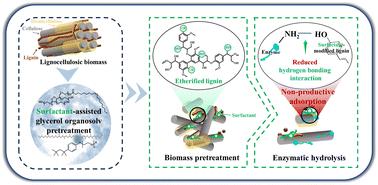
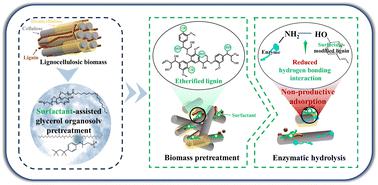
Alkaline-catalyzed organosolv pretreatment of lignocellulosic biomass affords excellent delignification, yielding a holocellulose-rich substrate for fermentable sugar production. However, complete lignin removal is impractical, and residual lignin also exacerbates negative effects on subsequent enzymatic hydrolysis. Herein, a novel strategy of developing surfactant-assisted organosolv pretreatment (Triton-X 100, AEO 9 and Tween 80) for in situ lignin modification was proposed to overcome this issue. The results indicated that the pretreated substrates showed considerable enzymatic hydrolyzability with a 15.7%–38.3% higher sugar yield compared to the control group without surfactants. Surfactants could graft on both residual and dissolved lignin through etherification, forming α-etherified lignin, though without significantly changing the component distribution and substrate-related properties. Quantum chemical calculations provided theoretical evidence of strong H-bonding and pronounced interaction energy between lignin and surfactants (maximally at −48.4 kcal mol−1). In particular, this surfactant modification decreased the aliphatic –OH and phenolic –OH contents of residual lignin by 16.0%–22.4% and 13.8%–28.8%, respectively. The reduction of –OH groups mitigated non-productive adsorption between lignin and cellulases via H-bonding interaction, which exhibited a significant correlation with the increased enzymatic hydrolyzability (>−0.9). Overall, this study offers valuable insight into the fundamental understanding of the mechanism involved in lignin modification during surfactant-assisted pretreatment and lignin–enzyme interaction during enzymatic hydrolysis. The new findings underscore the potential application of surfactants in organosolv pretreatment to achieve a feasible approach for developing an efficient enzyme-mediated lignocellulosic sugar platform.
期刊介绍:
Green Chemistry is a journal that provides a unique forum for the publication of innovative research on the development of alternative green and sustainable technologies. The scope of Green Chemistry is based on the definition proposed by Anastas and Warner (Green Chemistry: Theory and Practice, P T Anastas and J C Warner, Oxford University Press, Oxford, 1998), which defines green chemistry as the utilisation of a set of principles that reduces or eliminates the use or generation of hazardous substances in the design, manufacture and application of chemical products. Green Chemistry aims to reduce the environmental impact of the chemical enterprise by developing a technology base that is inherently non-toxic to living things and the environment. The journal welcomes submissions on all aspects of research relating to this endeavor and publishes original and significant cutting-edge research that is likely to be of wide general appeal. For a work to be published, it must present a significant advance in green chemistry, including a comparison with existing methods and a demonstration of advantages over those methods.



 京公网安备 11010802042870号
京ICP备2023020795号-1
京公网安备 11010802042870号
京ICP备2023020795号-1

 分享
分享
 求助内容:
求助内容: 应助结果提醒方式:
 扫码关注我们
