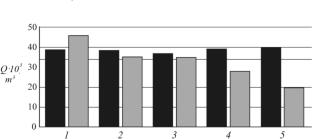
The research is devoted to solve the problem of elevated dust levels in subway air through the implementation of a proposed dust collection system. A comprehensive experiment to determine the fractional and chemical compositions, as well as dust density, in the existing metro systems of Almaty (Kazakhstan) and Novosibirsk (Russian Federation) was conducted. The experiment results led to hypotheses about the sources of dust emission in subways. An innovative method for de-dusting tunnel air has been developed. The method is based on the use of air flows generated by the piston action of trains and the installation of labyrinth filters in the ventilation joints of stations. The parameters of the computational model of a subway line on the basis of decomposition approach to mathematical modeling of aerodynamic processes methods of computational aerodynamics by transition from a full model of a subway line to an open-ended periodic one have been substantiated. The research also justifies the geometric parameters of the labyrinth filters, determining their effectiveness based on air velocity and the number of filter element rows. Additionally, potential energy savings achievable with the proposed system were assessed. The scope of application of the results of the presented study of air distribution from the piston effect in subway structures and the effectiveness of the proposed air filtration system are limited to subways with single-track tunnels and open-type stations equipped with ventilation joints.



 京公网安备 11010802042870号
京ICP备2023020795号-1
京公网安备 11010802042870号
京ICP备2023020795号-1

 分享
分享
 求助内容:
求助内容: 应助结果提醒方式:
 扫码关注我们
