Dr. Jessica K. Bilyj, Dr. Christina M. Gregg, Dr. Craig C. Wood, Dr. Trevor D. Rapson
{"title":"The Effect of Dithionite and its Decomposition Products on Redox Mediators Used in the Cyclic Voltammetry of Nitrogenase Enzymes","authors":"Dr. Jessica K. Bilyj, Dr. Christina M. Gregg, Dr. Craig C. Wood, Dr. Trevor D. Rapson","doi":"10.1002/cctc.202400595","DOIUrl":null,"url":null,"abstract":"<p>Cyclic voltammetry is a powerful tool to study enzyme mechanisms. Over the last decade, voltammetry has been applied to probe aspects of nitrogenase catalysis. One aspect that is often overlooked is the effect of dithionite (S<sub>2</sub>O<sub>4</sub><sup>2−</sup><sub>,</sub> DTH) on nitrogenase and the mediators used during voltammetry experiments. Dithionite is routinely added to purification and storage buffers to protect nitrogenase and other anaerobic enzymes from oxygen. Dithionite has extremely complex chemistry with a myriad of decomposition products. Herein, we sought to systematically investigate the effect of dithionite and some of its decomposition products on the voltammetry of different redox mediators independently and in conjunction with nitrogenase. We found the major decomposition product sulfite (SO<sub>3</sub><sup>2−</sup>) gives rise to reductive catalysis. This cannot be distinguished from enzyme catalysis, particularly with cobaltocenium mediators which can result in amplified <i>k<sub>obs</sub></i> values. We provide recommendations on how to identify and avoid interpreting ‘pseudo’ catalysis in lieu of enzyme catalysis by DTH and reinforce the requirement to remove DTH from the enzyme stock prior to performing cyclic voltammetry experiments.</p>","PeriodicalId":141,"journal":{"name":"ChemCatChem","volume":"16 23","pages":""},"PeriodicalIF":3.9000,"publicationDate":"2024-08-20","publicationTypes":"Journal Article","fieldsOfStudy":null,"isOpenAccess":false,"openAccessPdf":"https://onlinelibrary.wiley.com/doi/epdf/10.1002/cctc.202400595","citationCount":"0","resultStr":null,"platform":"Semanticscholar","paperid":null,"PeriodicalName":"ChemCatChem","FirstCategoryId":"92","ListUrlMain":"https://chemistry-europe.onlinelibrary.wiley.com/doi/10.1002/cctc.202400595","RegionNum":3,"RegionCategory":"化学","ArticlePicture":[],"TitleCN":null,"AbstractTextCN":null,"PMCID":null,"EPubDate":"","PubModel":"","JCR":"Q2","JCRName":"CHEMISTRY, PHYSICAL","Score":null,"Total":0}
引用次数: 0
Abstract
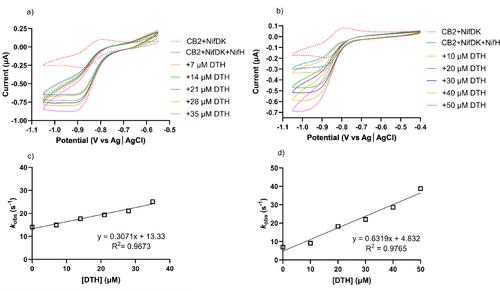
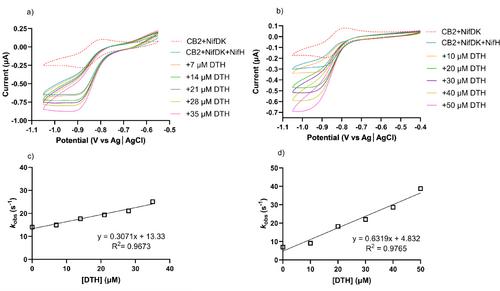
Cyclic voltammetry is a powerful tool to study enzyme mechanisms. Over the last decade, voltammetry has been applied to probe aspects of nitrogenase catalysis. One aspect that is often overlooked is the effect of dithionite (S2O42−, DTH) on nitrogenase and the mediators used during voltammetry experiments. Dithionite is routinely added to purification and storage buffers to protect nitrogenase and other anaerobic enzymes from oxygen. Dithionite has extremely complex chemistry with a myriad of decomposition products. Herein, we sought to systematically investigate the effect of dithionite and some of its decomposition products on the voltammetry of different redox mediators independently and in conjunction with nitrogenase. We found the major decomposition product sulfite (SO32−) gives rise to reductive catalysis. This cannot be distinguished from enzyme catalysis, particularly with cobaltocenium mediators which can result in amplified kobs values. We provide recommendations on how to identify and avoid interpreting ‘pseudo’ catalysis in lieu of enzyme catalysis by DTH and reinforce the requirement to remove DTH from the enzyme stock prior to performing cyclic voltammetry experiments.
期刊介绍:
With an impact factor of 4.495 (2018), ChemCatChem is one of the premier journals in the field of catalysis. The journal provides primary research papers and critical secondary information on heterogeneous, homogeneous and bio- and nanocatalysis. The journal is well placed to strengthen cross-communication within between these communities. Its authors and readers come from academia, the chemical industry, and government laboratories across the world. It is published on behalf of Chemistry Europe, an association of 16 European chemical societies, and is supported by the German Catalysis Society.



 京公网安备 11010802042870号
京ICP备2023020795号-1
京公网安备 11010802042870号
京ICP备2023020795号-1

 分享
分享
 求助内容:
求助内容: 应助结果提醒方式:
 扫码关注我们
