{"title":"IntelliChain: An Intelligent and Adaptive Framework for Decentralized Applications on Public Blockchain Technologies: An NFT Marketplace Case Study","authors":"Mohammadreza Rasolroveicy;Marios Fokaefs","doi":"10.1109/TR.2024.3451964","DOIUrl":null,"url":null,"abstract":"Non-fungible tokens (NFTs), attracting interest from a variety of audiences including collectors and traders, saw transactions exceeding $50 billion in 2022. The inherent features of blockchain technology–distributed, immutable, and transparent–make it an ideal platform for verifying ownership of digital assets. Despite these advantages, the high computational and transaction costs of networks, which utilizes proof of work pose significant challenges. To overcome these, alternative public blockchains have been developed, each offering unique benefits for NFT marketplaces. Choosing the right blockchain platform is crucial but complex. In our study, we introduce a prototype NFT marketplace optimized for scalability and efficiency, capable of rapidly handling a large volume of NFT transactions. We also conducted a comparative analysis of various public blockchains to identify the most cost-effective and reliable options for NFT exchanges. Further, we developed two predictive models to enhance decision-making around transaction fees and error management, thus improving cost-efficiency and reliability. We also propose a self-adaptive mechanism that allows for dynamic switching between blockchain platforms, enhancing the flexibility, and overall performance of the marketplace. Our contributions are integrated into IntelliChain, a self-adaptive framework designed to predict optimal transaction fees, reduce errors, and adapt to changing conditions like network stability and fee structures, bolstering efficiency, and reliability.","PeriodicalId":56305,"journal":{"name":"IEEE Transactions on Reliability","volume":"74 3","pages":"3192-3205"},"PeriodicalIF":5.7000,"publicationDate":"2024-09-09","publicationTypes":"Journal Article","fieldsOfStudy":null,"isOpenAccess":false,"openAccessPdf":"","citationCount":"0","resultStr":null,"platform":"Semanticscholar","paperid":null,"PeriodicalName":"IEEE Transactions on Reliability","FirstCategoryId":"94","ListUrlMain":"https://ieeexplore.ieee.org/document/10669837/","RegionNum":2,"RegionCategory":"计算机科学","ArticlePicture":[],"TitleCN":null,"AbstractTextCN":null,"PMCID":null,"EPubDate":"","PubModel":"","JCR":"Q1","JCRName":"COMPUTER SCIENCE, HARDWARE & ARCHITECTURE","Score":null,"Total":0}
引用次数: 0
Abstract
Non-fungible tokens (NFTs), attracting interest from a variety of audiences including collectors and traders, saw transactions exceeding $50 billion in 2022. The inherent features of blockchain technology–distributed, immutable, and transparent–make it an ideal platform for verifying ownership of digital assets. Despite these advantages, the high computational and transaction costs of networks, which utilizes proof of work pose significant challenges. To overcome these, alternative public blockchains have been developed, each offering unique benefits for NFT marketplaces. Choosing the right blockchain platform is crucial but complex. In our study, we introduce a prototype NFT marketplace optimized for scalability and efficiency, capable of rapidly handling a large volume of NFT transactions. We also conducted a comparative analysis of various public blockchains to identify the most cost-effective and reliable options for NFT exchanges. Further, we developed two predictive models to enhance decision-making around transaction fees and error management, thus improving cost-efficiency and reliability. We also propose a self-adaptive mechanism that allows for dynamic switching between blockchain platforms, enhancing the flexibility, and overall performance of the marketplace. Our contributions are integrated into IntelliChain, a self-adaptive framework designed to predict optimal transaction fees, reduce errors, and adapt to changing conditions like network stability and fee structures, bolstering efficiency, and reliability.
期刊介绍:
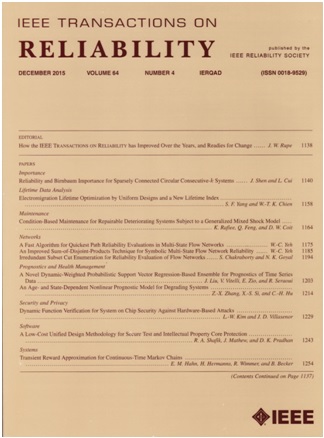
IEEE Transactions on Reliability is a refereed journal for the reliability and allied disciplines including, but not limited to, maintainability, physics of failure, life testing, prognostics, design and manufacture for reliability, reliability for systems of systems, network availability, mission success, warranty, safety, and various measures of effectiveness. Topics eligible for publication range from hardware to software, from materials to systems, from consumer and industrial devices to manufacturing plants, from individual items to networks, from techniques for making things better to ways of predicting and measuring behavior in the field. As an engineering subject that supports new and existing technologies, we constantly expand into new areas of the assurance sciences.



 京公网安备 11010802042870号
京ICP备2023020795号-1
京公网安备 11010802042870号
京ICP备2023020795号-1

 分享
分享
 求助内容:
求助内容: 应助结果提醒方式:
 扫码关注我们
