{"title":"Dynamic Reliability Assessment Model for IoT-Enabled Smart Offshore Wind Farm","authors":"Hongyan Dui;Yulu Zhang;Xinmin Wu;Liudong Xing","doi":"10.1109/TR.2024.3428870","DOIUrl":null,"url":null,"abstract":"Offshore wind farm is one of the most promising applications in the Internet of Things (IoT), due to being energy-renewable and resources-unlimited. However, the reliability monitoring and maintenance models of power equipment based on communication paths and sensors are still immature in the smart offshore wind farm (SOWF). Based on the hierarchical architecture and end-to-end communication, a dynamic reliability assessment model (DRAM) is proposed for SOWFs. First, based on the IoT hierarchy, a four-stage network is developed to represent the relationship or dependencies between diverse devices in a complex SOWF. Second, a two-layer DRAM with forward monitoring (FM) and lateral protection (LP) is proposed. The FM encompasses a sensor network-based state-monitoring phase (monitoring weather data like temperature and wind speed), and a data-monitoring phase (monitoring the reliability-related data like reception power and data processing speed). The LP includes a signal-protection mode (LP-I) ensuring that virtual machines read the data and issue protection orders before turbine failures to minimize losses, and a radius-maintenance model (LP-II) performing maintenance of the failed turbine nodes. Simulation results show that the optimal maintenance strategy based on DRAM outperforms the benchmark maintenance method for traditional wind grids.","PeriodicalId":56305,"journal":{"name":"IEEE Transactions on Reliability","volume":"74 3","pages":"3529-3543"},"PeriodicalIF":5.7000,"publicationDate":"2024-08-19","publicationTypes":"Journal Article","fieldsOfStudy":null,"isOpenAccess":false,"openAccessPdf":"","citationCount":"0","resultStr":null,"platform":"Semanticscholar","paperid":null,"PeriodicalName":"IEEE Transactions on Reliability","FirstCategoryId":"94","ListUrlMain":"https://ieeexplore.ieee.org/document/10638752/","RegionNum":2,"RegionCategory":"计算机科学","ArticlePicture":[],"TitleCN":null,"AbstractTextCN":null,"PMCID":null,"EPubDate":"","PubModel":"","JCR":"Q1","JCRName":"COMPUTER SCIENCE, HARDWARE & ARCHITECTURE","Score":null,"Total":0}
引用次数: 0
Abstract
Offshore wind farm is one of the most promising applications in the Internet of Things (IoT), due to being energy-renewable and resources-unlimited. However, the reliability monitoring and maintenance models of power equipment based on communication paths and sensors are still immature in the smart offshore wind farm (SOWF). Based on the hierarchical architecture and end-to-end communication, a dynamic reliability assessment model (DRAM) is proposed for SOWFs. First, based on the IoT hierarchy, a four-stage network is developed to represent the relationship or dependencies between diverse devices in a complex SOWF. Second, a two-layer DRAM with forward monitoring (FM) and lateral protection (LP) is proposed. The FM encompasses a sensor network-based state-monitoring phase (monitoring weather data like temperature and wind speed), and a data-monitoring phase (monitoring the reliability-related data like reception power and data processing speed). The LP includes a signal-protection mode (LP-I) ensuring that virtual machines read the data and issue protection orders before turbine failures to minimize losses, and a radius-maintenance model (LP-II) performing maintenance of the failed turbine nodes. Simulation results show that the optimal maintenance strategy based on DRAM outperforms the benchmark maintenance method for traditional wind grids.
期刊介绍:
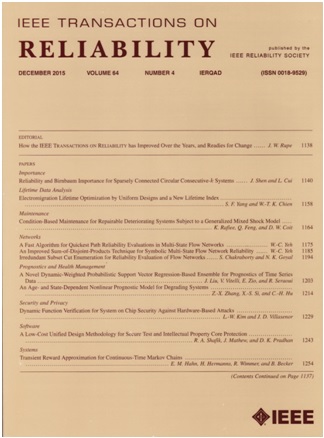
IEEE Transactions on Reliability is a refereed journal for the reliability and allied disciplines including, but not limited to, maintainability, physics of failure, life testing, prognostics, design and manufacture for reliability, reliability for systems of systems, network availability, mission success, warranty, safety, and various measures of effectiveness. Topics eligible for publication range from hardware to software, from materials to systems, from consumer and industrial devices to manufacturing plants, from individual items to networks, from techniques for making things better to ways of predicting and measuring behavior in the field. As an engineering subject that supports new and existing technologies, we constantly expand into new areas of the assurance sciences.



 京公网安备 11010802042870号
京ICP备2023020795号-1
京公网安备 11010802042870号
京ICP备2023020795号-1

 分享
分享
 求助内容:
求助内容: 应助结果提醒方式:
 扫码关注我们
