{"title":"Computational insights into the tailoring of photoelectric properties in graphene quantum dot-Ru(II) polypyridyl nanocomposites","authors":"Peng Cui, Qiulan Wu, Xia Hou, Zhiwei Li","doi":"10.1016/j.commatsci.2024.113387","DOIUrl":null,"url":null,"abstract":"<div><p>Graphene quantum dot-Ru(II) polypyridyl nanocomposites have emerged as promising materials for photoelectric applications due to their unique optoelectronic properties. This study investigates the impact of pyrenyl, 2,8-di-<em>tert</em>-butylpyreno[4,5-b:9,10-b’]dithiophene, and 2,8-di-<em>tert</em>-butyl-4,10-dihydropyrrolo[3′,2′:9,10]phenanthro[4,5-efg]indole substituents and N^N or C^N analogues of dipyrido[3,2-α:2′,3′-c]phenazine (dppz) on the photophysical characteristics and photoelectric behavior of Ru(II) complexes and their nanocomposites using density functional theory (DFT) calculations. The findings reveal that the incorporation of these substituents and the choice of ligand system significantly influence the chemical reactivity, electron injection, and ground state regeneration processes of the nanocomposites. The C^N nanocomposites demonstrate superior energy conversion efficiencies (14.9–15.6%) compared to the N^N counterparts (1.49–13.4%) due to their higher open-circuit voltages and fill factors. The pyrenyl substituent enhances light absorption and photocurrent generation in the N^N-based nanocomposite but slightly reduces efficiency in the C^N-based nanocomposite. The nanocomposites exhibit improved nonlinear optical characteristics compared to the individual Ru(II) complexes, with the N^N-based nanocomposites showing remarkably higher total hyperpolarizability values. These findings provide valuable insights for designing advanced materials tailored for photoelectric applications by strategically modifying the structural components of GQD-Ru(II) polypyridyl nanocomposites.</p></div>","PeriodicalId":10650,"journal":{"name":"Computational Materials Science","volume":"246 ","pages":"Article 113387"},"PeriodicalIF":3.3000,"publicationDate":"2024-09-18","publicationTypes":"Journal Article","fieldsOfStudy":null,"isOpenAccess":false,"openAccessPdf":"","citationCount":"0","resultStr":null,"platform":"Semanticscholar","paperid":null,"PeriodicalName":"Computational Materials Science","FirstCategoryId":"88","ListUrlMain":"https://www.sciencedirect.com/science/article/pii/S0927025624006086","RegionNum":3,"RegionCategory":"材料科学","ArticlePicture":[],"TitleCN":null,"AbstractTextCN":null,"PMCID":null,"EPubDate":"","PubModel":"","JCR":"Q2","JCRName":"MATERIALS SCIENCE, MULTIDISCIPLINARY","Score":null,"Total":0}
引用次数: 0
Abstract
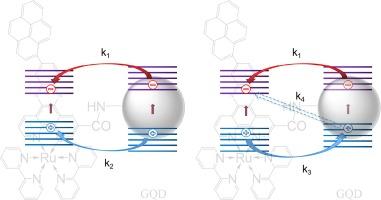
Graphene quantum dot-Ru(II) polypyridyl nanocomposites have emerged as promising materials for photoelectric applications due to their unique optoelectronic properties. This study investigates the impact of pyrenyl, 2,8-di-tert-butylpyreno[4,5-b:9,10-b’]dithiophene, and 2,8-di-tert-butyl-4,10-dihydropyrrolo[3′,2′:9,10]phenanthro[4,5-efg]indole substituents and N^N or C^N analogues of dipyrido[3,2-α:2′,3′-c]phenazine (dppz) on the photophysical characteristics and photoelectric behavior of Ru(II) complexes and their nanocomposites using density functional theory (DFT) calculations. The findings reveal that the incorporation of these substituents and the choice of ligand system significantly influence the chemical reactivity, electron injection, and ground state regeneration processes of the nanocomposites. The C^N nanocomposites demonstrate superior energy conversion efficiencies (14.9–15.6%) compared to the N^N counterparts (1.49–13.4%) due to their higher open-circuit voltages and fill factors. The pyrenyl substituent enhances light absorption and photocurrent generation in the N^N-based nanocomposite but slightly reduces efficiency in the C^N-based nanocomposite. The nanocomposites exhibit improved nonlinear optical characteristics compared to the individual Ru(II) complexes, with the N^N-based nanocomposites showing remarkably higher total hyperpolarizability values. These findings provide valuable insights for designing advanced materials tailored for photoelectric applications by strategically modifying the structural components of GQD-Ru(II) polypyridyl nanocomposites.
期刊介绍:
The goal of Computational Materials Science is to report on results that provide new or unique insights into, or significantly expand our understanding of, the properties of materials or phenomena associated with their design, synthesis, processing, characterization, and utilization. To be relevant to the journal, the results should be applied or applicable to specific material systems that are discussed within the submission.



 京公网安备 11010802042870号
京ICP备2023020795号-1
京公网安备 11010802042870号
京ICP备2023020795号-1

 分享
分享
 求助内容:
求助内容: 应助结果提醒方式:
 扫码关注我们
