Jian You Wang, Aparna Balakrishna, Claudio Martínez, Guan-Ting Erica Chen, Salim Sioud, Angel R. de Lera, Salim Al-Babili
{"title":"The rice orobanchol synthase catalyzes the hydroxylation of the noncanonical strigolactone methyl 4-oxo-carlactonoate","authors":"Jian You Wang, Aparna Balakrishna, Claudio Martínez, Guan-Ting Erica Chen, Salim Sioud, Angel R. de Lera, Salim Al-Babili","doi":"10.1111/nph.20135","DOIUrl":null,"url":null,"abstract":"<p>The plant hormone strigolactone (SL) is a main regulator of various growth and developmental processes, such as shoot branching/tillering, stem thickness, leaf senescence, and root development (Al-Babili & Bouwmeester, <span>2015</span>; Wang <i>et al</i>., <span>2024</span>). Accordingly, SL-deficient mutants, such as the rice <i>d17</i>, exhibit severe phenotypes with respect to shoot and root architecture, among others (Al-Babili & Bouwmeester, <span>2015</span>; Butt <i>et al</i>., <span>2018</span>; Wang <i>et al</i>., <span>2024</span>). Moreover, SLs play a pivotal role in both biotic and abiotic stress responses (Korek & Marzec, <span>2023</span>). However, SLs were initially discovered in root exudates as germination signals for root parasitic weeds (Cook <i>et al</i>., <span>1966</span>). Later, released SLs were identified as hyphal branching stimulants involved in the establishment of the beneficial symbiosis with arbuscular mycorrhizal fungi (AMF) under insufficient nutrient, particularly phosphate (Pi), conditions (Akiyama <i>et al</i>., <span>2005</span>; Lanfranco <i>et al</i>., <span>2018</span>; Wang <i>et al</i>., <span>2024</span>).</p><p>Structurally, SLs are characterized by a particular feature, a butenolide ring (D-ring; Fig. 1) linked to variable structures by an enol ether bridge in <i>R</i>-configuration, which is essential for their biological activity (Al-Babili & Bouwmeester, <span>2015</span>; Yoneyama <i>et al</i>., <span>2018</span>). Based on the presence or absence of a tricyclic lactone (the ABC-ring; Fig. 1), they are additionally classified into canonical and noncanonical SLs, respectively (Yoneyama <i>et al</i>., <span>2018</span>; Wang <i>et al</i>., <span>2024</span>). The SL-biosynthetic pathway starts with a reversible conversion of all-<i>trans</i>-β-carotene into 9-<i>cis</i>-β-carotene by the isomerase DWARF27 (D27). Subsequently, two carotenoid cleavage dioxygenases (CCDs), CCD7 and CCD8, convert successively 9-<i>cis</i>-β-carotene into carlactone (CL), the intermediate of SL biosynthesis (Alder <i>et al</i>., <span>2012</span>; Bruno <i>et al</i>., <span>2014</span>, <span>2017</span>; Seto <i>et al</i>., <span>2014</span>; Chen <i>et al</i>., <span>2022</span>). Up to now, there are more than 35 characterized natural SLs, with a structural diversity resulting from the modification of CL by cytochrome P450 monooxygenases (CYP), including the MORE AXILLARY GROWTH1 (MAX1) from the 711A clade, and other enzymes (Yoneyama <i>et al</i>., <span>2018</span>; Ito <i>et al</i>., <span>2022</span>; Chen <i>et al</i>., <span>2023</span>; Wang <i>et al</i>., <span>2023</span>, <span>2024</span>). In rice, OsMAX1-900 repeatedly oxygenates CL to produce the canonical SL 4-deoxyorobanchol (4DO) that is further hydroxylated into orobanchol (Oro) by another CYP711A enzyme OsMAX1-1400, the orobanchol synthase (also known as 4-deoxyorobanchol hydroxylase) (Zhang <i>et al</i>., <span>2014</span>; Ito <i>et al</i>., <span>2022</span>; Chen <i>et al</i>., <span>2023</span>; Fig. 1). In rice, the canonical SL pathway has been well investigated, while the biosynthesis of noncanonical SLs remains largely elusive.</p><p>Apart from its involvement in the biosynthesis of canonical SLs, OsMAX1-900, together with unidentified methyltransferase(s), converts the putative noncanonical SL 4-oxo-19-hydroxy-CL (CL + 30) into methyl 4-oxo-carlactonoate (4-oxo-MeCLA), a tentatively identified noncanonical SL that was previously described as methoxy-5-deoxystrigol isomer (Yoneyama <i>et al</i>., <span>2018</span>; Ito <i>et al</i>., <span>2022</span>; Haider <i>et al</i>., <span>2023</span>). Intriguingly, 4-oxo-MeCLA accumulated in the <i>Osmax1-1400</i> and <i>Osmax1-900/1400</i> rice mutants, but not in the <i>Osmax1-900</i> mutant (Chen <i>et al</i>., <span>2023</span>), suggesting that 4-oxo-MeCLA might be a substrate for MAX1-1400, and that both MAX1-900 and MAX1-1400 may be involved in the biosynthesis of both canonical and noncanonical SLs. To check the supposed role of MAX1-1400 in 4-oxo-MeCLA metabolism, we expressed the enzyme in yeast, incubated the isolated microsomes with different substrates, and analyzed the product formation by liquid chromatography–tandem mass spectrometry (LC-MS/MS). We also analyzed the root exudates of <i>Osmax1-900</i> and <i>Osmax1-900/1400</i> rice mutants, to determine the role of MAX1-1400 in the biosynthesis of noncanonical SLs.</p><p>We first incubated the yeast microsomes containing OsMAX1-1400 with root exudates of WT rice grown hydroponically under constant low-Pi conditions. As expected, we observed a significant decrease in the level of 4DO, accompanied by an enhancement in Oro content (Figs S2, S3). Intriguingly, the content of the putative 4-oxo-MeCLA was also remarkably reduced after incubation, indicating that 4-oxo-MeCLA can also be a substrate for MAX1-1400 enzyme (Figs S2, S4).</p><p>For unambiguous identification of the conversion product(s), a structurally confirmed 4-oxo-MeCLA is required; therefore, we chemically synthesized this noncanonical SL (Fig. S5) and compared it with the endogenous compound using LC-MS, which allowed us to unambiguously confirm it as a noncanonical rice SL (Fig. 2a). Next, we incubated the MAX1-1400 enzyme with enantiopure (<i>R</i>)-4-oxo-MeCLA (at 2 μM concentration) and used (<i>R</i>)-4DO as a positive control. We again detected an <i>c.</i> 80% reduction in 4DO content and a significant level of Oro produced by MAX1-1400, confirming that MAX1-1400 is a 4DO hydroxylase (Fig. 2b; Zhang <i>et al</i>., <span>2014</span>; Chen <i>et al</i>., <span>2023</span>). With respect to 4-oxo-MeCLA, we observed <i>c</i>. 50% decrease in its content, pointing to this noncanonical SL as a further substrate of MAX1-1400. However, we did not detect any potential product(s) in this experiment (Fig. 2b).</p><p>To identify the product(s), we combined six independent microsome assays, aiming to increase the product concentration, and performed untargeted LC-MS analysis, using void microsomes as a negative control. On the basis of the MS-fragment at 97.02820 (mass/charge ratio (<i>m/z</i>) ± 5 ppm), which is characteristic for the D-ring, we identified a product with a molecular formula C<sub>20</sub>H<sub>25</sub>O<sub>7</sub> (<i>m/z</i>) 377.16074 as positive ion [M + H]<sup>+</sup> in the atmospheric pressure chemical ionization mode (Fig. S6). By using electrospray ionization (ESI) mode, we obtained an accumulated metabolite in the MAX1-1400 sample with a molecular formula C<sub>20</sub>H<sub>24</sub>O<sub>6</sub> (<i>m/z</i>) 360.13440 ± 5 ppm as positive ion [M + H]<sup>+</sup> (Fig. S7), indicating a loss of water [M + H (−H<sub>2</sub>O)]<sup>+</sup>. The shift in the molecular mass from 4-oxo-MeCLA (molecular formula C<sub>20</sub>H<sub>25</sub>O<sub>6</sub>; (<i>m/z</i>) 361.16456 ± 5 ppm as positive ion [M + H]<sup>+</sup>) to the product indicated that MAX1-1400 catalyzes a hydroxylation (–OH) that leads to OH-4-oxo-MeCLA (Fig. S6). To further validate this assumption, we quantified 4-oxo-MeCLA and OH-4-oxo-MeCLA in another independent assay. Interestingly, we observed a significant increase (<i>c</i>. 85%) in OH-4-oxo-MeCLA content accompanied by a <i>c</i>. 97% decrease of the substrate, demonstrating that OH-4-oxo-MeCLA is a metabolite produced by MAX1-1400 <i>in vitro</i> (Fig. 3a). Furthermore, MS/MS fragmentation allowed us to tentatively identify the product as 18-OH-4-oxo-MeCLA (Fig. S8); however, nuclear magnetic resonance (NMR) spectroscopy will be needed to precisely confirm the structure of this noncanonical SL.</p><p>Recently, we showed that 4-oxo-MeCLA accumulated in rice mutants, such as <i>Osmax1-1400</i> and <i>Osmax1-900/1400</i>, which are disrupted in <i>MAX1-1400</i>, while it occurred in trace amounts in <i>Osmax1-900</i> mutants (Ito <i>et al</i>., <span>2022</span>; Wang <i>et al</i>., <span>2022a</span>; Chen <i>et al</i>., <span>2023</span>). This pattern suggests the involvement of MAX1-1400 in metabolizing 4-oxo-MeCLA, and is consistent with the here described <i>in vitro</i> results. To further confirm this conclusion, we analyzed the SLs present in the WT, <i>Osmax1-900</i>, and <i>Osmax1-900/1400</i> mutants, excluding the potential activity of MAX1-900 in noncanonical SL biosynthesis. As expected, none of the mutants contained detectable amounts of the canonical SLs 4DO and Oro, while both of them accumulated higher levels of the putative CL + 30 and CL + 14 (Oxo-CL), in comparison to the WT (Fig. S9). Interestingly, we did not detect the tentative 18-OH-4-oxo-MeCLA in the root exudates of <i>Osmax1-900/1400</i>, but this noncanonical SL was present in the exudates of <i>Osmax1-900</i> and WT plants (Fig. 3b). In addition, we observed a higher content of 4-oxo-MeCLA in <i>Osmax1-900/1400</i>, compared to <i>Osmax1-900</i> (Fig. 3c). These results suggest that OsMAX1-1400 catalyzes the hydroxylation of 4-oxo-MeCLA <i>in planta</i> and that the formation of the tentative 18-OH-4-oxo-MeCLA requires a functional MAX1-1400 (Fig. 3c).</p><p>Taken together, our work demonstrates that the rice orobanchol synthase, OsMAX1-1400, hydroxylates 4-oxo-MeCLA into a tentative 18-OH-4-oxo-MeCLA <i>in vitro</i>, besides the known hydroxylation of 4DO into Oro. By analyzing the corresponding mutants, we also show that this conversion takes place <i>in planta</i>, depending on OsMAX1-1400. Additionally, our results unarguably reveal the involvement of OsMAX1400 in noncanonical SL biosynthesis and expand the current knowledge of the enzymatic activities of MAX1s and their relation to both SL classes (Fig. 1a). The contribution of canonical SL-biosynthetic enzymes to the formation of noncanonical SLs may occur in other plant species and be related to the evolution of these enzymes. Future work, including the elucidation of SL biosynthesis at the cellular level, will identify the function of 4-oxo-MeCLA and the tentative 18-OH-4-oxo-MeCLA in rice and reveal the biological significance of this conversion. This may first require the elucidation of the biosynthesis of CL + 30, the precursor of 4-oxo-MeCLA. In any case, the accumulation of 4-oxo-MeCLA and/or the lack of tentative 18-OH-4-oxo-MeCLA might be a reason for the reduced AM symbiosis observed in <i>Osmax1-1400</i> mutants (Chen <i>et al</i>., <span>2023</span>).</p><p>None declared.</p><p>SA-B and JYW proposed the concept and designed the experiments. JYW, AB and G-TEC discussed and conducted experiments. CM and ARL synthesized 4-oxo-MeCLA. SS and JYW analyzed MS/MS data and proposed the structure. JYW and SA-B analyzed and discussed the data. JYW and SA-B wrote the manuscript. All authors read, edited and approved the manuscript.</p>","PeriodicalId":214,"journal":{"name":"New Phytologist","volume":"244 6","pages":"2121-2126"},"PeriodicalIF":8.1000,"publicationDate":"2024-09-19","publicationTypes":"Journal Article","fieldsOfStudy":null,"isOpenAccess":false,"openAccessPdf":"https://onlinelibrary.wiley.com/doi/epdf/10.1111/nph.20135","citationCount":"0","resultStr":null,"platform":"Semanticscholar","paperid":null,"PeriodicalName":"New Phytologist","FirstCategoryId":"99","ListUrlMain":"https://nph.onlinelibrary.wiley.com/doi/10.1111/nph.20135","RegionNum":1,"RegionCategory":"生物学","ArticlePicture":[],"TitleCN":null,"AbstractTextCN":null,"PMCID":null,"EPubDate":"","PubModel":"","JCR":"Q1","JCRName":"PLANT SCIENCES","Score":null,"Total":0}
引用次数: 0
Abstract
The plant hormone strigolactone (SL) is a main regulator of various growth and developmental processes, such as shoot branching/tillering, stem thickness, leaf senescence, and root development (Al-Babili & Bouwmeester, 2015; Wang et al., 2024). Accordingly, SL-deficient mutants, such as the rice d17, exhibit severe phenotypes with respect to shoot and root architecture, among others (Al-Babili & Bouwmeester, 2015; Butt et al., 2018; Wang et al., 2024). Moreover, SLs play a pivotal role in both biotic and abiotic stress responses (Korek & Marzec, 2023). However, SLs were initially discovered in root exudates as germination signals for root parasitic weeds (Cook et al., 1966). Later, released SLs were identified as hyphal branching stimulants involved in the establishment of the beneficial symbiosis with arbuscular mycorrhizal fungi (AMF) under insufficient nutrient, particularly phosphate (Pi), conditions (Akiyama et al., 2005; Lanfranco et al., 2018; Wang et al., 2024).
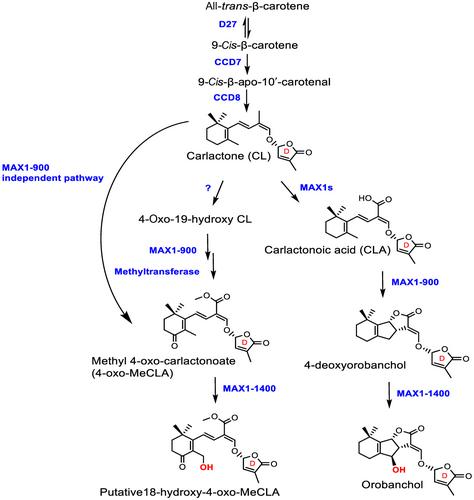
Structurally, SLs are characterized by a particular feature, a butenolide ring (D-ring; Fig. 1) linked to variable structures by an enol ether bridge in R-configuration, which is essential for their biological activity (Al-Babili & Bouwmeester, 2015; Yoneyama et al., 2018). Based on the presence or absence of a tricyclic lactone (the ABC-ring; Fig. 1), they are additionally classified into canonical and noncanonical SLs, respectively (Yoneyama et al., 2018; Wang et al., 2024). The SL-biosynthetic pathway starts with a reversible conversion of all-trans-β-carotene into 9-cis-β-carotene by the isomerase DWARF27 (D27). Subsequently, two carotenoid cleavage dioxygenases (CCDs), CCD7 and CCD8, convert successively 9-cis-β-carotene into carlactone (CL), the intermediate of SL biosynthesis (Alder et al., 2012; Bruno et al., 2014, 2017; Seto et al., 2014; Chen et al., 2022). Up to now, there are more than 35 characterized natural SLs, with a structural diversity resulting from the modification of CL by cytochrome P450 monooxygenases (CYP), including the MORE AXILLARY GROWTH1 (MAX1) from the 711A clade, and other enzymes (Yoneyama et al., 2018; Ito et al., 2022; Chen et al., 2023; Wang et al., 2023, 2024). In rice, OsMAX1-900 repeatedly oxygenates CL to produce the canonical SL 4-deoxyorobanchol (4DO) that is further hydroxylated into orobanchol (Oro) by another CYP711A enzyme OsMAX1-1400, the orobanchol synthase (also known as 4-deoxyorobanchol hydroxylase) (Zhang et al., 2014; Ito et al., 2022; Chen et al., 2023; Fig. 1). In rice, the canonical SL pathway has been well investigated, while the biosynthesis of noncanonical SLs remains largely elusive.
Apart from its involvement in the biosynthesis of canonical SLs, OsMAX1-900, together with unidentified methyltransferase(s), converts the putative noncanonical SL 4-oxo-19-hydroxy-CL (CL + 30) into methyl 4-oxo-carlactonoate (4-oxo-MeCLA), a tentatively identified noncanonical SL that was previously described as methoxy-5-deoxystrigol isomer (Yoneyama et al., 2018; Ito et al., 2022; Haider et al., 2023). Intriguingly, 4-oxo-MeCLA accumulated in the Osmax1-1400 and Osmax1-900/1400 rice mutants, but not in the Osmax1-900 mutant (Chen et al., 2023), suggesting that 4-oxo-MeCLA might be a substrate for MAX1-1400, and that both MAX1-900 and MAX1-1400 may be involved in the biosynthesis of both canonical and noncanonical SLs. To check the supposed role of MAX1-1400 in 4-oxo-MeCLA metabolism, we expressed the enzyme in yeast, incubated the isolated microsomes with different substrates, and analyzed the product formation by liquid chromatography–tandem mass spectrometry (LC-MS/MS). We also analyzed the root exudates of Osmax1-900 and Osmax1-900/1400 rice mutants, to determine the role of MAX1-1400 in the biosynthesis of noncanonical SLs.
We first incubated the yeast microsomes containing OsMAX1-1400 with root exudates of WT rice grown hydroponically under constant low-Pi conditions. As expected, we observed a significant decrease in the level of 4DO, accompanied by an enhancement in Oro content (Figs S2, S3). Intriguingly, the content of the putative 4-oxo-MeCLA was also remarkably reduced after incubation, indicating that 4-oxo-MeCLA can also be a substrate for MAX1-1400 enzyme (Figs S2, S4).
For unambiguous identification of the conversion product(s), a structurally confirmed 4-oxo-MeCLA is required; therefore, we chemically synthesized this noncanonical SL (Fig. S5) and compared it with the endogenous compound using LC-MS, which allowed us to unambiguously confirm it as a noncanonical rice SL (Fig. 2a). Next, we incubated the MAX1-1400 enzyme with enantiopure (R)-4-oxo-MeCLA (at 2 μM concentration) and used (R)-4DO as a positive control. We again detected an c. 80% reduction in 4DO content and a significant level of Oro produced by MAX1-1400, confirming that MAX1-1400 is a 4DO hydroxylase (Fig. 2b; Zhang et al., 2014; Chen et al., 2023). With respect to 4-oxo-MeCLA, we observed c. 50% decrease in its content, pointing to this noncanonical SL as a further substrate of MAX1-1400. However, we did not detect any potential product(s) in this experiment (Fig. 2b).
To identify the product(s), we combined six independent microsome assays, aiming to increase the product concentration, and performed untargeted LC-MS analysis, using void microsomes as a negative control. On the basis of the MS-fragment at 97.02820 (mass/charge ratio (m/z) ± 5 ppm), which is characteristic for the D-ring, we identified a product with a molecular formula C20H25O7 (m/z) 377.16074 as positive ion [M + H]+ in the atmospheric pressure chemical ionization mode (Fig. S6). By using electrospray ionization (ESI) mode, we obtained an accumulated metabolite in the MAX1-1400 sample with a molecular formula C20H24O6 (m/z) 360.13440 ± 5 ppm as positive ion [M + H]+ (Fig. S7), indicating a loss of water [M + H (−H2O)]+. The shift in the molecular mass from 4-oxo-MeCLA (molecular formula C20H25O6; (m/z) 361.16456 ± 5 ppm as positive ion [M + H]+) to the product indicated that MAX1-1400 catalyzes a hydroxylation (–OH) that leads to OH-4-oxo-MeCLA (Fig. S6). To further validate this assumption, we quantified 4-oxo-MeCLA and OH-4-oxo-MeCLA in another independent assay. Interestingly, we observed a significant increase (c. 85%) in OH-4-oxo-MeCLA content accompanied by a c. 97% decrease of the substrate, demonstrating that OH-4-oxo-MeCLA is a metabolite produced by MAX1-1400 in vitro (Fig. 3a). Furthermore, MS/MS fragmentation allowed us to tentatively identify the product as 18-OH-4-oxo-MeCLA (Fig. S8); however, nuclear magnetic resonance (NMR) spectroscopy will be needed to precisely confirm the structure of this noncanonical SL.
Recently, we showed that 4-oxo-MeCLA accumulated in rice mutants, such as Osmax1-1400 and Osmax1-900/1400, which are disrupted in MAX1-1400, while it occurred in trace amounts in Osmax1-900 mutants (Ito et al., 2022; Wang et al., 2022a; Chen et al., 2023). This pattern suggests the involvement of MAX1-1400 in metabolizing 4-oxo-MeCLA, and is consistent with the here described in vitro results. To further confirm this conclusion, we analyzed the SLs present in the WT, Osmax1-900, and Osmax1-900/1400 mutants, excluding the potential activity of MAX1-900 in noncanonical SL biosynthesis. As expected, none of the mutants contained detectable amounts of the canonical SLs 4DO and Oro, while both of them accumulated higher levels of the putative CL + 30 and CL + 14 (Oxo-CL), in comparison to the WT (Fig. S9). Interestingly, we did not detect the tentative 18-OH-4-oxo-MeCLA in the root exudates of Osmax1-900/1400, but this noncanonical SL was present in the exudates of Osmax1-900 and WT plants (Fig. 3b). In addition, we observed a higher content of 4-oxo-MeCLA in Osmax1-900/1400, compared to Osmax1-900 (Fig. 3c). These results suggest that OsMAX1-1400 catalyzes the hydroxylation of 4-oxo-MeCLA in planta and that the formation of the tentative 18-OH-4-oxo-MeCLA requires a functional MAX1-1400 (Fig. 3c).
Taken together, our work demonstrates that the rice orobanchol synthase, OsMAX1-1400, hydroxylates 4-oxo-MeCLA into a tentative 18-OH-4-oxo-MeCLA in vitro, besides the known hydroxylation of 4DO into Oro. By analyzing the corresponding mutants, we also show that this conversion takes place in planta, depending on OsMAX1-1400. Additionally, our results unarguably reveal the involvement of OsMAX1400 in noncanonical SL biosynthesis and expand the current knowledge of the enzymatic activities of MAX1s and their relation to both SL classes (Fig. 1a). The contribution of canonical SL-biosynthetic enzymes to the formation of noncanonical SLs may occur in other plant species and be related to the evolution of these enzymes. Future work, including the elucidation of SL biosynthesis at the cellular level, will identify the function of 4-oxo-MeCLA and the tentative 18-OH-4-oxo-MeCLA in rice and reveal the biological significance of this conversion. This may first require the elucidation of the biosynthesis of CL + 30, the precursor of 4-oxo-MeCLA. In any case, the accumulation of 4-oxo-MeCLA and/or the lack of tentative 18-OH-4-oxo-MeCLA might be a reason for the reduced AM symbiosis observed in Osmax1-1400 mutants (Chen et al., 2023).
None declared.
SA-B and JYW proposed the concept and designed the experiments. JYW, AB and G-TEC discussed and conducted experiments. CM and ARL synthesized 4-oxo-MeCLA. SS and JYW analyzed MS/MS data and proposed the structure. JYW and SA-B analyzed and discussed the data. JYW and SA-B wrote the manuscript. All authors read, edited and approved the manuscript.
期刊介绍:
New Phytologist is an international electronic journal published 24 times a year. It is owned by the New Phytologist Foundation, a non-profit-making charitable organization dedicated to promoting plant science. The journal publishes excellent, novel, rigorous, and timely research and scholarship in plant science and its applications. The articles cover topics in five sections: Physiology & Development, Environment, Interaction, Evolution, and Transformative Plant Biotechnology. These sections encompass intracellular processes, global environmental change, and encourage cross-disciplinary approaches. The journal recognizes the use of techniques from molecular and cell biology, functional genomics, modeling, and system-based approaches in plant science. Abstracting and Indexing Information for New Phytologist includes Academic Search, AgBiotech News & Information, Agroforestry Abstracts, Biochemistry & Biophysics Citation Index, Botanical Pesticides, CAB Abstracts®, Environment Index, Global Health, and Plant Breeding Abstracts, and others.




 京公网安备 11010802042870号
京ICP备2023020795号-1
京公网安备 11010802042870号
京ICP备2023020795号-1

 分享
分享
 求助内容:
求助内容: 应助结果提醒方式:
 扫码关注我们
